
NEW YORK — Aryna Sabalenka’s bid to make US Open history ended in heartbreak Saturday as Elena Rybakina defeated the two-time defending champion 6-4, 5-7, 6-2 to capture her first US Open women’s singles title.
For Sabalenka, the defeat was more than another Grand Slam final loss. She entered Arthur Ashe Stadium chasing a historic third consecutive US Open championship — a feat that would have placed her alongside Serena Williams and Chris Evert as the only women in the Open Era to win the tournament three straight times.
Instead, Rybakina produced the decisive performance when it mattered most.
The Kazakh player absorbed Sabalenka’s trademark power, attacked her returns and steadily seized control of the match. After Sabalenka fought back to force a third set, Rybakina pulled away decisively, winning the final set 6-2 to claim the third Grand Slam title of her career and her first in New York.
The result also completed a remarkable changing of the guard in women’s tennis.
Rybakina had already secured the No. 1 ranking before the final after Sabalenka’s 99 consecutive weeks at the top. By winning the championship as well, she took both the ranking and the US Open crown from the player who had dominated Flushing Meadows for the previous two years.
The pressure of history
Sabalenka acknowledged after the match that the pursuit of a three-peat brought an enormous emotional burden.
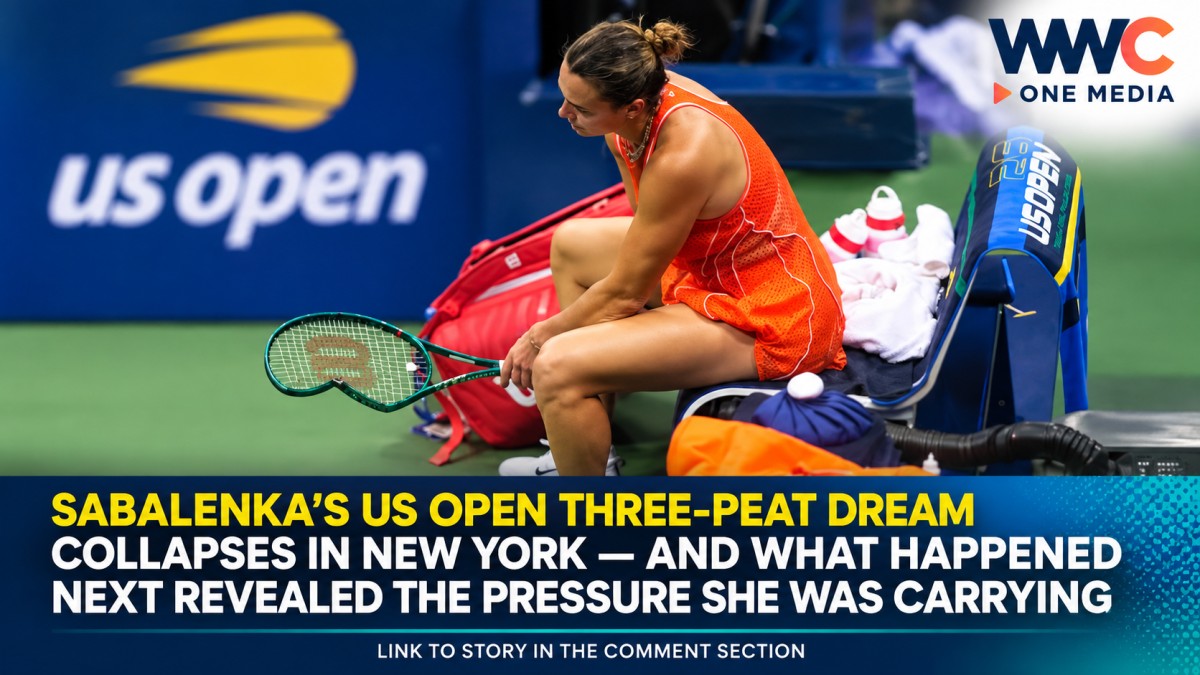
The Belarusian admitted that controlling her emotions became particularly difficult as the historic opportunity began slipping away. During the match, her frustration boiled over at times, including when she hit a ball into the crowd and later smashed her racket.
Rather than hide from the disappointment, Sabalenka said the pressure surrounding the three-peat made the final especially difficult emotionally.
She also praised Rybakina’s performance, acknowledging that her opponent simply played the better tennis on the day.
Rybakina ends Sabalenka’s remarkable New York streak
The defeat ended Sabalenka’s 19-match winning streak at the US Open.
Sabalenka had not lost at Flushing Meadows since the 2023 final against Coco Gauff. She subsequently won the 2024 and 2025 championships and arrived in this year’s tournament as the two-time defending champion.
Her run to the 2026 final was also historically significant. Sabalenka reached her fourth consecutive US Open final, becoming the first woman since Serena Williams from 2011 through 2014 to reach four straight finals at the tournament.
She had defeated Jessica Pegula 7-5, 6-2 in the semifinals, extending her US Open winning streak to 19 matches and setting up the highly anticipated final against Rybakina.
Rybakina completes a remarkable rise
Rybakina’s victory capped one of the biggest breakthroughs of her career at Flushing Meadows.
The 27-year-old, who represents Kazakhstan, had previously struggled to make a deep run at the US Open. Her best previous result in New York was reaching the fourth round.
That changed dramatically in 2026.
After winning the Australian Open earlier this year — also against Sabalenka — Rybakina added another hard-court Grand Slam title by defeating the same rival in New York. She now has three major championships, having also won Wimbledon in 2022.
She is now just one Grand Slam title away from completing a career Grand Slam.
Rybakina also becomes the first woman to defeat Sabalenka in two Grand Slam finals in the same season.
A changing of the guard
The US Open final effectively marked a dramatic transfer of power in women’s tennis.
Sabalenka leaves New York without a Grand Slam title in 2026 despite reaching another major final and maintaining elite results throughout the season. She will also surrender the No. 1 ranking after a 99-week reign.
Rybakina, meanwhile, leaves New York with the trophy, the No. 1 ranking and two Grand Slam championships in 2026.
She also collected $5.5 million, the largest women’s singles prize in US Open history, while Sabalenka received $2.8 million as runner-up.
For Sabalenka, the night ended with disappointment.
For Rybakina, it may have been the night a new era began.
And the question now hanging over women’s tennis is no longer whether Sabalenka can dominate New York for a third straight year — but whether Rybakina has just become the player capable of taking her place at the top.



Leave a Reply