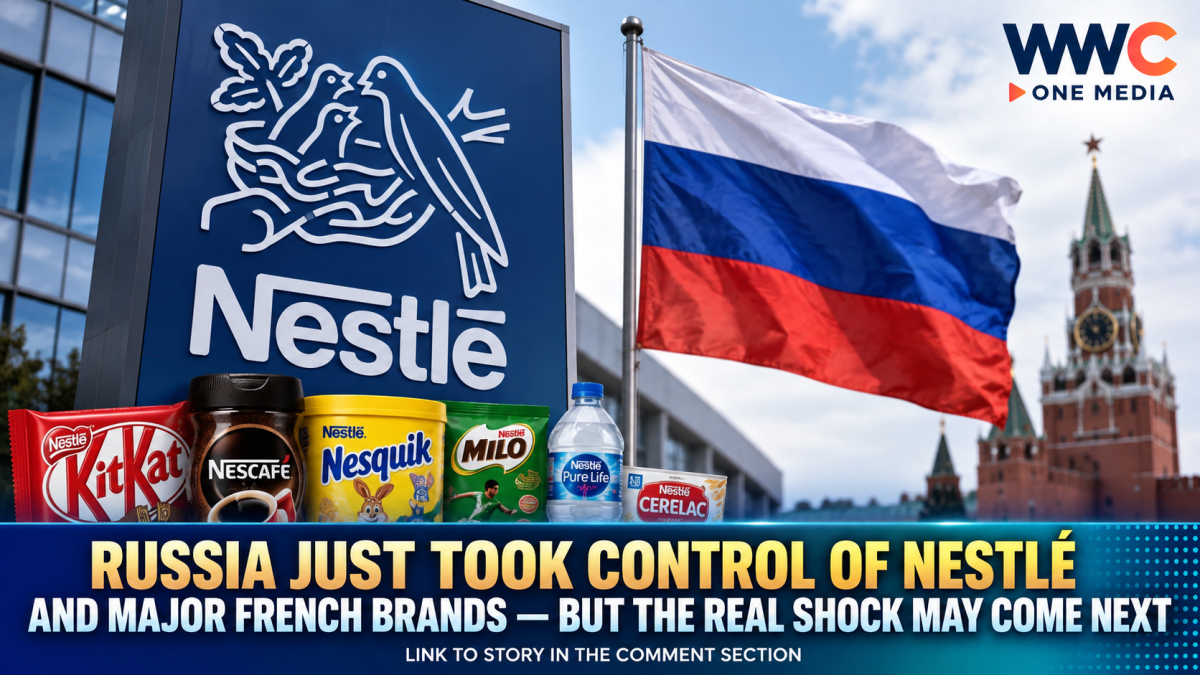
Russia has moved to tighten its grip on the remaining Russian operations of several major Western companies, placing assets linked to Swiss food giant Nestlé and French groups including Auchan, Lemana Pro and FM Logistic under temporary administration.
A presidential decree signed by Russian President Vladimir Putin on Thursday, September 17, transferred management of stakes and shares in a number of Russian companies to L.E.V. Management, a relatively little-known Russian company. The move was reported by CNA, Reuters and other international media on Friday.
The companies affected include Nestlé’s Russian businesses, Auchan’s Russian subsidiary, Le Monlid, which operates the former Leroy Merlin home-improvement chain under the Lemana Pro brand, and several Russian entities connected to French logistics company FM Logistic.
The development marks another escalation in Moscow’s campaign to exert control over foreign-owned businesses that remained in Russia following the full-scale invasion of Ukraine in 2022.
What Russia Actually Did
Despite headlines describing the move as a seizure or nationalisation, the legal mechanism is more specific.
Russia has placed the companies’ Russian assets under temporary external administration. This means control of the businesses is transferred to a designated administrator, while formal ownership is not necessarily extinguished by the decree itself.
That distinction matters because temporary administration has previously been followed by the sale or transfer of foreign-owned businesses to Russian buyers.
Russia introduced the mechanism in 2023 as Western companies attempted to leave the Russian market after the invasion of Ukraine. Moscow has subsequently used it against a number of major foreign companies, including French food group Danone and Danish brewer Carlsberg.
Nestlé Says It Is Assessing Its Options
Nestlé, the Swiss maker of Nescafé, KitKat and numerous other food brands, confirmed that its Russian operations had been placed under temporary external administration.
The company said it was assessing the situation and its available options.
Nestlé also said it was committed to taking steps to protect its rights and maintain business operations in the interests of stakeholders, particularly employees.
Nestlé has maintained a reduced presence in Russia since the invasion. According to Reuters, the company has six factories and around 7,000 employees in the country. It has suspended most non-essential sales, imports and exports, advertising and capital investment while continuing to supply products it considers essential.
Russia’s importance to Nestlé’s global business has also fallen significantly.
Reuters reported that Russia represented roughly 2% of Nestlé’s sales before the war, while analysts now estimate the country contributes about 1% of group sales.
That means the immediate financial impact on Nestlé’s worldwide business may be limited compared with the broader legal and strategic implications.
Auchan and Lemana Pro Also Caught in the Move
French retailer Auchan was another major target of the decree.
Reuters reported that Auchan had more than 24,000 employees and 229 stores in Russia at the end of 2025, with the company generating significant revenue from the market. Euronews separately reported that the Russian operation has approximately 230 stores and an online business, employing around 30,000 people. Differences in reported employee figures reflect different reporting periods.
Auchan has remained in Russia despite the exodus of many Western companies following the 2022 invasion.
The former Leroy Merlin business was also included. The French home-improvement group exited direct control of its Russian operation in 2023, after which the business was rebranded Lemana Pro. Euronews reported that the chain now operates 112 stores in Russia.
French logistics company FM Logistic was also named among the affected businesses.
Who Is L.E.V. Management?
The company appointed to manage the affected assets is L.E.V. Management, a Moscow-based firm with a limited public profile.
Reuters reported that the company was registered in Moscow in 2024. Euronews said its shareholders are not publicly disclosed and that publicly available accounts showed little evidence of active business operations in 2025.
Euronews also reported that the company’s general director was appointed shortly before the presidential decree. An independent report cited by Euronews linked the director’s identity to a Russian Interior Ministry major general, although that identification has not been independently confirmed.
That uncertainty is important: claims about the company’s leadership and connections should be treated as reported allegations or findings rather than established fact.
Why Is Russia Doing This?
The Kremlin has increasingly used temporary administration and other measures to control foreign-owned assets since Western sanctions were imposed following Russia’s invasion of Ukraine.
Kremlin spokesman Dmitry Peskov said the countries where the affected businesses are based were considered “unfriendly” by Moscow. Reuters reported that Russian officials have also become increasingly critical of Switzerland because of Bern’s adoption of many European sanctions against Russia.
There may also be commercial considerations.
Reuters reported that Russian newspaper Kommersant had previously said Nestlé’s assets could be targeted because of the company’s reluctance to expand its Russian operations and resume exports of products manufactured there. Reuters stressed that the precise motivation for the latest decree remains unclear.
A Warning From What Happened to Danone and Carlsberg
The latest move follows a pattern that has already affected other Western corporations.
In 2023, Russia placed the Russian businesses of Danone and Carlsberg under state-linked control. Danone subsequently sold its Russian operation in 2024 at a substantial discount, while Carlsberg eventually sold its interest in Baltika Breweries through a management buyout.
Russia has also imposed increasingly restrictive conditions on foreign companies seeking to exit, including requirements for government approval, exit taxes and discounts on certain transactions.
This history explains why the temporary-administration decision is being closely watched by Western corporations that still maintain assets in Russia.
What Happens Next?
For Nestlé, the immediate question is whether the company can challenge the decision, negotiate a future arrangement or ultimately lose control of its remaining Russian assets.
Nestlé has not publicly detailed what legal or commercial measures it plans to take. Its official statement says only that it is assessing the situation and its options while taking steps to protect its rights.
For employees and consumers in Russia, the businesses have continued operating for now. Euronews reported that Auchan said its stores and facilities were operating normally, while Lemana Pro said it had not yet received official information about the decree and was continuing normal operations.
The bigger issue, however, extends beyond Nestlé, Auchan or Lemana Pro.
Russia’s latest move reinforces the growing uncertainty surrounding foreign companies that chose to retain operations in the country after 2022. For those businesses, remaining in Russia can mean navigating sanctions, government restrictions and the increasing possibility that Moscow could intervene directly in their assets.
And if previous cases are any indication, the temporary handover announced this week may not necessarily be the final chapter.