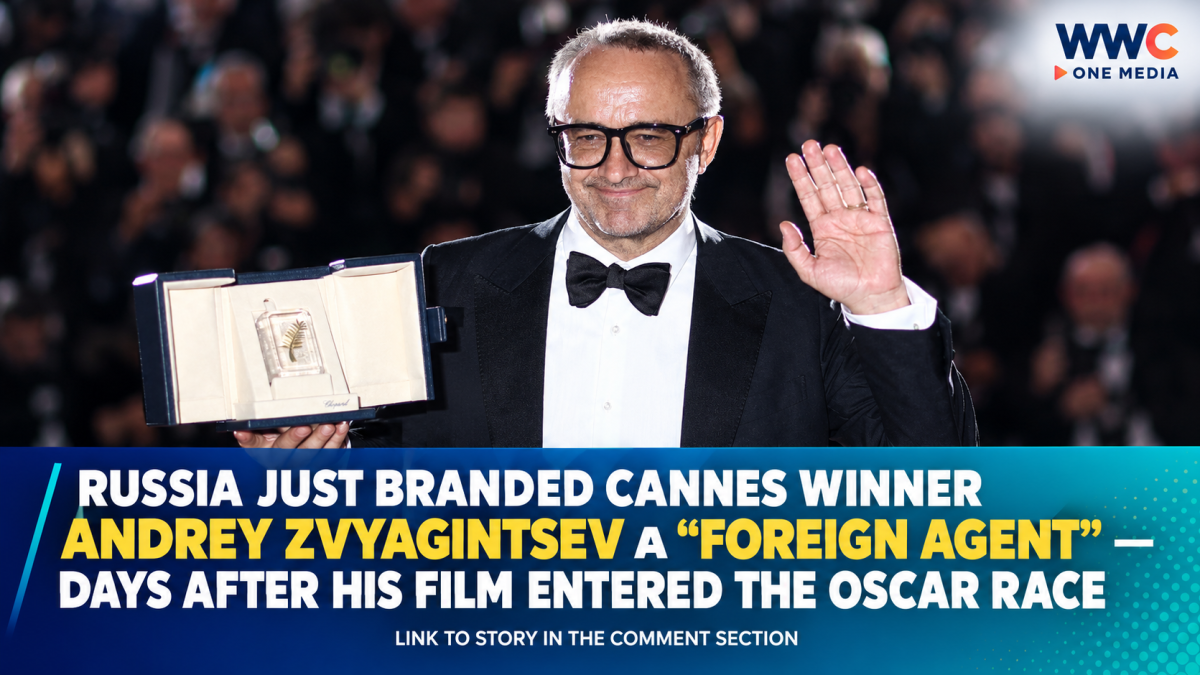
MOSCOW — Acclaimed Russian filmmaker Andrey Zvyagintsev has been designated a “foreign agent” by Russia, just days after his latest film, Minotaur, was selected to represent France in the Best International Feature category at the 2027 Academy Awards.
Russia’s Justice Ministry added the 62-year-old director to its foreign-agent register on September 18, accusing him of spreading what it described as “false information” about Russian government decisions and policies, interacting with people already designated as foreign agents and contributing to material produced by foreign agents and organisations deemed undesirable by Moscow.
The designation comes at a particularly prominent moment in Zvyagintsev’s career. His first feature in nearly a decade, Minotaur, won the Grand Prix at the 2026 Cannes Film Festival in May. The film is a Russian-language production made primarily with French backing, with additional involvement from Latvia and Germany.
From Cannes triumph to Moscow’s foreign-agent list
Zvyagintsev used his Cannes acceptance speech to make an appeal for an end to the bloodshed in Ukraine.
Accepting the Grand Prix, he said that millions of people on both sides of the front line wanted the fighting to stop and said Russian President Vladimir Putin was the person capable of ending it. Reuters reported that the remarks reflected Zvyagintsev’s repeated criticism of Moscow’s war in Ukraine.
The filmmaker has lived outside Russia since the COVID-19 pandemic and is now based in France. Russian authorities cited his residence abroad as one of the factors in the designation.
Zvyagintsev has not publicly responded to the latest designation, according to the Kyiv Independent’s report published after the announcement.
What is Minotaur about?
The film places a troubled Russian businessman against the backdrop of wartime mobilisation.
According to the Cannes Film Festival, Minotaur follows Gleb, a successful company director whose carefully controlled life begins to unravel amid growing corporate pressure and an increasingly unstable environment.
Other reporting describes the film as examining the pressure placed on a businessman to provide employees for military mobilisation while attempting to protect his own position.
The film’s subject matter has therefore drawn considerable attention because of its connection to Russia’s war in Ukraine and the broader question of how ordinary people respond to state pressure.
France sends the film into the Oscar race
The foreign-agent designation arrived only two days after France selected Minotaur as its submission for the Best International Feature Film category at the 99th Academy Awards.
The decision was made by an 11-member French selection committee following consideration of five shortlisted films.
The selection is significant because Minotaur is Russian-language but is a French-majority international co-production. The film was produced by French companies CG Cinéma and MK Productions, alongside Latvian and German partners.
The 99th Academy Awards are scheduled for March 14, 2027, in Los Angeles.
Zvyagintsev’s international reputation
Zvyagintsev is one of Russia’s most internationally recognised contemporary filmmakers.
His breakthrough feature, The Return, won the Golden Lion at the Venice Film Festival. He later directed Elena, Leviathan and Loveless, with Leviathan and Loveless receiving Academy Award nominations for Best Foreign Language Film.
Leviathan, in particular, drew international attention for its bleak portrayal of corruption, power and life in contemporary Russia.
With Minotaur, Zvyagintsev has returned to the international festival circuit after a prolonged absence. The film’s Cannes Grand Prix marked one of the year’s most significant moments for Russian cinema abroad.
What does Russia’s “foreign agent” designation mean?
Despite the term’s espionage-related connotations, being designated a “foreign agent” under Russian law is a legal classification rather than a declaration that someone is a spy.
However, the designation carries significant restrictions and administrative requirements.
People on the register can face requirements to place prominent disclaimers on material they publish, including social-media posts, while also facing restrictions affecting income and professional activity. Reuters reported that the rules impose substantial bureaucratic obligations and restrictions on those designated.
Human Rights Watch has documented a broader expansion of Russia’s foreign-agent and “undesirable organisation” laws in recent years, including additional restrictions on people designated as foreign agents and increased penalties for violations.
The system has been used against journalists, activists, media organisations, artists and other public figures. Reuters noted that writer Boris Akunin and musician Boris Grebenshchikov are among other cultural figures who have received the designation.
A striking moment for Russian cinema
The timing puts Zvyagintsev at the centre of an unusual international moment.
His film has just won one of Cannes’ major prizes and has been chosen by France for the 2027 Oscar race, while Russia has simultaneously placed its director on its foreign-agent register.
For now, Minotaur continues its international awards campaign. The film is scheduled for release in French cinemas on October 14, with Mubi handling its US release and MK2 Films overseeing international sales.
The episode also highlights the increasingly complicated position of Russian artists working outside the country while producing films that engage directly or indirectly with the consequences of the war in Ukraine.
Zvyagintsev’s latest film has moved from the Cannes stage to the Oscar race — and, almost simultaneously, its director has found himself formally labelled by the Russian state.
The next chapter may unfold not only on the international film circuit, but also in the increasingly restrictive legal environment facing Russian cultural figures abroad.