
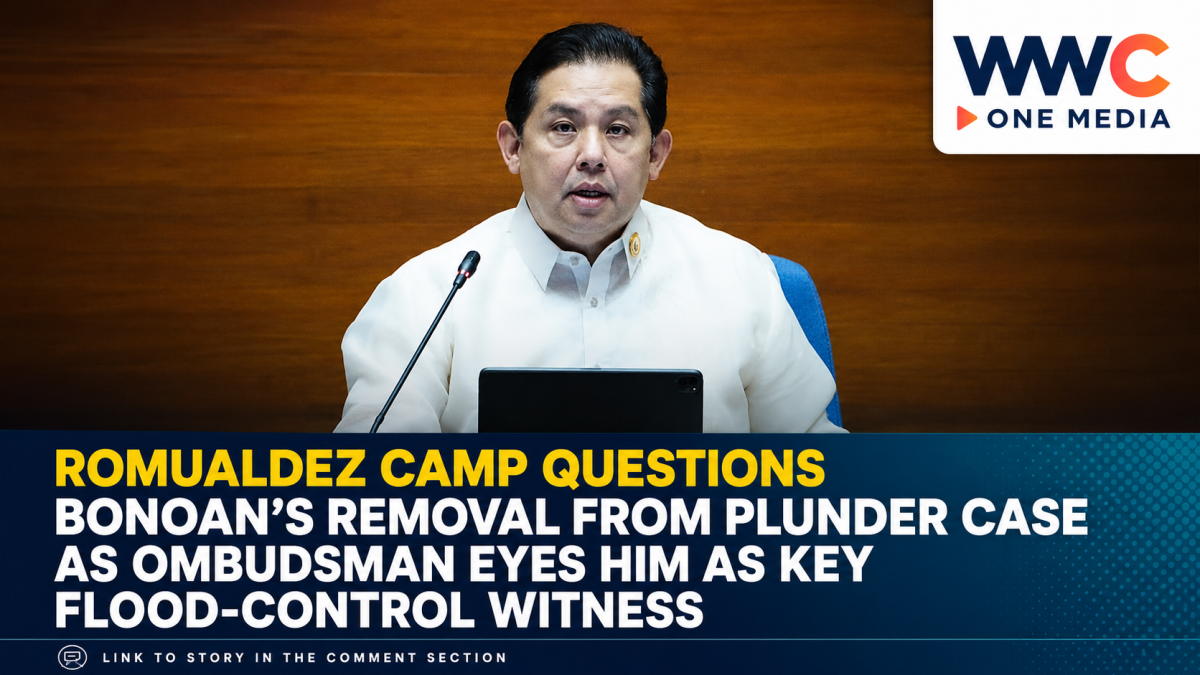
MANILA, Philippines — The legal battle surrounding the Philippines’ massive flood-control controversy took another turn after former Public Works Secretary Manuel Bonoan was removed as an accused in a plunder and graft case, clearing the way for him to cooperate with prosecutors — a development that has raised fresh concerns from the camp of former House Speaker Ferdinand Martin Romualdez.
Romualdez’s lawyer and spokesperson, Atty. Ade Fajardo, said the former Speaker’s camp was surprised by the Sandiganbayan decision, questioning why Bonoan could now emerge as a government witness when, according to the defense, Bonoan had not previously made a public accusation directly implicating Romualdez in a specific irregular flood-control project.
That argument, however, represents Romualdez’s defense position and not a finding by the court or the Office of the Ombudsman.
The Sandiganbayan Fifth Division voted 2-1 to grant the Ombudsman’s request to remove Bonoan from the plunder and graft cases involving Senator Jinggoy Estrada and other accused. The court held that deciding whom prosecutors may use as a cooperating or state witness falls within the Ombudsman’s prosecutorial discretion.
The cases involve allegations that Bonoan, Estrada and others conspired in a scheme involving hundreds of millions of pesos in alleged kickbacks from flood-control projects. The Fifth Division proceedings have been reported as involving approximately ₱573 million. The accusations remain subject to judicial proceedings, and the accused are entitled to the presumption of innocence.
Why prosecutors want Bonoan
The most consequential part of the ruling may not be Bonoan’s removal itself, but what investigators believe he could provide.
The Ombudsman had already announced in June that Bonoan was willing to cooperate. Assistant Ombudsman Mico Clavano said Bonoan had been part of what prosecutors described as an “intricate scheme” and could potentially provide information about officials higher in the alleged chain of command.
Ombudsman officials have specifically said Bonoan’s cooperation could help investigators strengthen their case involving Romualdez.
In a June resolution cited in subsequent reports, the Ombudsman argued that Bonoan’s testimony was necessary to help investigators understand the structure behind the alleged kickback operation.
That distinction matters: allowing Bonoan to cooperate does not itself establish that Romualdez committed a crime. Any information Bonoan provides would still have to be assessed, corroborated and subjected to the applicable legal process.
Romualdez has repeatedly denied wrongdoing.
Bonoan released from hospital detention
The Sandiganbayan subsequently ordered Bonoan released from his hospital detention at the Philippine National Police General Hospital in Camp Crame.
His convoy left the facility at around 10:35 a.m. on September 4, according to the PNP.
But his legal problems have not completely disappeared.
GMA News reported that Bonoan continues to face a separate graft charge before the Sandiganbayan Second Division. That charge is bailable, and he had already posted ₱90,000 bail.
This means descriptions suggesting that all cases against Bonoan have been dismissed would be inaccurate.
Romualdez camp: Where is the direct evidence?
Fajardo argues that no DPWH engineer or official has identified a specific flood-control project in which Romualdez personally interfered or used his influence to favor a contractor.
The camp is also relying heavily on the changing testimony of the so-called “maleta boys” — former security personnel who had previously alleged that suitcases containing cash were delivered in connection with the flood-control controversy.
One of the most prominent witnesses, former Marine Orly Guteza, withdrew his earlier allegation that he personally delivered cash to Romualdez. In his new affidavit, Guteza claimed he had been pressured into making the original allegations, claims that were subsequently disputed by some of the people he accused.
Romualdez submitted Guteza’s recantation along with affidavits from 25 other individuals as part of a supplemental counter-affidavit asking the Ombudsman to dismiss complaints against him.
Ombudsman says the investigation does not depend on Guteza alone
The Ombudsman, however, has rejected the argument that the recantations have destroyed its case.
After Guteza changed his testimony, the anti-graft office said it still had 28 additional witnesses with what it described as direct and material information connected with transactions under investigation.
By August 28, Assistant Ombudsman Clavano said investigators had a total of 42 witnesses, consisting of the 28 additional witnesses and 14 members of the original group of 18 “maleta boys” who had not recanted, according to the Inquirer.
That creates two sharply opposing narratives.
Romualdez’s lawyers maintain that critical witnesses have withdrawn or contradicted allegations against him and insist there is insufficient credible evidence to proceed.
The Ombudsman maintains that its investigation extends well beyond the witnesses who recanted and that other testimony and evidence remain under evaluation.
Palace stays out of Sandiganbayan decision
Malacañang has also distanced President Ferdinand Marcos Jr. from Bonoan’s removal from the case.
Palace officials said the Sandiganbayan belongs to the judiciary and that its decision is outside the President’s authority under the constitutional separation of powers.
For now, Bonoan’s release should therefore not be interpreted as either an exoneration of everyone involved in the wider controversy or proof of the allegations being investigated against Romualdez.
What it does mean is that prosecutors have traded one defendant in a major case for what they believe could be a valuable cooperating witness.
And that makes the next question considerably more important than Bonoan’s release:
What exactly does the former DPWH secretary know — and can prosecutors independently prove whatever he tells them?
That answer could determine whether Bonoan’s removal from the plunder case becomes merely a procedural footnote, or one of the most significant turning points yet in the Philippines’ widening flood-control investigation.
WWC ONE MEDIA J.M.D



Leave a Reply