
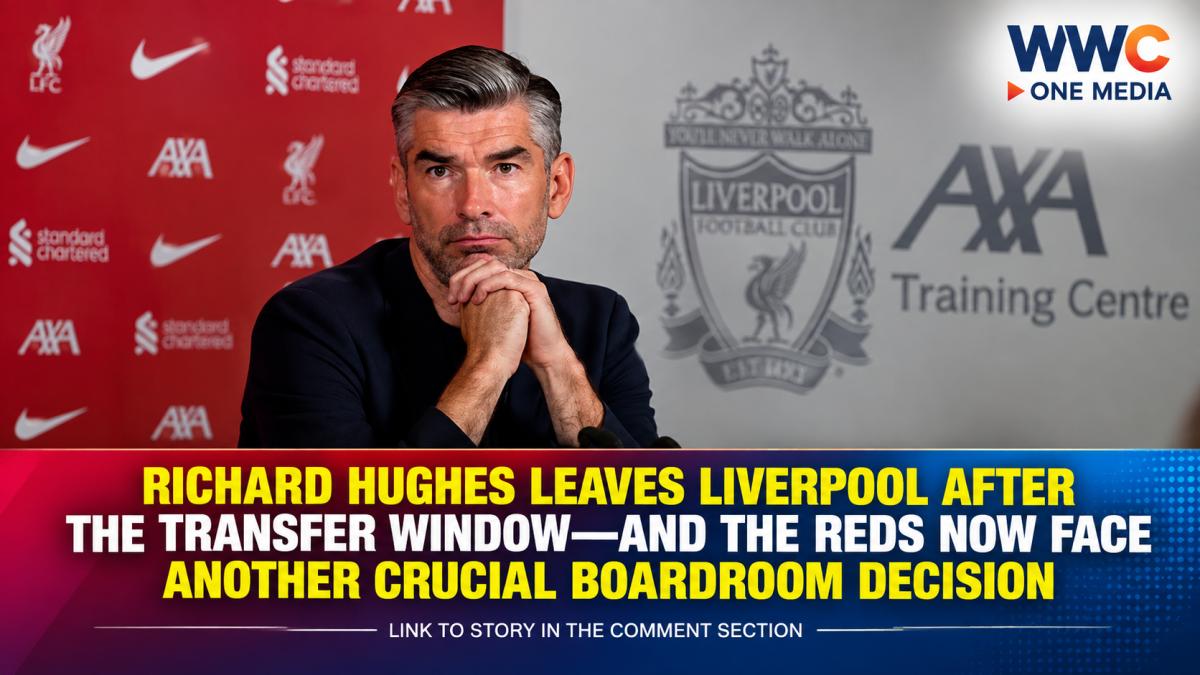
LIVERPOOL — Liverpool have confirmed that sporting director Richard Hughes has stepped down from his position, bringing an end to a two-year spell that began during one of the biggest transitions in the club’s recent history.
The announcement came immediately after the summer transfer window closed, with Liverpool saying Hughes had informed the club’s ownership of his desire to seek a fresh challenge.
Hughes joined Liverpool from Bournemouth in June 2024 and played a central role in recruitment during the transition from the Jürgen Klopp era. He also helped oversee the appointment of Arne Slot, who delivered Liverpool’s 20th English top-flight title in his first season.
His departure now leaves Fenway Sports Group searching for another sporting director while new head coach Andoni Iraola begins his first season in charge.
Liverpool waited until the transfer window closed
The timing of Hughes’ exit is significant.
According to The Guardian, Hughes had informed Liverpool earlier in 2026 that he intended to leave. However, he remained in the position through the summer window so that the club could complete its transfer plans without another major disruption.
Liverpool’s summer business included the high-profile signing of Bradley Barcola, while Hughes’ overall tenure included major investments in players such as Florian Wirtz and Alexander Isak.
Liverpool’s official statement did not identify Hughes’ next destination. However, multiple reports say he is expected to take up a sporting-director role with Saudi Pro League club Al-Hilal.
That distinction matters: Liverpool has confirmed Hughes’ departure, while his reported move to Al-Hilal is being reported separately.
Hughes leaves after overseeing a huge recruitment operation
Hughes arrived at Anfield with a difficult assignment.
Liverpool were preparing for life after Klopp, who had transformed the club during a near-nine-year reign.
The club needed to maintain its competitive level while simultaneously rebuilding its squad and changing its coaching structure.
Hughes’ first major success came quickly.
Working with Liverpool’s leadership, he helped bring in Slot as Klopp’s successor.
The decision proved highly successful initially.
Slot guided Liverpool to the 2024-25 Premier League title, giving the club its 20th English top-flight championship.
Liverpool subsequently qualified for the Champions League for the following season, according to the club.
But the second season of the post-Klopp transition proved much more difficult.
Liverpool finished fifth in the Premier League in 2025-26, leading to Slot’s departure and the appointment of Iraola.
That dramatically changed the context surrounding Hughes’ recruitment strategy.
The transfer spending became part of the debate
Hughes’ time at Liverpool coincided with an enormous reshaping of the squad.
The Times and The Independent estimate that Liverpool spent roughly £670 million during his tenure.
Among the biggest deals were:
- Florian Wirtz
- Alexander Isak
- Bradley Barcola
The size of that investment means Hughes’ legacy will ultimately be judged not simply by the transfer fees, but by whether those players deliver sustained success on the pitch.
The Times noted that Hughes’ recruitment record contains both major successes and unresolved questions, particularly concerning squad balance and depth.
That debate intensified after Liverpool’s disappointing 2025-26 campaign.
Liverpool fans had mixed feelings about the summer window
Liverpool’s summer transfer business generated considerable discussion among supporters.
The club made major investments, but critics questioned whether the squad had been strengthened sufficiently in certain positions.
The Guardian’s assessment of the Premier League transfer window highlighted Liverpool’s acquisition of Barcola while also pointing to concerns about whether the squad had received enough reinforcement overall.
Reuters, meanwhile, reported before Hughes’ departure that Liverpool were ready to move on from the transfer window with Iraola expressing confidence in his squad.
Barcola was viewed as a significant attacking addition, although the French forward was expected to need time to fully integrate after limited preseason preparation.
That makes Hughes’ timing particularly interesting.
He leaves after the window has closed, meaning the squad he helped construct will now largely be judged under a new sporting leadership structure.
Hughes’ exit follows Michael Edwards out the door
The departure is even more significant because it comes only months after Michael Edwards left his position as chief executive of football at Fenway Sports Group.
Edwards returned to Liverpool in 2024 to oversee the club’s transition after Klopp’s departure and had been closely involved in shaping the new football structure.
He announced his departure in July 2026.
Hughes’ own appointment had been closely connected to Edwards.
With both men now gone, Liverpool’s football leadership is undergoing another substantial reshaping.
FSG president Mike Gordon has returned to a more hands-on role in the club’s football operations following Edwards’ exit.
The Guardian reports that Gordon is now leading the search for Hughes’ replacement.
Liverpool are already looking for Hughes’ replacement
The club has confirmed that the process of appointing a successor is underway.
Reports indicate Liverpool could consider candidates from within the existing football structure, although an external appointment has not been ruled out.
Among the names being discussed internally are:
- Assistant sporting director David Woodfine
- FSG technical director Julian Ward
- Director of football development Pedro Marques
However, those are reported possibilities rather than confirmed appointments.
The club’s wider football structure is expected to remain intact while the search continues.
Why Al-Hilal is the obvious next destination
Hughes has been strongly linked with Saudi Pro League side Al-Hilal.
The connection is notable because Al-Hilal already has personnel familiar to Hughes from his Bournemouth days.
Reports say Hughes is expected to reunite with Simon Francis, his former Bournemouth colleague, who has moved into Al-Hilal’s football structure.
The Saudi club has also become an increasingly powerful force in the transfer market, making the move potentially significant for Hughes’ career.
However, Liverpool’s departure announcement itself only says Hughes is seeking a fresh challenge. His reported Al-Hilal appointment should therefore be treated as expected/reported rather than as part of Liverpool’s official confirmation.
Liverpool’s next sporting director inherits a complicated job
Whoever replaces Hughes will walk into a position carrying enormous responsibility.
The new sporting director will inherit:
A recently rebuilt squad.
A new head coach in Iraola.
Several expensive recent signings whose long-term value remains to be established.
Contract situations involving key senior players.
A club still adjusting to major changes in its football leadership.
And, perhaps most importantly, the pressure to ensure Liverpool’s huge transfer investments translate into sustained success.
The Guardian describes Hughes’ departure as the club’s fourth change in the sporting-director position in four years, following Julian Ward and Jörg Schmadtke after Edwards’ earlier period in the role.
That level of turnover makes the next appointment especially important.
The Hughes legacy is not easy to define
It would be simplistic to label Hughes’ Liverpool tenure either a success or a failure.
He arrived during a difficult transition and helped oversee a Premier League title in his first season.
He was also involved in significant recruitment and helped establish the football structure that followed Klopp.
But Liverpool subsequently endured a difficult 2025-26 campaign, finished fifth and changed managers.
The club then entered another expensive rebuilding phase before Hughes’ departure.
The full judgment on his work may therefore take years.
Players signed during his tenure could still become central figures in Liverpool’s next era—or some could ultimately be viewed as expensive mistakes.
That is why the biggest question surrounding Hughes’ departure isn’t necessarily why he left.
It’s what Liverpool’s next sporting director does with the squad Hughes leaves behind.
The bottom line
Richard Hughes is officially out at Liverpool.
His exit comes immediately after the summer transfer window, following a two-year spell that included a Premier League title, Champions League qualification, major transfer spending and a difficult second season that ultimately brought another managerial change.
Liverpool now have to find the person capable of taking the club’s recruitment strategy into its next phase.
And with FSG already reshaping the leadership structure, the next sporting-director appointment could have consequences far beyond the January transfer window.
WWC ONE MEDIA M.J.E




Leave a Reply