
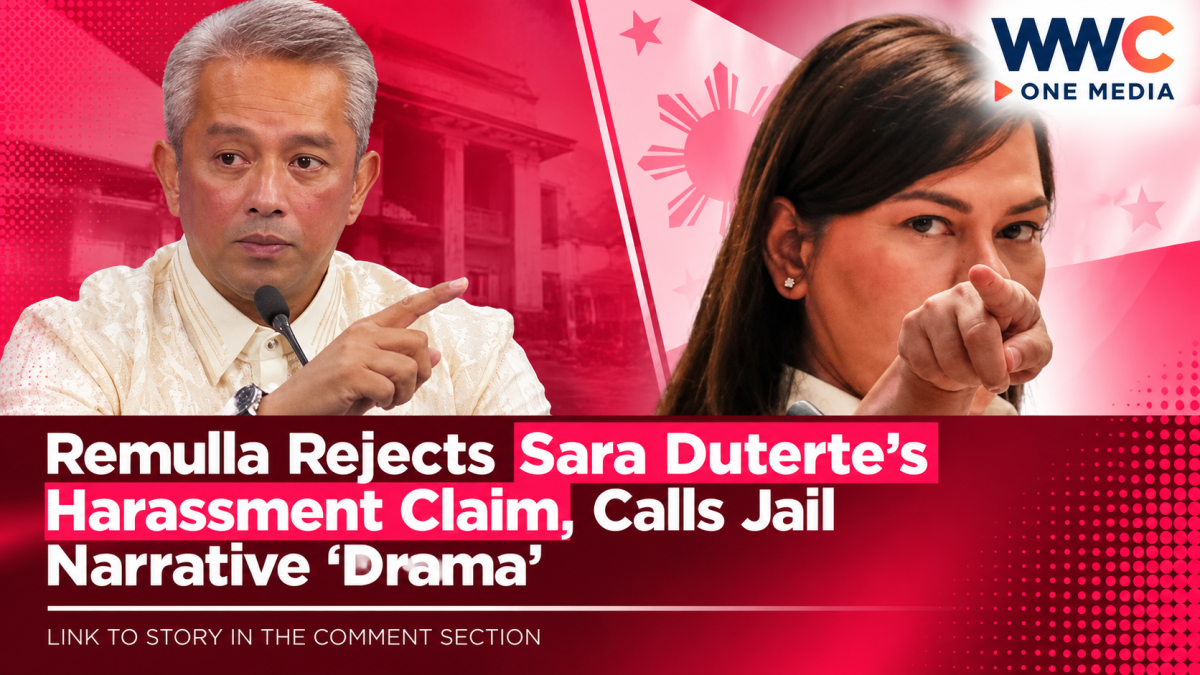
MANILA, Philippines — Interior and Local Government Secretary Jonvic Remulla has strongly rejected Vice President Sara Duterte’s allegations of harassment surrounding the service of an arrest warrant against her, describing her camp’s account of possible detention as “drama.”
The dispute has added another volatile chapter to the widening political conflict between the Duterte and Marcos camps, following Duterte’s arrest warrant over three counts of grave threats and her subsequent decision to post P360,000 bail.
Remulla Says Police Did Not Harass Duterte
At a briefing on September 7, Remulla disputed Duterte’s claim that she and her family had been harassed by authorities.
He presented video footage showing members of the Philippine National Police’s Criminal Investigation and Detection Group, or CIDG, serving the arrest warrant at the Office of the Vice President in Mandaluyong City and at Duterte’s residence in San Juan.
According to Remulla, the officers involved in serving the warrant were mostly women, unarmed and were allowed into the premises. He said there was no SWAT deployment or armed police component during the operation.
Remulla challenged Duterte’s camp to release any CCTV footage that would support allegations of harassment, arguing that police video documentation showed authorities followed proper procedures.
Duterte Says She Was Being Watched and Harassed
Duterte, however, has maintained that she has serious concerns about her safety and has accused government agencies of conducting harassment and surveillance operations against her.
Her latest accusations followed comments by Remulla indicating that authorities knew where she was when the arrest warrant was issued but did not immediately force its service.
Duterte said those remarks appeared to reinforce documents she claimed showed long-running surveillance and harassment against her.
The disagreement has now produced two sharply different narratives.
Duterte says she was being politically targeted.
Remulla says authorities were simply carrying out a lawful court order.
The Fight Over Whether Duterte Wanted to Go to Jail
The most explosive claim from Remulla concerned what happened before Duterte eventually posted bail.
CIDG Director Maj. Gen. Robert Alexander Morico II said police coordinated with Duterte’s Vice Presidential Security and Protection Group shortly after receiving the warrant.
According to Morico, Duterte’s camp initially asked authorities where she would be detained if she decided not to post bail.
Morico said he was informed that Duterte initially did not want to post bail and instead wanted to be incarcerated.
Because the offense was bailable, police said Duterte could undergo booking procedures before being escorted to the Quezon City Regional Trial Court. Authorities said they did not intend to place the Vice President in a regular jail and considered accommodating her in a CIDG conference room instead.
Remulla then accused Duterte’s camp of seeking dramatic images of her behind bars or in handcuffs — an allegation that has not been independently established and for which Duterte’s camp had not yet provided a response in the reports cited.
Duterte Eventually Posted P360,000 Bail
Duterte ultimately chose to post bail.
She paid a total of P360,000, or P120,000 for each of the three counts of grave threats filed against her.
The Quezon City Regional Trial Court issued the arrest warrant after finding probable cause for the criminal case to proceed.
The case stems from remarks Duterte made during an online press conference in November 2024.
Prosecutors alleged that Duterte made statements involving a supposed assassin and threats against:
- President Ferdinand Marcos Jr.
- First Lady Liza Araneta-Marcos
- Former House Speaker Martin Romualdez
Duterte has denied making criminal threats and has condemned the case as politically motivated harassment.
A Political Feud Is Now Playing Out in Court
The criminal case cannot be separated from the broader political collapse between the Marcos and Duterte families.
The two camps were allies during the 2022 national elections, when Marcos ran for president and Duterte for vice president.
But their alliance later collapsed into one of the Philippines’ most serious modern political conflicts.
Duterte is also facing an impeachment case and separate allegations involving the use of public funds, which she has denied. Reuters and AP reported that the latest criminal case has further intensified the political divide between the country’s two most powerful political dynasties.
The grave-threats case is particularly significant because the allegations are also connected to broader accusations raised against Duterte in her impeachment proceedings.
Remulla Insists the Police Followed Protocol
For Remulla and the DILG, the central argument is straightforward:
The warrant was issued by a court, the police served it, and Duterte had the right to post bail because the charges were bailable.
Police officials said they coordinated with Duterte’s security personnel because of her position as the country’s Vice President and used female, unarmed CIDG personnel during the warrant service.
Authorities have maintained that Duterte was not threatened and that their actions were documented.
But Duterte’s camp sees the situation differently, arguing that government monitoring and the handling of the warrant form part of a wider campaign against her.
Why This Case Matters Beyond the Arrest Warrant
The legal dispute could have major political consequences.
Duterte remains one of the country’s most influential political figures and is widely viewed as a potential contender in the 2028 presidential race.
Reuters and AP have noted that a conviction in cases against her could affect her political future and eligibility for public office, while her impeachment proceedings could also threaten her position as Vice President.
That is why the battle over the arrest warrant has become about far more than the warrant itself.
Every police action is now being politically interpreted.
Every statement is being challenged.
And every image has the potential to influence public opinion.
Two Narratives, One Legal Battle
The latest confrontation leaves the public with two competing accounts.
Sara Duterte’s position: She says she has been subjected to political harassment and surveillance and fears for her safety.
Jonvic Remulla’s position: He says the harassment allegations are false, police followed protocol and Duterte’s camp was attempting to create a dramatic detention narrative.
The courts will ultimately determine the criminal case.
But the political battle is already underway.
For Duterte, the arrest warrant has become evidence of what she describes as political persecution.
For Remulla and the government, Duterte’s response has become evidence of political theatrics surrounding a routine legal process.
With Duterte’s criminal case, impeachment proceedings and the continuing Marcos-Duterte feud all moving forward at the same time, this latest clash is unlikely to be the last.
The warrant may have been resolved with bail — but the political war behind it is only getting louder.
WWC ONE MEDIA J.M.D



Leave a Reply