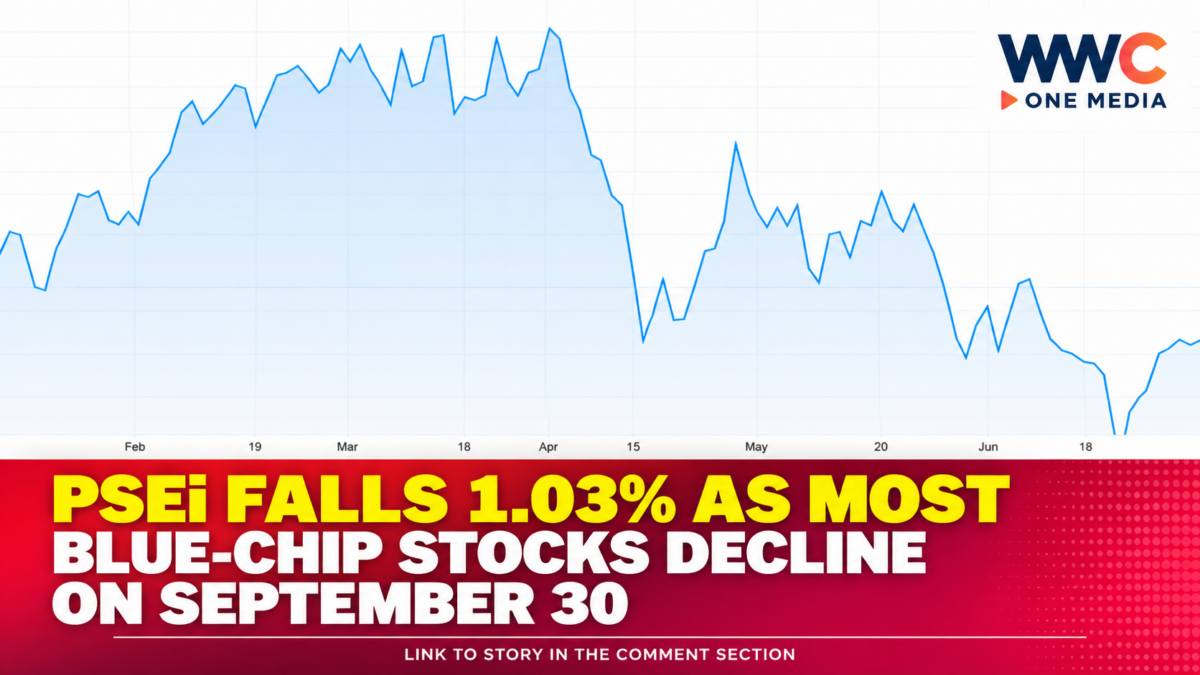
Philippine stocks ended lower on Wednesday, September 30, with the benchmark Philippine Stock Exchange index (PSEi) falling 58.92 points, or 1.03%, to close at 5,679.48 as investors monitored global risks and domestic economic concerns.
The decline was reflected across most major sectors. The All Shares index dropped 23.75 points, or 0.74%, while financials fell 1.28%, industrials declined 0.61%, services lost 1.84%, and mining and oil slipped 1.21%. The property index edged down 0.10%.
Holding firms were the only major sectoral index to post a gain, rising 0.21% during the session.
The session capped a weaker stretch for the local market as investors continued to assess developments affecting interest rates, inflation, corporate earnings and the broader economic outlook.
Movements among the 30 companies comprising the PSEi varied, with some counters declining alongside the broader market while others managed to hold their ground or advance. The index remains closely watched because its constituents represent some of the country’s largest and most actively traded listed companies.
Market activity also came as investors digested fresh economic developments, including expectations that Philippine inflation may have accelerated in September. Concerns surrounding global trade and geopolitical tensions have also continued to influence market sentiment.
The peso and local equities have faced additional pressure from uncertainty in international markets, particularly as investors assess developments involving major economies and their possible effects on capital flows, commodity prices and interest-rate expectations.
Despite the day’s decline, the market’s performance remained a reflection of individual stock movements as much as broader investor sentiment. Companies within the PSEi were affected differently depending on their respective sectors, earnings outlooks and exposure to domestic and international developments.
The PSEi’s September 30 close also provides a snapshot of how the country’s leading listed companies performed at the end of the month, offering investors a reference point as trading moves into the final quarter of 2026.