
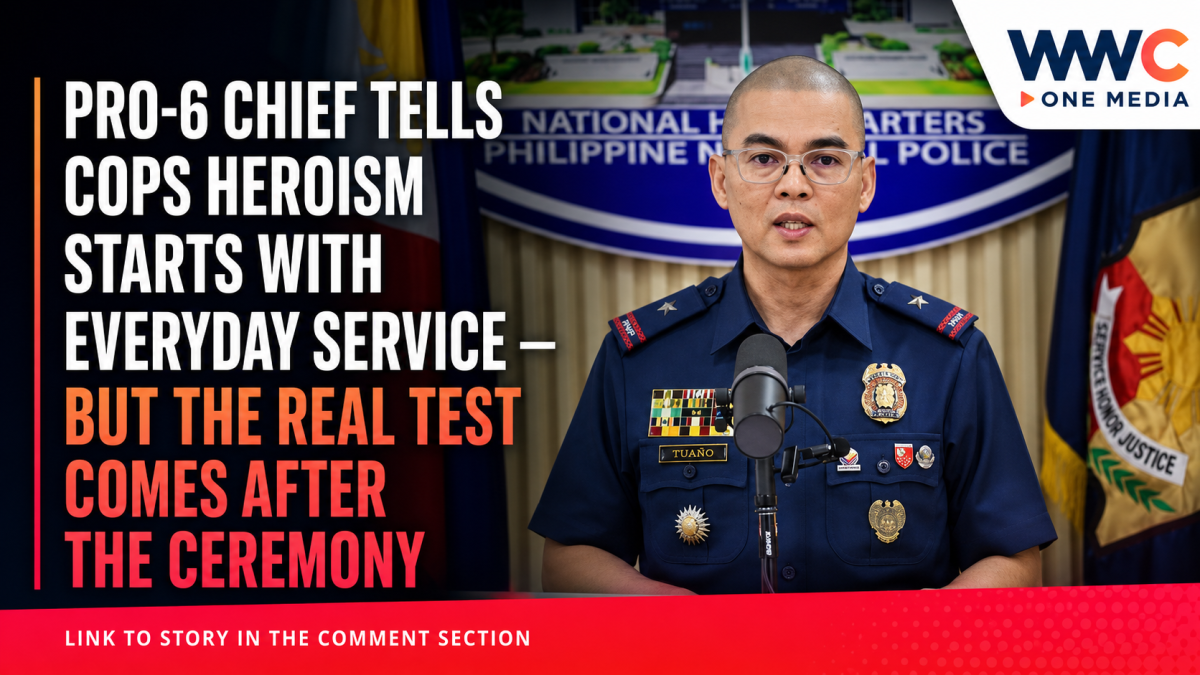
ILOILO CITY, Philippines — Police officers do not need a battlefield, a medal or a dramatic rescue to prove their heroism. For Western Visayas’ top police official, the more difficult test may come during the ordinary decisions officers make when nobody is celebrating them.
Police Regional Office 6 chief Brig. Gen. Randulf Tuaño used the observance of National Heroes Day to challenge police personnel and ordinary Filipinos to turn patriotism into daily action, arguing that service, compassion and integrity are modern forms of heroism.
His message comes at a significant moment for the Philippine National Police in Western Visayas, where authorities are simultaneously pushing stronger police visibility, community-based policing and crime prevention while facing the continuing challenge of building public trust.
Heroism Beyond Medals and Memorials
Tuaño said honoring the Philippines’ heroes should go beyond remembering historic sacrifices once a year.
For police officers in particular, he said the legacy of the country’s heroes should be reflected in how they use their authority, respond to citizens and make decisions that can directly affect people’s safety and lives.
His central message was simple: a police officer who chooses integrity instead of the easier option, shows compassion instead of indifference and places public service ahead of personal interest is already practicing a form of heroism.
Tuaño also widened that definition beyond the police force.
Parents, teachers, health workers, volunteers, government employees and ordinary residents who quietly help their communities deserve recognition as everyday heroes, he said. Their work may never make national headlines, but their contribution to families and communities can still strengthen society.
That broader definition closely echoed the national message delivered during this year’s National Heroes Day.
President Ferdinand Marcos Jr. urged Filipinos on August 31 to do more than simply remember the country’s heroes and instead carry their ideals into present-day life. He cited soldiers, first responders, teachers, health workers, farmers, fisherfolk, overseas Filipinos and citizens helping their neighbors as examples of modern service to the country.
National Heroes Day is observed on the last Monday of August under Republic Act No. 9492. In 2026, the national commemoration was held on August 31, with ceremonies led at the Libingan ng mga Bayani in Taguig City.
For PRO-6, the Message Comes With a Bigger Test
For Western Visayas police, however, calls for integrity carry consequences beyond ceremonial speeches.
Tuaño took over the regional police command in May 2026 following a PNP leadership reshuffle. Before his assignment to Western Visayas, he served as the PNP’s chief spokesperson and head of its Public Information Office.
Soon after assuming the post, he identified stronger police visibility as one of his priorities, saying a greater police presence could help prevent crime and make communities feel safer.
PRO-6 has also been expanding community-based policing.
In June, the regional office continued training officers under the Revitalized Pulis sa Barangay Program, with personnel intended for deployment in geographically isolated and disadvantaged communities. The initiative reflects an approach in which police officers are expected to work more closely with residents instead of relying solely on conventional enforcement operations.
Those programs give Tuaño’s National Heroes Day message a practical dimension: the public will ultimately judge police heroism not through slogans, but through what residents experience at police stations, on the streets and during encounters with officers.
Integrity Is Where the Message Gets Complicated
That standard has already been tested.
In July, GMA Regional TV reported that PRO-6 opened an investigation after an audio recording circulated involving someone claiming to be an Iloilo police officer and allegedly demanding money from the family of a drug suspect.
The caller allegedly sought ₱150,000 in exchange for supposed assistance involving the detainee.
Tuaño said at the time that authorities were examining whether the incident could have been a scam designed to victimize both arrested suspects’ families and damage the image of the Philippine National Police. He stressed that detainees cannot simply be released through such arrangements.
No conclusion about the identity of the caller should be made beyond the results of the investigation.
But the episode illustrates exactly why Tuaño’s latest call for integrity matters.
Public confidence in law enforcement is built not only through arrests, drug seizures and patrols but through transparency when allegations arise, accountability when misconduct is proven and clear communication when police personnel are wrongly accused.
Crime Prevention Remains Part of the Equation
Operationally, PRO-6 has continued reporting significant law-enforcement activity under Tuaño.
During a one-month period from May 22 to June 21, the regional police office reported 133 anti-drug operations that led to the arrest of 168 suspects and the seizure of suspected shabu estimated at ₱75.95 million.
Authorities also reported intensified campaigns against loose firearms and environmental offenses. PIA reported in July that PRO-6 had accounted for 3,683 voluntarily surrendered firearms across Western Visayas since 2019, while PNA later reported hundreds of arrests linked to alleged illegal fishing and logging activities during operations conducted under the regional command.
And on September 1, just a day before the Panay News report on his Heroes Day message was published, Tuaño said Western Visayas data did not support the common perception that crime automatically rises during the beginning of the “ber” months, although he continued urging residents to remain cautious.
The Harder Definition of Heroism
The National Heroes Day message therefore raises a question that extends well beyond Western Visayas:
What does heroism look like inside a modern police organization?
Courage during emergencies is one answer.
But so are refusing corruption, treating victims respectfully, protecting suspects’ rights, investigating colleagues when evidence warrants it, resisting political influence and exercising police power within the law.
President Marcos struck a similar theme during the national commemoration, saying strong institutions require transparency, accountability and standards of public service worthy of Filipinos. He also called protecting national interests and sovereignty a responsibility shared by the entire country.
That makes Tuaño’s challenge to his officers harder than simply honoring heroes of the past.
A ceremony lasts a day.
A reputation for integrity is built — or lost — one police encounter at a time.
And for the men and women wearing the badge in Western Visayas, that may be where the country’s idea of everyday heroism faces its most important test.
WWC ONE MEDIA MJE


Leave a Reply