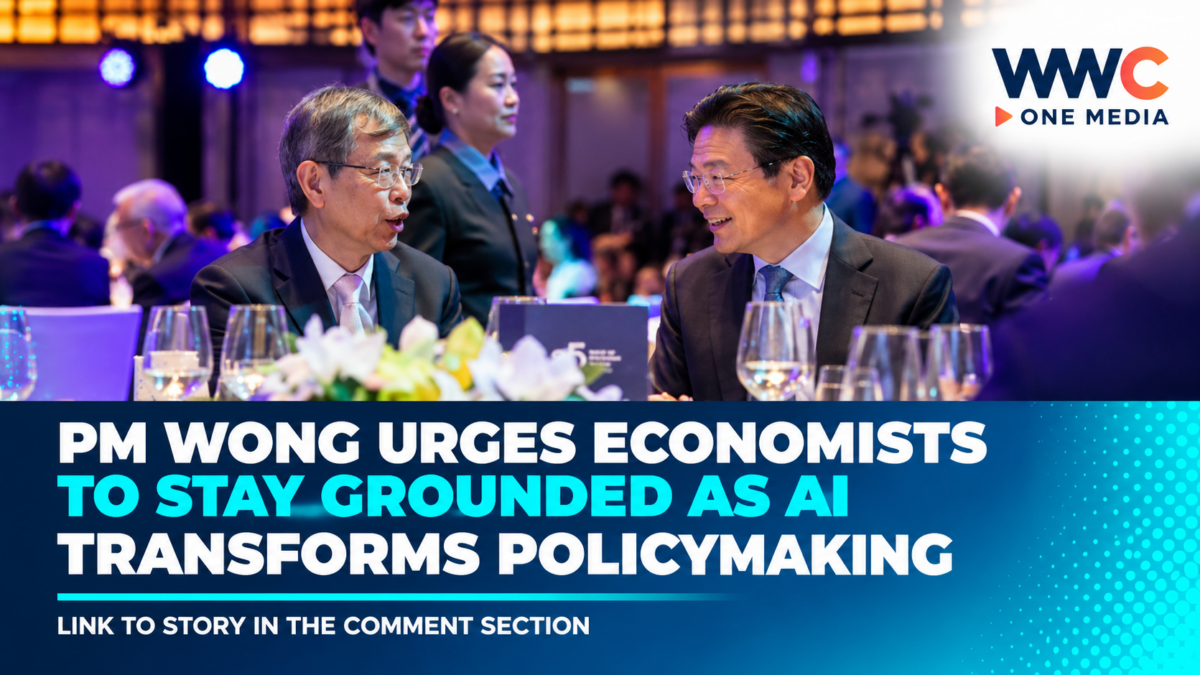
Prime Minister Lawrence Wong has urged Singapore’s economists to make full use of artificial intelligence and advanced analytical tools while remaining grounded in sound economic judgment.
Speaking at the 25th anniversary celebration of Singapore’s Economist Service on Sept. 30, Wong said economists now have access to high-frequency data, sophisticated analytical techniques, machine learning and AI that were unavailable when he began his career.
He encouraged economists to use these tools to build better models and test policies more rigorously. But he warned that increasingly powerful technology should not be mistaken for better judgment.
Policymaking, Wong said, takes place in the real world, where information is often incomplete and outcomes can be uncertain. Economic models may work neatly in theory but produce different results when applied to real-world situations.
He stressed that economists must understand both the strengths and limitations of their models and know when human judgment is required.
Wong also called for economists to maintain discipline when advising the Government, particularly when policymakers face pressure to act quickly or pursue seemingly simple solutions.
They should carefully consider the problem being addressed, the trade-offs involved, the incentives created by a policy and the possible unintended consequences, he said.
The Prime Minister also said government intervention remains important as workers and communities face disruption from AI and wider global uncertainty. However, he emphasized that interventions must be carefully designed and based on a clear diagnosis of the problem.
He cited the risk of policies such as rent controls and price caps producing unintended effects when incentives and market conditions are not properly considered.
Wong said good economic policymaking requires more than technical expertise. It also demands intellectual honesty, sound judgment and the willingness to speak up when analysis leads to an uncomfortable conclusion.
He further emphasized the importance of communicating complex economic issues clearly so that rigorous analysis can be translated into effective public policy.
The remarks come as Singapore prepares for an economy increasingly shaped by AI, automation and rapid technological change. Wong has previously said that while the long-term impact of AI on the number of jobs remains uncertain, the nature of work and the skills required are certain to change.
For Singapore’s economists, the challenge is therefore not simply to develop more sophisticated models, but to combine new technology with disciplined analysis and human judgment as the country navigates a rapidly changing economic environment.