
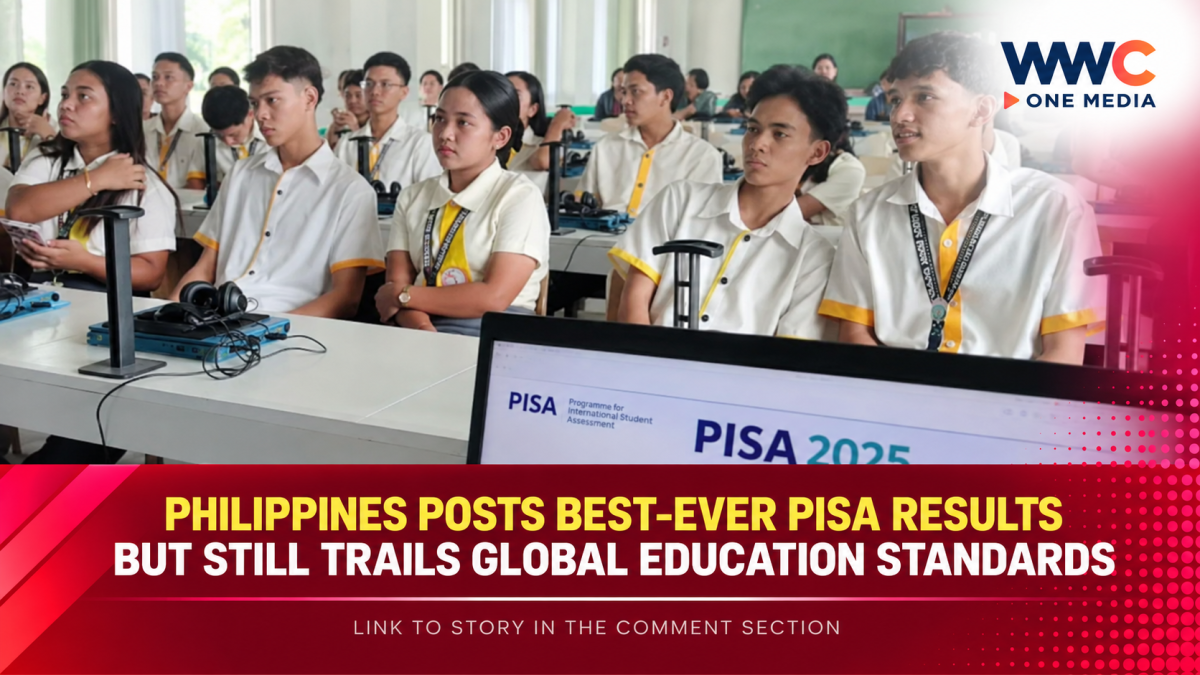
The Philippines has recorded its strongest performance yet in the Programme for International Student Assessment, with Filipino students posting significant gains in mathematics, science and reading in the 2025 assessment.
Despite the improvement, the country remains well below the average performance of OECD countries, highlighting the scale of the education challenges that still need to be addressed.
The Philippines ranked 72nd in reading and 74th in mathematics among 90 participating countries and economies. In science, it ranked 77th among 91 participants.
Scores improve across all three subjects
Filipino students recorded a mean score of 371 in mathematics, 367 in reading and 373 in science.
All three scores were below the OECD averages of 463 in mathematics, 461 in reading and 482 in science.
Still, the gains compared with the previous PISA cycle were substantial.
The country’s average score increased by 16 points in mathematics, 17 points in science and 20 points in reading.
The reading improvement was particularly notable. Education officials said the Philippines recorded the biggest improvement in reading among participating countries and was also among the most improved performers in mathematics.
The country also outperformed 14 participating countries in science, 16 in mathematics and 18 in reading based on mean scores.
A major improvement from previous PISA cycles
The latest results represent a significant change from the Philippines’ performance in earlier assessments.
In PISA 2018, the country ranked at or near the bottom of the participating countries across the major subjects.
Although there were some improvements in 2022, the Philippines remained among the lowest-performing participants.
The 2025 results therefore give education officials a stronger indication that recent interventions may be beginning to produce measurable improvements.
The assessment covered 208 sampled schools and 8,072 Filipino learners, providing a nationwide snapshot of the performance of 15-year-old students.
DepEd points to reading and learning interventions
The Department of Education has linked the improvements to continuing efforts to strengthen foundational learning, reading comprehension, critical thinking and problem-solving.
Among the programmes being implemented is the Academic Recovery and Accessible Learning, or ARAL, programme.
The initiative targets learners in Grades 4 to 10 who are performing below minimum proficiency standards.
Its reading component includes ARAL-Reading Basic, which focuses on foundational literacy, and ARAL-Reading Plus, which aims to improve reading fluency and comprehension.
DepEd is also implementing a Literacy Remediation Program for Grade 3 pupils identified as low-emerging readers through the Comprehensive Rapid Literacy Assessment.
These programmes are designed to provide more targeted support to students who have fallen behind.
Gains are encouraging but major gaps remain
The latest PISA results have given the Philippines reason for optimism, but education officials and policy experts have cautioned against treating the improvement as the end of the country’s learning crisis.
The Philippines remains substantially below the OECD average in all three core areas.
The relatively low rankings also show that many Filipino students continue to struggle with the skills needed to apply knowledge to real-world problems.
The challenge now is to sustain the improvement rather than allow the gains recorded in 2025 to become temporary.
The Second Congressional Commission on Education has said continued reforms are necessary to address persistent weaknesses in foundational learning.
Philippines still faces a long road ahead
PISA measures how well 15-year-old students can apply knowledge and skills in reading, mathematics and science to real-life situations.
For the Philippines, the 2025 results show that progress is possible after years of weak performance.
The 20-point increase in reading, 17-point rise in science and 16-point improvement in mathematics represent meaningful gains, particularly compared with the country’s earlier results.
But the gap with the OECD average remains wide.
The next challenge for the Philippine education system will therefore be turning the latest improvement into sustained progress across schools and regions.
For now, the 2025 PISA results provide a rare piece of good news for Philippine education: the country’s students are moving in the right direction, even though they still have a considerable distance to travel.




Leave a Reply