
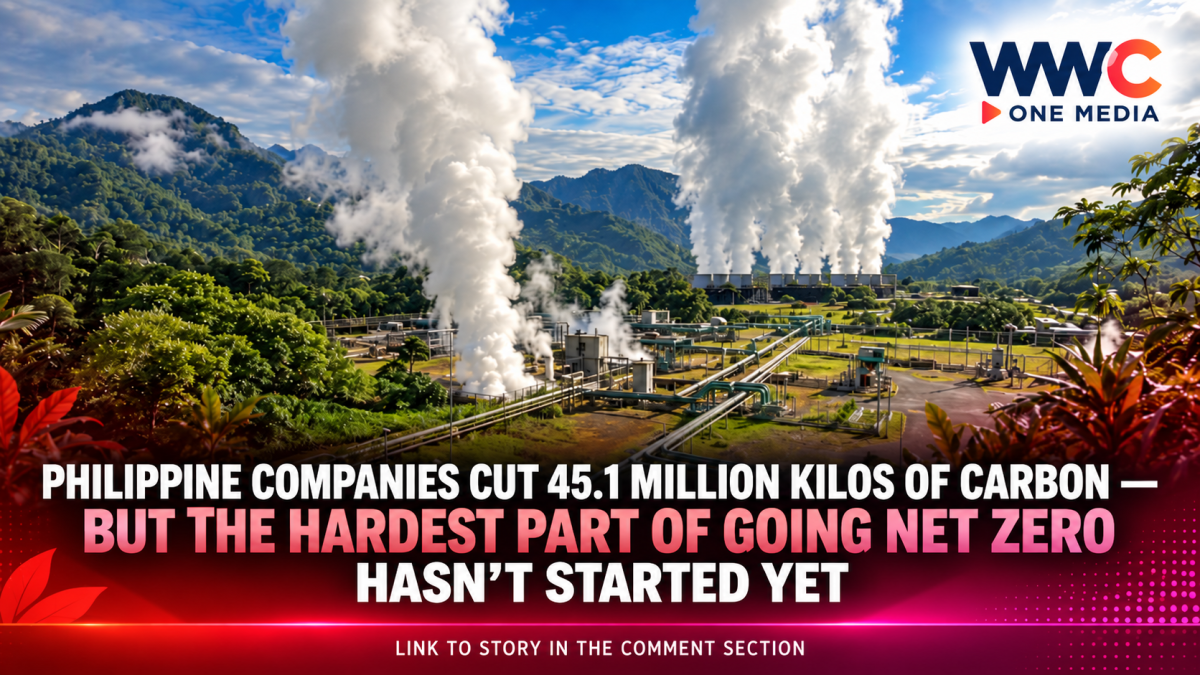
MANILA, Philippines — Philippine companies belonging to the Net Zero Carbon Alliance reported cutting a combined 45.1 million kilograms of greenhouse-gas emissions in 2025, giving one of the clearest numerical snapshots yet of how corporate climate pledges are beginning to translate into measurable reductions.
The figure, disclosed by the Net Zero Carbon Alliance or NZCA, covers 16 reporting partners and is equivalent to approximately 45,100 metric tons of carbon dioxide equivalent, or CO₂e.
It is a notable milestone for an alliance that began in 2021 largely around a promise: help Philippine businesses move toward net-zero greenhouse-gas emissions by 2050.
Five years later, the conversation is becoming more demanding.
Companies are increasingly being asked not merely to announce sustainability targets but to measure their emissions, disclose them consistently, show how reductions were achieved and eventually subject those numbers to stronger validation.
That distinction matters because cutting emissions is not the same as reaching net zero.
And with the Philippines unveiling a new national climate commitment just days before NZCA released its latest figures, pressure on the private sector to produce verifiable results is likely to intensify.
What does 45.1 million kilograms actually mean?
Expressed in the more commonly used corporate-carbon unit, the NZCA figure represents roughly 45,100 tonnes of CO₂-equivalent reductions.
CO₂e is used because businesses can emit several greenhouse gases—not only carbon dioxide. Different gases have different warming impacts, so they are converted into a common carbon-dioxide-equivalent measurement for reporting purposes.
NZCA said the reductions came from 16 partners reporting progress under the alliance.
The number should be understood as an aggregate reported reduction, rather than the total remaining carbon footprint of those companies.
A business could reduce emissions significantly in a particular year and still have substantial emissions left to eliminate or neutralize before reaching net zero.
That is why NZCA’s own approach places measurement at the beginning, not the end, of the process.
NZCA’s model requires companies to measure first
The alliance was established by First Gen-owned Energy Development Corporation in 2021 to encourage Philippine businesses and institutions to pursue carbon neutrality and, ultimately, net-zero emissions.
Its framework calls for participating organizations to make commitments, measure their greenhouse-gas footprints, create reduction roadmaps, implement interventions, track their performance, disclose progress and validate results over time.
That sequence is significant.
Companies cannot credibly claim reductions without first establishing what they emitted and defining the baseline against which improvement is calculated.
NZCA also developed its Zero Carbon Gateway, a platform intended to help participating organizations track progress and calculate emissions, including Scope 1 and Scope 2 emissions.
Scope 1 generally covers greenhouse gases released directly from sources controlled by the organization, while Scope 2 covers indirect emissions associated with purchased electricity, steam, heating or cooling.
For many companies, however, the largest challenge eventually becomes Scope 3.
Those are indirect emissions generated elsewhere in the value chain—from suppliers, raw materials, employee travel, logistics and product use to what happens after a product is sold.
That can make measuring a company’s true climate footprint far more complicated than reading electricity bills or fuel consumption.
The first seven partners show how different the solutions can be
There is no single route to decarbonization because NZCA members operate in vastly different industries.
Its original partners included Arthaland, First Balfour, Drink Sustainability Communications, Silliman University, Knowles Electronics Philippines and Unilever Philippines, alongside founding company EDC.
Their strategies illustrate how varied corporate emissions reduction can be.
Silliman University, for example, has used renewable electricity from solar and geothermal sources as part of its campus sustainability program.
Knowles Philippines has worked on renewable energy, wastewater treatment, reforestation and alternatives to ozone-depleting substances. NZCA says the latter initiative has helped reduce the company’s direct Scope 1 greenhouse-gas emissions.
Unilever’s Philippine operations have pursued renewable power as well. Its Cavite nutrition facility signed a long-term solar power arrangement for a 1,211-kilowatt installation expected to generate about 1,847 megawatt-hours annually, supplementing geothermal electricity already used by the site.
Other alliance members have taken different approaches.
Mondelēz International’s Philippine operation said when it joined NZCA that changes at its manufacturing facility had reduced carbon emissions by as much as 96%, according to company information reported by BusinessMirror.
Those examples show why a single aggregate figure can only tell part of the story.
The more meaningful question is how much each business emitted before, what it emits now, what operational changes produced the difference and whether those reductions persist year after year.
NZCA has grown far beyond its original membership
The alliance has expanded since its launch.
By 2023, BusinessMirror reported that the organization had grown to 20 participating companies and institutions, after adding businesses including CEMEX Holdings Philippines, Holcim Philippines, Monde Nissin, Mondelēz-related operations, First Philippine Industrial Park and others.
In 2026, the alliance also gained its first public-sector institutional partner.
The Philippine Trade Training Center, the training arm of the Department of Trade and Industry, joined NZCA through an agreement intended to bring decarbonization education and capacity-building to businesses, particularly micro, small and medium enterprises.
That expansion matters because large corporations are not the only contributors to national emissions.
Thousands of smaller businesses consume electricity, operate vehicles, purchase raw materials and participate in supply chains.
Yet they often lack the technical personnel and financial resources available to large listed companies for emissions accounting and clean-energy projects.
The new Philippine climate target raises the stakes
The NZCA figures were released at an especially significant moment.
On September 8, 2026, the Philippines submitted its new NDC 3.0 to the United Nations Framework Convention on Climate Change.
The new plan covers the 2025-to-2035 period and commits the Philippines to a 75% cumulative reduction and avoidance of projected greenhouse-gas emissions, including forestry and other land use.
Of that target, 7% is unconditional, meaning the Philippines commits to pursue it using domestically available resources, while 68% depends on international support such as financing, technology and capacity-building.
That is an important change from the country’s previous NDC.
The earlier commitment also used a 75% headline target, but only 2.71% was unconditional, with 72.29% dependent on external support.
The 2026 submission therefore raises the domestically supported share to 7% and extends the climate-planning horizon to 2035.
The plan covers energy, transport, industrial processes, agriculture, waste and forestry and other land use.
Crucially for NZCA, the new NDC explicitly recognizes the role of businesses, financial institutions and other non-state actors in meeting national climate objectives.
Energy remains one of the biggest battlegrounds
The latest Philippine NDC projects energy-sector emissions rising substantially without additional interventions.
Its reference scenario shows energy emissions increasing from 74.89 million tonnes of CO₂e in 2015 to 167.15 million tonnes by 2035.
That helps explain why so many corporate decarbonization programs begin with electricity.
Shifting factories, offices, campuses and commercial buildings to renewable energy can directly reduce one of the largest sources of business emissions.
The Philippines’ current energy plan, cited in the new NDC, targets more than 40% renewable energy in the total energy mix by 2030 and more than 50% by 2040.
But the transition requires more than companies signing renewable-power contracts.
Grid capacity, transmission infrastructure, permitting, financing and reliable power supply can all determine how quickly businesses can replace fossil-fuel-based electricity.
That is why NZCA’s 2026 conference has put financing, policy architecture, technology and grid development alongside corporate emissions management.
Net zero is increasingly becoming a financial-reporting issue
There is another reason the quality of corporate emissions data now matters more.
The Philippines has begun adopting much tougher sustainability-disclosure requirements.
The Securities and Exchange Commission approved Philippine Financial Reporting Standards S1 and S2, based largely on the International Sustainability Standards Board’s IFRS S1 and IFRS S2 frameworks.
The rules require covered companies to disclose financially relevant sustainability and climate information under a more consistent framework.
Implementation is phased.
Large publicly listed companies with market capitalization above ₱50 billion begin applying the requirements for fiscal years starting in 2026, followed by other covered companies in later years.
The significance extends well beyond sustainability departments.
Climate information increasingly affects investors, lenders, insurers and boards deciding where to allocate capital.
A company that says it is moving toward net zero may therefore be expected to explain not only its ambition, but its actual greenhouse-gas numbers, risks, targets and transition plans.
Scope 3 could become the hardest part
For many companies, reductions from electricity and direct fuel use are relatively measurable.
Supply-chain emissions are much harder.
A food manufacturer, for example, may have to account for emissions from agricultural inputs, packaging, transport, refrigeration and eventually disposal.
A property developer’s emissions can extend back to cement and steel production.
A technology company may have significant emissions embedded in purchased components.
A retailer may have comparatively modest direct emissions but a much larger footprint among suppliers and logistics providers.
The Philippine sustainability rules recognize that difficulty.
S&P Global noted that the Philippine version of the climate-disclosure standard provides companies additional time before requiring Scope 3 reporting compared with the international ISSB framework.
That transition period illustrates a broader problem confronting corporate net-zero programs worldwide:
the easiest emissions to measure are not always the biggest emissions to eliminate.
The 45,100-tonne reduction is progress, not the finish line
That is why NZCA’s 45.1-million-kilogram figure needs context.
It is meaningful because companies are beginning to put numbers beside their pledges.
But a single aggregate reduction does not by itself reveal whether emissions are falling quickly enough, whether the reductions cover Scope 1, Scope 2 and Scope 3 consistently, or whether every company is on a pathway compatible with its 2050 target.
Those questions require baselines, year-on-year comparisons, standardized measurement and independent assurance.
NZCA itself recognizes that credibility is part of the next phase.
Its 2026 conference includes sessions specifically focused on greenhouse-gas accounting, Scope 3 measurement, emissions-data systems, verification standards and building credible disclosures.
That may ultimately be more important than announcing ever-larger headline numbers.
Corporate climate action is also becoming an energy-security strategy
The business argument for decarbonization is changing as well.
NZCA originally emerged primarily as a climate initiative.
By 2026, its messaging increasingly connects cleaner energy with energy security, operating costs and resilience to global fossil-fuel shocks.
BusinessMirror reported ahead of the group’s fifth conference that NZCA leaders were framing the energy transition not merely as an environmental objective but as protection against supply disruptions, volatile fuel costs and climate-related business risk.
That argument has become especially relevant in an energy-import-dependent economy such as the Philippines.
When international oil and gas prices rise, businesses can experience higher logistics, electricity and production costs.
Renewable-energy investments therefore potentially serve two purposes at once: cutting emissions and reducing exposure to imported fossil-fuel volatility.
The economics will differ by company and technology, but the relationship between decarbonization and energy security is becoming harder for Philippine businesses to separate.
The next milestone should be harder to achieve—and harder to dispute
NZCA was founded when many Philippine companies were still trying to understand what a credible net-zero commitment required.
Its first years focused heavily on getting organizations to commit, measure emissions and build roadmaps.
The newest figure suggests that at least part of the membership has moved further along that process.
Sixteen partners now collectively report 45.1 million kilograms of avoided or reduced CO₂-equivalent emissions.
But the Philippine climate landscape is also becoming more demanding.
The country submitted a stronger 2035 NDC.
The SEC is imposing more standardized climate disclosures.
Investors increasingly want comparable emissions data.
Companies must eventually confront difficult Scope 3 emissions.
And net-zero claims are facing greater scrutiny over whether they rely on real operational reductions or merely offsets.
So NZCA’s 45.1-million-kilogram result is less an endpoint than a marker.
The first challenge was persuading companies to make climate promises.
The next is proving—year after year, tonne after tonne—that those promises are actually changing how Philippine businesses operate.




Leave a Reply