
MANILA, Philippines — Moving millions of liters of water across Metro Manila every day takes enormous amounts of electricity. Maynilad Water Services Inc. now wants more of that power to come from renewable sources.
The West Zone water concessionaire has completed a new Renewable Energy Transition Plan that targets renewables for 35% of its total electricity consumption by 2037, as the company tries to reduce emissions while expanding water and wastewater infrastructure.
The first major step arrives in 2027.
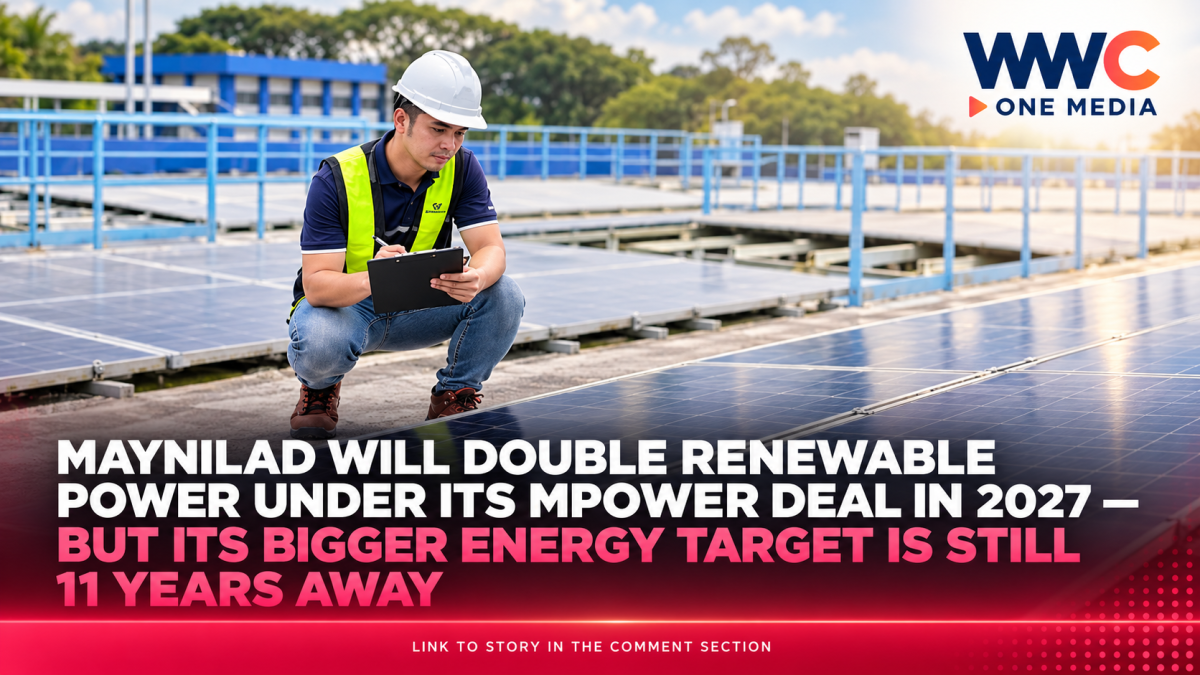
Maynilad will increase the renewable-energy component of electricity supplied through its contract with MPower, Meralco’s retail electricity supplier, from 10% to 20%. The company estimates that change alone will cut greenhouse-gas emissions by around 8,500 metric tons annually.
But the plan goes much further than buying greener electricity.
Maynilad intends to install rooftop solar systems at 20 water and wastewater facilities, expand on-site generation and implement energy-efficiency measures across operations that include treatment plants, pumping stations, reservoirs and sewage facilities.
For a water utility, that matters because electricity is not simply an office expense.
It is what keeps water moving.
Why a water company uses so much electricity
Before clean water reaches a household tap, raw water must be collected, treated, pumped into reservoirs and moved across extensive distribution networks.
Wastewater then has to be collected, pumped and treated again.
Maynilad’s network includes water-treatment plants, pumping stations, reservoirs and thousands of kilometers of pipelines serving the western portion of Metro Manila and parts of Cavite.
Its 2024 sustainability report listed nine water-treatment plants, 39 pumping stations, 39 reservoirs and more than 11,800 kilometers of water pipelines.
That physical system creates significant electricity demand.
Maynilad reported 737,413 gigajoules of total energy consumption in 2024, with purchased grid electricity forming the overwhelming majority of its energy use.
By 2025, First Pacific ESG reporting showed Maynilad’s total energy consumption rising to approximately 709,891 GJ under that report’s methodology, while purchased non-renewable electricity remained a major component of consumption.
That is why renewable electricity can produce a meaningful emissions impact even though Maynilad is not an energy company.
The immediate move: 10% becomes 20%
The new roadmap starts with an existing contract.
Under Maynilad’s arrangement with MPower, some facilities currently receive electricity with a mix of 90% conventional power and 10% renewable energy.
Beginning next year, the renewable portion will rise to 20%.
Maynilad Chief Sustainability Officer Roel Espiritu said the roadmap is intended both to lower the company’s carbon footprint and strengthen the long-term resilience of its operations.
The transition plan was developed after reviewing Maynilad’s electricity consumption and greenhouse-gas emissions and conducting renewable-energy feasibility and implementation studies.
The company says the 10-percentage-point increase under its MPower arrangement should eliminate around 8,500 metric tons of carbon emissions each year.
That estimate is a company projection based on the expected change in electricity sourcing; it is not yet a measured post-implementation result because the higher renewable share begins in 2027.
Twenty new solar installations are part of the plan
Buying renewable electricity from suppliers is only one part of Maynilad’s strategy.
The company also plans rooftop solar photovoltaic systems at 20 facilities.
Those locations are expected to include:
water-treatment plants, pumping stations, reservoirs, wastewater-treatment facilities and sewage pumping stations.
The projects will add to solar installations already operating at Maynilad’s La Mesa Compound.
Maynilad began developing solar capacity there several years ago.
The company previously disclosed two solar facilities supplying a combined 2 megawatts to supplement the electricity requirements of La Mesa Treatment Plant 1 and pumping stations inside the compound.
IFC project disclosures have also noted that La Mesa Treatment Plant 1 receives part of its electricity from Maynilad’s own solar facility.
Rooftop systems at additional sites could allow Maynilad to generate power closer to where it is consumed while reducing part of its dependence on grid electricity.
The bigger target: 35% by 2037
Maynilad’s new roadmap establishes 35% renewable electricity by 2037 as the company-wide goal.
That figure is part of a broader Climate Neutrality Plan.
Other long-term objectives disclosed by Maynilad include increasing electric vehicles in its fleet, creating a 180,000-metric-ton CO₂ carbon sink, and supporting thousands of hectares of reforestation.
The renewable-energy target is particularly significant because purchased electricity accounts for a large portion of the utility’s operational greenhouse-gas footprint.
First Pacific’s 2025 ESG report placed Maynilad’s Scope 1 and Scope 2 location-based emissions at around 114,854 metric tons of CO₂ equivalent in 2025, up from roughly 100,203 tons in 2024.
Scope 2—emissions associated primarily with purchased electricity—represented around 96,300 tons of the 2025 total.
That means shifting the electricity mix can directly address one of Maynilad’s largest reported sources of operational emissions.
It also provides an important reality check.
Maynilad has already been adding renewable power, but overall electricity requirements and emissions can still rise as operations expand.
Decarbonization therefore requires renewable deployment to outpace growing energy demand.
Maynilad previously announced more aggressive near-term targets
There is another important piece of context.
In an earlier announcement, Maynilad said it planned to increase renewable-energy utilization to 30% in 2025 and 40% by 2027.
Those milestones are different from the newly completed 2026 Renewable Energy Transition Plan.
In 2025, Maynilad described its longer-range target as 35% to 50% renewable energy by 2037.
The latest September 2026 company disclosure now specifies 35% of total electricity requirements by 2037 and identifies the immediate MPower-contract increase from 10% to 20% as the first major initiative.
For accuracy, the new roadmap should therefore be treated as Maynilad’s current stated plan, rather than combining it with older milestones and implying that the company will reach 40% next year.
The company did not explain in its latest announcement why the earlier 2027 target differs from the new roadmap.
The MPower relationship has been expanding
Maynilad widened its relationship with MPower in 2025.
Under an agreement announced that year, the company’s Poblacion Water Treatment Plant in Muntinlupa was enrolled in the Retail Electricity Supply program.
Another 54 Maynilad water and wastewater facilities were brought into MPower’s Retail Aggregation Program, which allows smaller electricity accounts to be combined for power procurement.
Maynilad said the arrangement was designed both to improve operational efficiency and prepare facilities for greater renewable-energy use.
That means the 2027 increase is not an isolated electricity purchase.
It builds on a broader restructuring of how the water utility buys power.
Renewable energy could also become an operating-cost issue
There is a financial dimension behind the environmental target.
Electricity is an unavoidable input in water treatment and distribution.
The more water a utility treats and pumps—and the more wastewater infrastructure it operates—the more energy efficiency matters to operating expenses.
Maynilad is simultaneously investing heavily in new infrastructure.
The company spent ₱12.89 billion on capital expenditures during the first half of 2026, up 18.9% from ₱10.85 billion a year earlier.
Those investments supported water and wastewater facilities, network reliability, production capacity and efforts to reduce water losses.
As Maynilad expands sewerage and sanitation services, it also adds facilities that require electricity.
That creates an unusual challenge:
The company must increase infrastructure and treatment capacity while trying to reduce the carbon intensity of the power needed to operate it.
Water losses and electricity use are connected
One of Maynilad’s biggest operational programs may also indirectly affect its energy requirements: reducing non-revenue water, or NRW.
Non-revenue water is water that enters the distribution system but does not generate revenue because of leaks, illegal connections, meter problems or other losses.
In the first half of 2026, Maynilad said NRW had improved to 29.7% from 35.25% a year earlier.
Reducing leakage can have an energy benefit.
If less treated water disappears before reaching paying customers, the utility can reduce wasted treatment and pumping for each usable liter delivered.
Maynilad’s long-term sustainability strategy therefore combines several measures that reinforce one another:
cleaner electricity, energy efficiency, reduced water losses, renewable generation and infrastructure modernization.
Maynilad is also rapidly expanding wastewater treatment
The energy question becomes more important as wastewater coverage increases.
Maynilad reported overall wastewater coverage of 88% in the first half of 2026, up from 85% a year earlier.
Sewerage coverage increased to 26%, while sanitation coverage improved to 62%.
Wastewater treatment protects rivers, Manila Bay and public health.
But treatment facilities also consume power.
Pumps, aeration systems, filtration equipment and sludge-processing systems can require substantial electricity.
So as Maynilad expands wastewater services, renewable electricity becomes both an environmental strategy and a way of limiting the additional emissions associated with that expansion.
The Philippine grid is also moving toward more renewables
Maynilad’s transition is happening alongside a broader shift in the national electricity sector.
As of the end of 2025, renewable energy accounted for around 32.9% of Philippine installed generating capacity, behind coal at approximately 40.6%.
Solar had grown to about 11.1% of installed capacity, with hydro, geothermal, biomass and wind supplying additional renewable capacity.
The national government is seeking a much larger renewable share over the coming years.
For companies such as Maynilad, a cleaner national grid can lower the carbon intensity of electricity even before their own procurement choices are considered.
But corporate power-purchasing arrangements and on-site solar allow businesses to move more deliberately instead of waiting solely for the national generation mix to change.
Why resilience is part of Maynilad’s argument
Maynilad is framing renewable energy not simply as an emissions program but also as part of its resilience strategy.
Water utilities cannot easily stop operating when electricity markets become volatile.
Treatment plants and pumping stations provide an essential public service.
A more diversified energy supply—including grid electricity, contracted renewable power and on-site solar—can reduce dependence on a single source or technology.
Maynilad said its Renewable Energy Transition Plan is intended to strengthen energy security and the long-term resilience of water and wastewater operations.
Solar panels alone cannot run every facility continuously, particularly at night or during low-generation periods.
The strategy therefore depends on a mix of procurement, on-site generation, grid supply and efficiency improvements rather than complete energy independence.
Maynilad’s business itself is getting bigger
The transition is occurring as Maynilad continues to expand financially and operationally.
For the first six months of 2026, the water company reported ₱8.51 billion in net income while continuing large infrastructure investments.
Its water-service coverage reached nearly 95%, while 24-hour availability at minimum pressure was reported at 92.1%.
Maynilad also completed its major initial public offering process in 2025, raising capital intended largely for government-approved infrastructure investments.
That puts greater investor attention on how the company manages not only revenue and infrastructure spending but also climate risk, energy consumption and environmental performance.
IFC, which evaluated the Maynilad investment, specifically identified environmental and social issues including energy efficiency, greenhouse-gas emissions and solar supply-chain risks among matters requiring management.
The 8,500-ton reduction is only the first measurable step
Maynilad’s announcement contains one immediately understandable number:
8,500 metric tons of avoided carbon emissions per year.
That is what the company expects from raising the renewable component of the relevant MPower electricity supply from 10% to 20%.
But its 2037 objective is much larger.
To reach 35% renewable electricity across its operations, Maynilad will have to expand clean-energy procurement, install the planned rooftop systems, improve efficiency and manage increasing electricity requirements as new water and wastewater infrastructure comes online.
That is the harder part of the transition.
A water company cannot simply use less power if doing so means treating less water or running fewer wastewater facilities.
It has to make the energy behind those essential services cleaner and more efficient.
So the real story behind Maynilad’s renewable-energy roadmap is not that a water utility is suddenly becoming a solar company.
It is that every liter delivered through a modern urban water system carries an energy footprint—and Maynilad is trying to change what powers that footprint before its network grows even larger.




Leave a Reply