
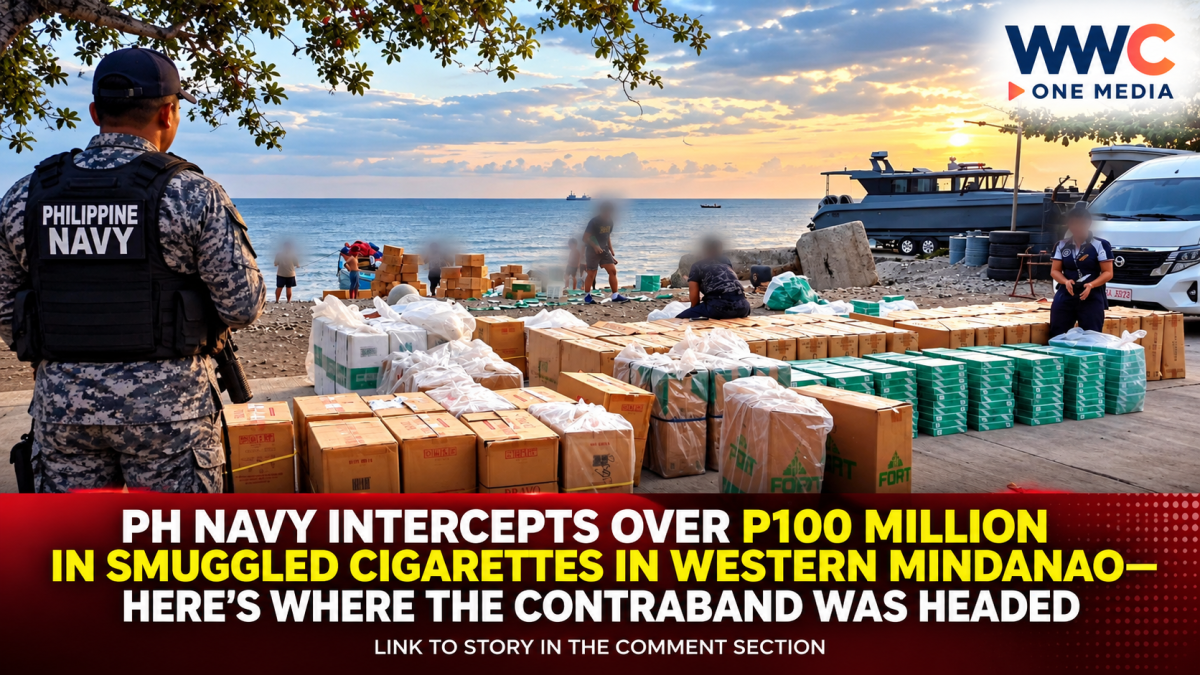
ZAMBOANGA CITY — The Philippine Navy has intensified its campaign against maritime smuggling in Western Mindanao after separate sea operations led to the seizure of more than P100 million worth of undocumented cigarettes, according to reports from authorities and multiple news outlets.
The operations targeted vessels moving through the waters around Sulu and the Zamboanga Peninsula, areas that authorities have repeatedly identified as vulnerable routes for the movement of illicit goods.
According to the reported operations, Navy personnel intercepted vessels carrying large quantities of foreign-branded cigarettes that lacked the required importation and cargo documents. The shipments were subsequently brought to Zamboanga City for inventory, documentation and turnover to the Bureau of Customs (BOC) for appropriate legal action.
Two-day maritime crackdown
The Manila Bulletin reported that Navy personnel conducted separate interceptions from May 23 to 24, resulting in the seizure of more than P113 million worth of smuggled cigarettes.
During the first operation near Tongkil Island in Sulu, the Naval Command Western Mindanao intercepted the FB Sea Dragon and MPB Sea Horse, recovering 282 cases of undocumented cigarettes estimated at P42.7 million.
The following day, authorities intercepted another vessel, the MB Lappas, and seized 473 master cases of undocumented foreign-branded cigarettes valued at approximately P70.9 million.
The cargoes were found to lack the necessary legal documents and permits. The vessels and seized goods were later transported to Naval Station Romulo Espaldon in Zamboanga City before being turned over to the Bureau of Customs.
Part of a much larger crackdown
The latest seizure was not an isolated incident.
Just days earlier, the Western Mindanao Naval Command reported another major operation in which two vessels carrying nearly P94 million worth of undocumented foreign-brand cigarettes were intercepted in the Sulu Sea.
One vessel, M/B Aslinda, was carrying 305 master cases valued at about P47.6 million, while another vessel, M/V Babyboy, was found carrying roughly 300 master cases valued at more than P46.3 million.
The Navy’s recent operations followed an even larger crackdown in Basilan. In May, authorities reported the seizure of approximately P526.3 million worth of foreign-brand cigarettes during two separate maritime interdiction operations conducted within 48 hours. Twenty-one crew members were arrested and nearly 3,916 master cases of undocumented tobacco products were confiscated.
Why Western Mindanao remains a smuggling hotspot
The repeated interceptions underscore the challenges faced by authorities in securing the country’s southern maritime borders.
The waters surrounding Sulu, Basilan, Tawi-Tawi and the Zamboanga Peninsula include numerous islands, coastal communities and maritime routes linking the Philippines with neighboring Southeast Asian countries. These geographic conditions can make the region attractive to smugglers attempting to move untaxed or undocumented goods into the Philippine market.
Authorities have increasingly relied on maritime patrols, vessel inspections, intelligence reports and coordination with other law-enforcement agencies to disrupt these operations.
Contraband turned over to Customs
The seized cigarettes and vessels are not considered legally cleared simply because they were intercepted. The Bureau of Customs is responsible for the subsequent legal and administrative proceedings involving the confiscated goods.
In the recent Western Mindanao operations, the Navy turned over the seized cargoes and vessels to the BOC for proper disposition and possible prosecution under applicable Philippine laws.
The repeated seizures also show that authorities are increasingly targeting maritime smuggling before contraband can reach distribution networks on the mainland.
Navy steps up pressure on maritime smugglers
The Philippine Navy and its Western Mindanao command have signaled that maritime patrols will continue as authorities attempt to prevent the region’s waters from being used as entry points for illicit trade.
The scale and frequency of the recent seizures suggest that the crackdown is becoming a sustained campaign rather than a series of isolated interceptions.
With hundreds and, in some operations, thousands of master cases being intercepted, authorities are now facing a larger question: how extensive are the smuggling networks behind the shipments—and how many more vessels are still attempting to slip through the southern maritime routes?
For now, the seized cargoes are in government custody while authorities pursue the appropriate legal proceedings against those involved.
WWC ONE MEDIA J.M.S




Leave a Reply