
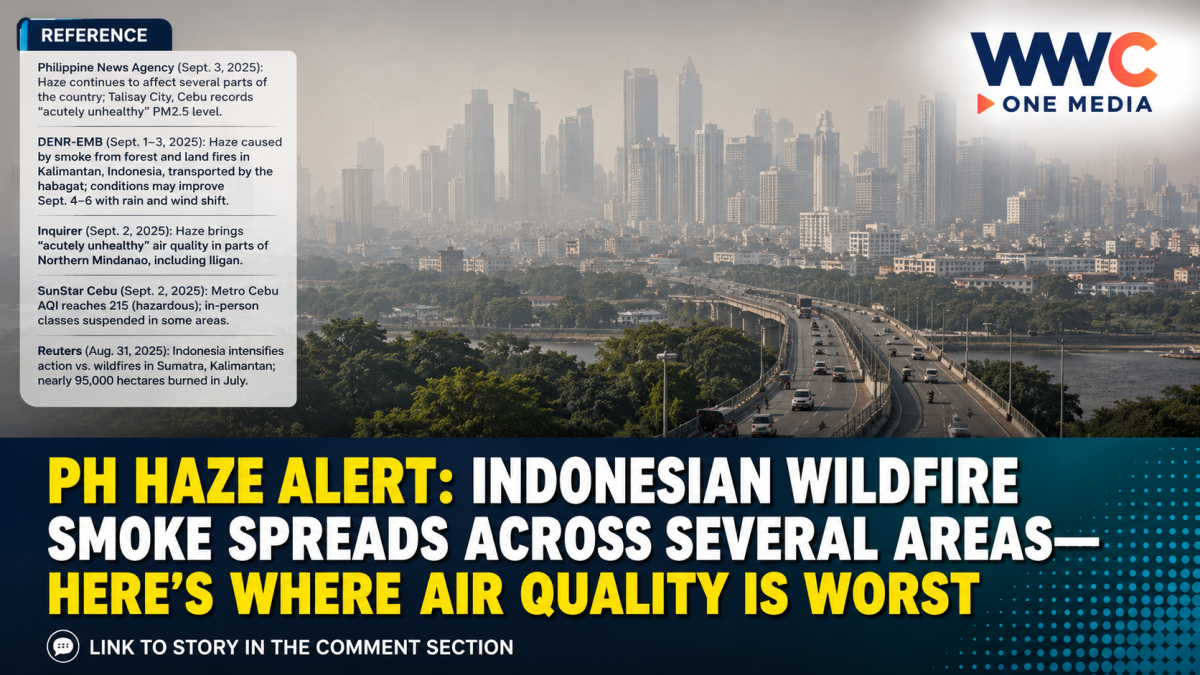
MANILA, Philippines — The haze hanging over parts of the Philippines is continuing to raise air-quality concerns, with authorities monitoring elevated levels of fine particulate matter in several areas as smoke from forest and land fires in Kalimantan, Indonesia, is carried across the region by prevailing winds.
The Philippine News Agency reported Thursday that haze remained visible in several parts of the country, with Talisay City, Cebu, recording a PM2.5 reading classified as “acutely unhealthy.”
The situation highlights how the Indonesian fires are affecting areas far beyond Metro Manila.
From Metro Manila to Cebu and Mindanao
The Department of Environment and Natural Resources–Environmental Management Bureau (DENR-EMB) has attributed the haze to smoke from fires in Kalimantan being transported toward the Philippines by the southwest monsoon, or habagat.
Earlier this week, the DENR-EMB said haze could continue affecting parts of the country through Sept. 3 as fires in Kalimantan remained active and prevailing winds continued carrying smoke toward the Philippines.
Metro Manila experienced a significant deterioration in air quality earlier in the week. However, monitoring later showed improvement in some parts of the capital as wind conditions changed.
The haze has also become a serious concern in Metro Cebu. Local reports said air-quality readings in the area reached hazardous levels, prompting authorities in some locations to suspend in-person classes. SunStar Cebu reported an AQI of 215 in Metro Cebu on Sept. 2, describing the conditions as hazardous.
Cebu was not the only area affected.
In Northern Mindanao, the DENR-EMB reported rising concentrations of fine particulate matter, with neighboring areas including Iligan experiencing “acutely unhealthy” readings.
Reports from Albay also described poor visibility as haze covered parts of the province, with the normally prominent Mayon Volcano becoming difficult to see.
Why is the Philippines experiencing haze from Indonesia?
The current episode is linked to forest and land fires in Kalimantan, the Indonesian portion of the island of Borneo.
Smoke generated by those fires can travel long distances when atmospheric conditions and prevailing winds carry the pollutants across national boundaries.
The DENR-EMB explained that the southwest monsoon has been transporting smoke from Kalimantan toward parts of the Philippines. The agency has been monitoring PM2.5 concentrations because these extremely small particles are an important indicator of air pollution.
The regional situation is significant because Indonesia itself is dealing with an extensive wildfire problem.
Reuters reported on Aug. 31 that Indonesian authorities were intensifying efforts against widespread fires in Sumatra and Kalimantan amid a severe dry season. The report said nearly 95,000 hectares burned in July alone, while authorities were investigating companies whose concession areas contained fires.
Will the haze continue?
The answer may depend heavily on rainfall and wind direction.
According to the DENR-EMB, air quality could gradually improve from Sept. 4 to 6 if widespread rain continues and wind patterns shift. Rain can help remove suspended particles from the atmosphere, while changing winds can reduce the amount of smoke being transported toward the Philippines.
But authorities have cautioned that conditions beyond that period will depend on whether the Indonesian fires continue producing smoke, whether additional hotspots develop and whether winds continue pushing pollutants toward the Philippines.
That means clearer skies are possible—but they are not guaranteed.
What should residents do?
Health authorities have advised the public to limit prolonged outdoor exposure when air quality deteriorates, particularly people who are more sensitive to air pollution.
The Department of Health has also advised taking precautions when outdoor exposure cannot be avoided. Reports from Metro Manila said residents were urged to limit unnecessary outdoor activities and use appropriate respiratory protection during periods of poor air quality.
The key message from authorities is simple: monitor local air-quality advisories rather than relying solely on how the sky looks.
Haze can vary significantly from one location to another, and conditions can change as winds and rainfall shift.
For now, the Philippine skies remain closely tied to a fire situation hundreds of kilometers away—and the next few days could determine whether the haze finally begins to lift or remains a problem for communities across the country
WWC ONE MEDIA G.A


Leave a Reply