
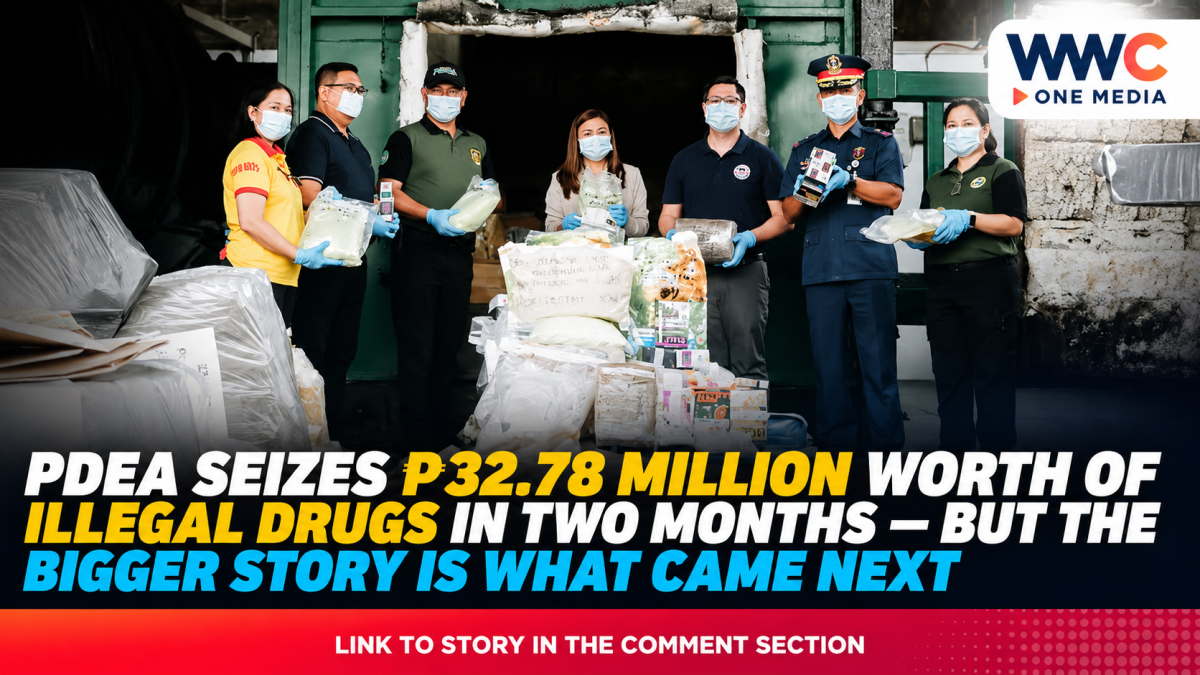
MANILA, Philippines — The Philippine Drug Enforcement Agency (PDEA) seized an estimated ₱32.78 million worth of illegal drugs in a series of operations conducted from July to August 2026, underscoring the government’s continuing crackdown on the illegal drug trade.
The latest figure, reported by ABS-CBN News based on PDEA data, comes as authorities intensify anti-drug operations nationwide and step up coordination with other law-enforcement agencies.
The seizures form part of a broader campaign that has produced significantly larger hauls in other operations this year.
In July alone, PDEA and its partner agencies conducted 3,572 anti-drug operations nationwide, resulting in the arrest of 4,426 drug suspects and the seizure of approximately ₱1.10 billion worth of illegal drugs, according to the Philippine News Agency. Authorities also reported the dismantling of 39 illegal drug facilities during the month.
The July haul included 201.89 kilograms of shabu, 0.34 kilogram of cocaine, 1,307 ecstasy tablets and 63.11 kilograms of dried marijuana leaves and bricks.
Shabu remains a major target
Methamphetamine hydrochloride, commonly known as shabu, continues to account for a significant portion of the illegal drugs intercepted by authorities.
In another major development, PDEA recently destroyed more than ₱12.34 billion worth of dangerous drugs, controlled precursors and essential chemicals in Cavite. The disposal involved more than 2.2 metric tons of solid dangerous drugs and more than 106,000 milliliters of liquid dangerous drugs.
The bulk consisted of approximately 1.77 metric tons of shabu valued at around ₱12.06 billion.
The destruction was intended to ensure that confiscated substances that were no longer needed as court evidence could not find their way back into circulation.
Border interdiction is also being intensified
Authorities are also focusing heavily on the country’s ports and airports.
In July, the Bureau of Customs, PDEA and other agencies intercepted approximately 41.85 kilograms of marijuana worth more than ₱62.7 million at Ninoy Aquino International Airport Terminal 3. Four arriving passengers from Bangkok were arrested after their baggage was flagged during screening and subjected to further examination.
Earlier in the month, Customs and its partner agencies also intercepted 39 international inbound parcels containing suspected dangerous drugs valued at more than ₱41 million. The shipments originated from several countries, including India, the United States, Spain, Germany, Canada, the Netherlands and the United Kingdom.
These operations illustrate how authorities are pursuing the drug trade not only through street-level enforcement but also through intelligence, parcel screening and border interdiction.
PDEA says the campaign is broader than seizures
PDEA’s campaign under the Marcos administration has increasingly been framed around enforcement alongside prevention, rehabilitation and community intervention.
From July 2022 through June 30, 2026, PDEA and its partner agencies reported more than 155,000 anti-illegal-drug operations, resulting in the arrest of 206,516 drug personalities. Authorities said the operations led to the seizure of more than 16 metric tons of shabu, along with cocaine, ecstasy and marijuana, with a combined estimated street value of ₱122.53 billion.
PDEA has also emphasized education and community-based intervention. In Region 9, for example, the agency recently highlighted education, coordination and public awareness as key components of its continuing anti-drug strategy.
The agency’s approach therefore extends beyond simply counting arrests and seizures, with government programs also targeting prevention, treatment, rehabilitation and reintegration.
The bigger question
The ₱32.78-million figure reported for the July–August operations is another indication of continuing enforcement activity, but it represents only one part of a much larger nationwide campaign.
With billion-peso drug seizures recorded in individual months and major interdictions continuing at airports and other entry points, authorities face a persistent challenge: disrupting the supply chains and organized networks behind the illegal drug trade while ensuring that enforcement remains within the bounds of the law.
For PDEA and its partner agencies, the next test will be whether these operations can translate into sustained disruption of trafficking networks — not simply larger seizure numbers
WWC ONE MEDA MJE



Leave a Reply