
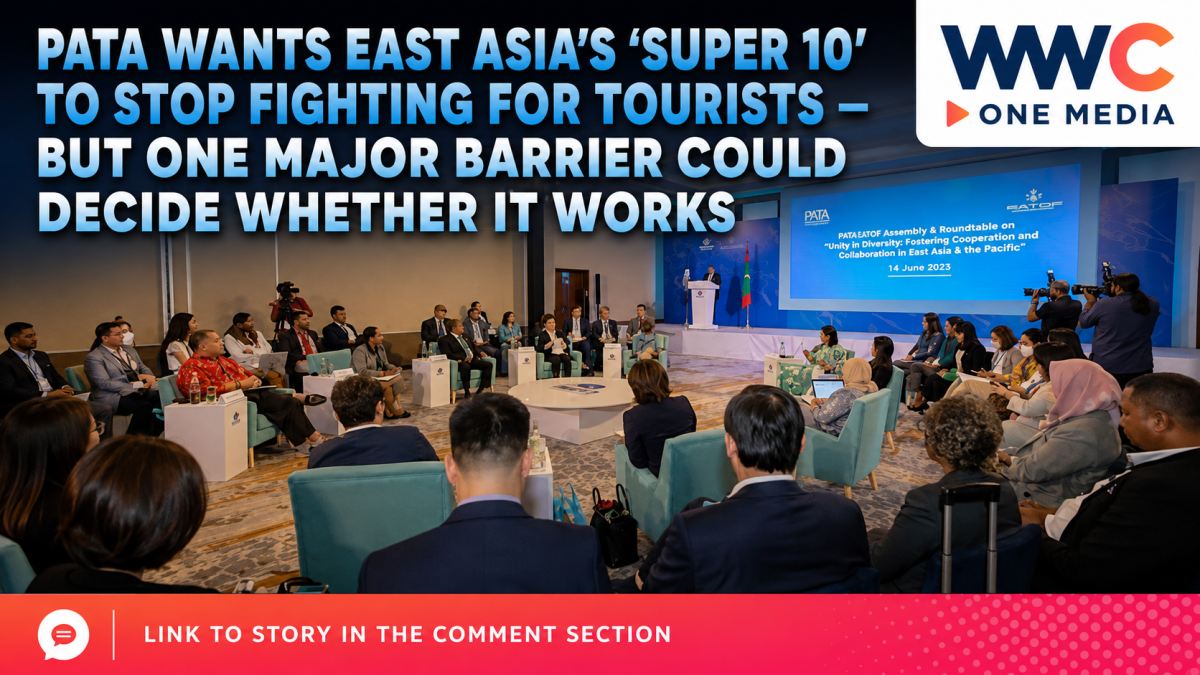
CEBU, Philippines — Ten major tourism regions across East and Southeast Asia are being challenged to stop fighting over the same travelers and start selling themselves as a connected tourism powerhouse — a proposed “Super 10” that could reshape how destinations compete for Asia’s rapidly growing travel market.
But turning that vision into reality may depend on something far less glamorous than beaches, temples and marketing campaigns: whether tourists can actually move easily between the destinations.
Pacific Asia Travel Association (PATA) CEO Noor Ahmad Hamid raised the idea during the Governors’ Conference of the 19th East Asia Inter-Regional Tourism Federation (EATOF) General Assembly, held in Cebu on September 3.
Instead of destinations spending increasingly large sums competing for the same tourists, airline seats, events and international attention, Hamid argued that EATOF members could expand the overall market by working together.
The concept would turn EATOF’s members into what he described as the “Super 10” — destinations that retain their individual identities while cooperating on tourism intelligence, travel products, promotions, technology and visitor experiences.
The ‘Super 10’ stretches across 10 Asian countries
EATOF’s current membership consists of 10 regional governments in 10 countries: Cebu in the Philippines, Gangwon in South Korea, Tottori in Japan, Jilin in China, Töv in Mongolia, Sarawak in Malaysia, Yogyakarta in Indonesia, Quang Ninh in Vietnam, Luang Prabang in Laos and Siem Reap in Cambodia.
The federation was established in 2000 and is led by Gangwon State, where its permanent secretariat is based. Its members meet through annual standing committee sessions and biennial general assemblies to coordinate tourism policies, exchanges and sustainable-development programs.
Not all 10 member governments were necessarily represented at the same level at the Cebu meeting. Reports surrounding the assembly identified delegations from eight regional governments among roughly 300 participants, alongside tourism organizations, academics and industry representatives.
Still, Hamid’s proposal targets the federation as a whole.
Rather than marketing Cebu’s beaches, Siem Reap’s temples, Gangwon’s mountains, Tottori’s landscapes, Sarawak’s natural attractions, Yogyakarta’s culture and Luang Prabang’s heritage as isolated products, the idea is to make them complementary parts of wider Asian journeys.
That could allow destinations with limited international marketing budgets to pool resources, develop joint campaigns and reach travelers who might otherwise visit only one country.
Asia-Pacific tourism is getting much bigger
The timing matters.
PATA’s latest Asia Pacific Visitor Forecasts 2026–2028 Mid-Year Update, released in June, projects international visitor arrivals across 39 Asia-Pacific destinations to reach approximately 714.9 million in 2026, climb to 758.8 million in 2027, and hit 789.2 million in 2028 under its baseline scenario.
That would put arrivals at roughly 115.6 percent of 2019 levels by 2028, signaling that the region has moved beyond simply recovering from the pandemic and into another period of tourism expansion.
PATA has also identified Northeast Asia as the region expected to command the largest share of Asia-Pacific arrivals by 2028, strengthening the economic argument for closer tourism links across the wider East Asian market.
The opportunity, therefore, is enormous.
The harder question is whether EATOF can make the destinations function as a genuine travel network rather than simply a collection of tourism partners.
The biggest problem may be getting from Point A to Point B
Hamid highlighted a practical weakness during the Cebu gathering: regional connectivity remains surprisingly difficult.
One example involved travel between Cebu and Kuching, the capital of Sarawak. Because of limited direct connections, a journey between two destinations that belong to the same regional tourism federation could reportedly take close to 20 hours.
That is the contradiction at the heart of the “Super 10” idea.
A multi-country tourism campaign becomes much harder to sell if travelers must make inconvenient connections, spend hours in transit or navigate significantly different entry requirements every time they cross a border.
Cebu Governor Pamela Baricuatro has separately identified direct air connectivity as one of Cebu’s priorities during the EATOF gathering, saying the province wants to explore more direct links with participating regions.
She has also pushed the assembly beyond tourism promotion alone, identifying investment, cultural exchange, sports tourism, sustainable destination development and people-to-people cooperation as areas where Cebu could benefit from stronger regional partnerships.
That means the “Super 10” could eventually become more than a marketing slogan — but only if transportation, tourism policy and private-sector cooperation catch up.
The alliance is already moving beyond speeches
The Cebu meeting also produced developments that give the cooperation plan more substance.
On September 3, representatives attending the assembly adopted a joint declaration on sustainable international tourism cooperation with five major areas of focus.
According to reporting from South Korea, these include developing greener and lower-carbon destinations, expanding high-value local tourism content, building cooperation between governments, universities and tourism industries, creating AI-powered smart-travel environments, and strengthening tourism safety and crisis-management systems.
Participants also agreed to work toward tourism products connecting regional natural and cultural assets, while using artificial intelligence to reduce language barriers and improve the visitor experience.
Plans include a cooperative tourism-safety network intended to help member governments respond jointly when disasters or major crises affect travelers.
Those initiatives closely match Hamid’s argument that tourism cooperation must go beyond advertising.
Sharing data, technology, training, crisis-management practices and successful tourism models could potentially prevent every destination from having to solve the same problems independently.
PATA and EATOF already have a formal partnership
The “Super 10” concept also builds on an existing relationship.
PATA and EATOF signed a memorandum of understanding in May 2024 aimed at strengthening Asia-Pacific tourism cooperation.
That agreement covered participation in each organization’s major events, sharing sustainable-tourism practices and developing collaborative educational and regional tourism initiatives.
At the time, the organizations also identified areas including youth engagement and tourism data analysis as opportunities for cooperation.
In other words, Cebu’s “Super 10” proposal is not starting from zero. There is already an institutional framework through which some of the ideas could be developed.
Cebu hands the next chapter to Gangwon
The Cebu gathering also set the stage for the federation’s next phase.
At EATOF Night on September 3, Cebu formally handed the EATOF flag to Gangwon State in South Korea.
Gangwon is expected to host the EATOF Standing Committee Meeting in 2027, followed by the 20th EATOF General Assembly in 2028.
That gives members roughly two years before the next general assembly to demonstrate whether the cooperation discussed in Cebu can produce something travelers can actually see and use.
Joint promotions are relatively easy.
Creating coordinated tourism products, improving flight links, making cross-border travel simpler, sharing data, responding collectively to crises and convincing airlines and private companies to participate will be considerably harder.
And that may ultimately determine whether “Super 10” becomes a genuine regional tourism force — or another ambitious slogan unveiled at an international conference.
For Cebu and its nine EATOF partners, the next test is no longer whether they can agree that cooperation sounds good.
It is whether they can make 10 very different destinations feel like one connected journey.CEBU, Philippines — Ten major tourism regions across East and Southeast Asia are being challenged to stop fighting over the same travelers and start selling themselves as a connected tourism powerhouse — a proposed “Super 10” that could reshape how destinations compete for Asia’s rapidly growing travel market.
But turning that vision into reality may depend on something far less glamorous than beaches, temples and marketing campaigns: whether tourists can actually move easily between the destinations.
Pacific Asia Travel Association (PATA) CEO Noor Ahmad Hamid raised the idea during the Governors’ Conference of the 19th East Asia Inter-Regional Tourism Federation (EATOF) General Assembly, held in Cebu on September 3.
Instead of destinations spending increasingly large sums competing for the same tourists, airline seats, events and international attention, Hamid argued that EATOF members could expand the overall market by working together.
The concept would turn EATOF’s members into what he described as the “Super 10” — destinations that retain their individual identities while cooperating on tourism intelligence, travel products, promotions, technology and visitor experiences.
The ‘Super 10’ stretches across 10 Asian countries
EATOF’s current membership consists of 10 regional governments in 10 countries: Cebu in the Philippines, Gangwon in South Korea, Tottori in Japan, Jilin in China, Töv in Mongolia, Sarawak in Malaysia, Yogyakarta in Indonesia, Quang Ninh in Vietnam, Luang Prabang in Laos and Siem Reap in Cambodia.
The federation was established in 2000 and is led by Gangwon State, where its permanent secretariat is based. Its members meet through annual standing committee sessions and biennial general assemblies to coordinate tourism policies, exchanges and sustainable-development programs.
Not all 10 member governments were necessarily represented at the same level at the Cebu meeting. Reports surrounding the assembly identified delegations from eight regional governments among roughly 300 participants, alongside tourism organizations, academics and industry representatives.
Still, Hamid’s proposal targets the federation as a whole.
Rather than marketing Cebu’s beaches, Siem Reap’s temples, Gangwon’s mountains, Tottori’s landscapes, Sarawak’s natural attractions, Yogyakarta’s culture and Luang Prabang’s heritage as isolated products, the idea is to make them complementary parts of wider Asian journeys.
That could allow destinations with limited international marketing budgets to pool resources, develop joint campaigns and reach travelers who might otherwise visit only one country.
Asia-Pacific tourism is getting much bigger
The timing matters.
PATA’s latest Asia Pacific Visitor Forecasts 2026–2028 Mid-Year Update, released in June, projects international visitor arrivals across 39 Asia-Pacific destinations to reach approximately 714.9 million in 2026, climb to 758.8 million in 2027, and hit 789.2 million in 2028 under its baseline scenario.
That would put arrivals at roughly 115.6 percent of 2019 levels by 2028, signaling that the region has moved beyond simply recovering from the pandemic and into another period of tourism expansion.
PATA has also identified Northeast Asia as the region expected to command the largest share of Asia-Pacific arrivals by 2028, strengthening the economic argument for closer tourism links across the wider East Asian market.
The opportunity, therefore, is enormous.
The harder question is whether EATOF can make the destinations function as a genuine travel network rather than simply a collection of tourism partners.
The biggest problem may be getting from Point A to Point B
Hamid highlighted a practical weakness during the Cebu gathering: regional connectivity remains surprisingly difficult.
One example involved travel between Cebu and Kuching, the capital of Sarawak. Because of limited direct connections, a journey between two destinations that belong to the same regional tourism federation could reportedly take close to 20 hours.
That is the contradiction at the heart of the “Super 10” idea.
A multi-country tourism campaign becomes much harder to sell if travelers must make inconvenient connections, spend hours in transit or navigate significantly different entry requirements every time they cross a border.
Cebu Governor Pamela Baricuatro has separately identified direct air connectivity as one of Cebu’s priorities during the EATOF gathering, saying the province wants to explore more direct links with participating regions.
She has also pushed the assembly beyond tourism promotion alone, identifying investment, cultural exchange, sports tourism, sustainable destination development and people-to-people cooperation as areas where Cebu could benefit from stronger regional partnerships.
That means the “Super 10” could eventually become more than a marketing slogan — but only if transportation, tourism policy and private-sector cooperation catch up.
The alliance is already moving beyond speeches
The Cebu meeting also produced developments that give the cooperation plan more substance.
On September 3, representatives attending the assembly adopted a joint declaration on sustainable international tourism cooperation with five major areas of focus.
According to reporting from South Korea, these include developing greener and lower-carbon destinations, expanding high-value local tourism content, building cooperation between governments, universities and tourism industries, creating AI-powered smart-travel environments, and strengthening tourism safety and crisis-management systems.
Participants also agreed to work toward tourism products connecting regional natural and cultural assets, while using artificial intelligence to reduce language barriers and improve the visitor experience.
Plans include a cooperative tourism-safety network intended to help member governments respond jointly when disasters or major crises affect travelers.
Those initiatives closely match Hamid’s argument that tourism cooperation must go beyond advertising.
Sharing data, technology, training, crisis-management practices and successful tourism models could potentially prevent every destination from having to solve the same problems independently.
PATA and EATOF already have a formal partnership
The “Super 10” concept also builds on an existing relationship.
PATA and EATOF signed a memorandum of understanding in May 2024 aimed at strengthening Asia-Pacific tourism cooperation.
That agreement covered participation in each organization’s major events, sharing sustainable-tourism practices and developing collaborative educational and regional tourism initiatives.
At the time, the organizations also identified areas including youth engagement and tourism data analysis as opportunities for cooperation.
In other words, Cebu’s “Super 10” proposal is not starting from zero. There is already an institutional framework through which some of the ideas could be developed.
Cebu hands the next chapter to Gangwon
The Cebu gathering also set the stage for the federation’s next phase.
At EATOF Night on September 3, Cebu formally handed the EATOF flag to Gangwon State in South Korea.
Gangwon is expected to host the EATOF Standing Committee Meeting in 2027, followed by the 20th EATOF General Assembly in 2028.
That gives members roughly two years before the next general assembly to demonstrate whether the cooperation discussed in Cebu can produce something travelers can actually see and use.
Joint promotions are relatively easy.
Creating coordinated tourism products, improving flight links, making cross-border travel simpler, sharing data, responding collectively to crises and convincing airlines and private companies to participate will be considerably harder.
And that may ultimately determine whether “Super 10” becomes a genuine regional tourism force — or another ambitious slogan unveiled at an international conference.
For Cebu and its nine EATOF partners, the next test is no longer whether they can agree that cooperation sounds good.
It is whether they can make 10 very different destinations feel like one connected journey.
WWC ONE MEDIA J.M.D




Leave a Reply