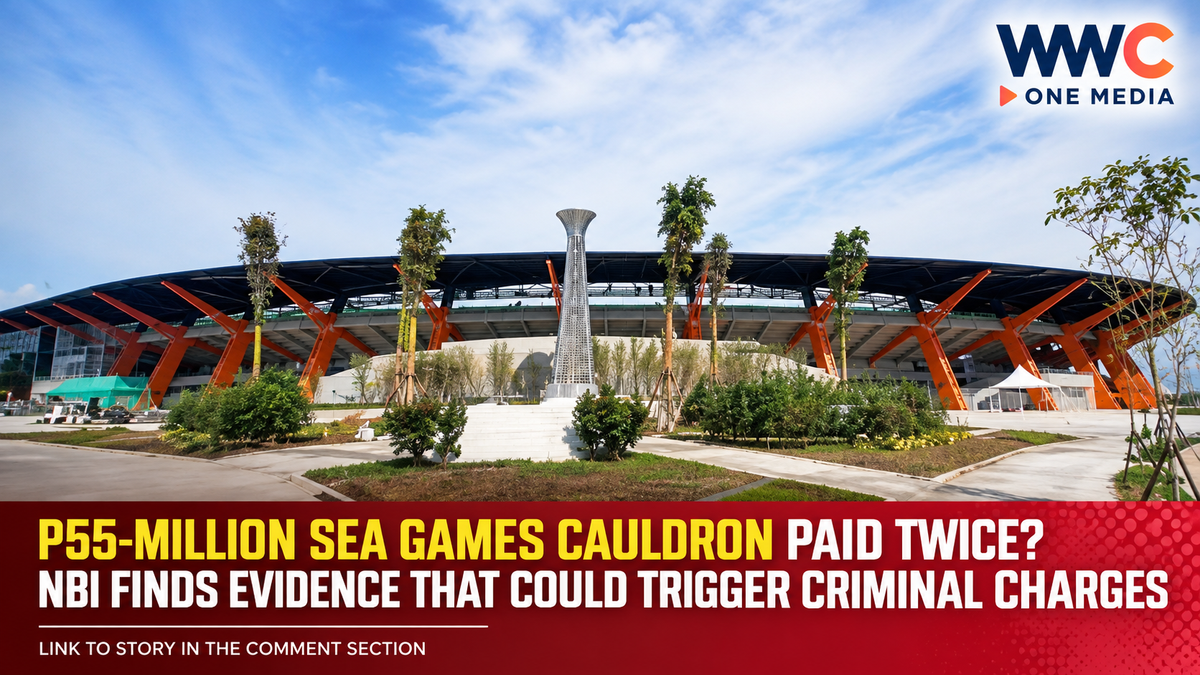
MANILA, Philippines — A six-year-old controversy surrounding the Philippines’ 2019 Southeast Asian Games has taken a dramatic new turn after the National Bureau of Investigation said it found evidence suggesting that the controversial SEA Games cauldron may have been paid for twice.
NBI Director Melvin Matibag said Wednesday that investigators uncovered documents indicating what appeared to be duplicate payments connected to the cauldron installed at New Clark City in Tarlac.
The development adds another layer to the long-running controversy over the structure, which was declared to have cost P55 million. Matibag now says investigators believe the project should have cost only about P30 million, although the NBI stressed that it is still examining the underlying transactions and documents.
NBI: Evidence points to possible duplicate payment
Speaking to DZBB, Matibag said two additional witnesses recently provided testimony and evidence that strengthened the bureau’s investigation.
According to the NBI chief, investigators found an entry in an undisclosed document that appeared to show the transaction being made twice.
“We saw what appeared to be double payments,” Matibag said, according to GMA News.
But investigators are not yet treating the finding as the final word.
Matibag said the documents must still be carefully reviewed and cross-checked against the evidence previously gathered before the NBI proceeds with charges. The bureau had initially hoped to begin filing cases this week, but the newly surfaced evidence prompted investigators to examine the transactions more closely.
That distinction is important: the NBI is reporting an apparent double payment, not a final judicial finding of fraud or corruption.
Why the cauldron has been under scrutiny for years
The cauldron became one of the most recognizable symbols of the 2019 SEA Games hosted by the Philippines — and one of the most controversial expenses associated with the event.
Earlier NBI findings placed its declared cost at P55 million, while Matibag recently said investigators believe its actual cost should have been considerably lower.
The latest allegation comes after the NBI also discovered that the P55-million cauldron project had been contracted to different contractors, further prompting investigators to examine how the project was structured and paid for.
The issue is now part of a much larger NBI investigation into alleged financial and procurement irregularities involving the Philippine Southeast Asian Games Organizing Committee (PHISGOC).
The investigation goes beyond the cauldron
The NBI began expanding its investigation after receiving what Matibag described as new information and documents concerning PHISGOC.
In July, the bureau announced plans to establish a task force to examine alleged anomalies involving SEA Games bidding, funding and unliquidated funds. The investigation includes coordination with the Commission on Audit and the Securities and Exchange Commission.
The NBI has also said PHISGOC received approximately P6.7 billion in government funds, including money from the Philippine Sports Commission, Philippine Olympic Committee and Department of Budget and Management. When private-sector funding is included, Matibag said the total resources handled by the organizing committee could exceed P10 billion.
Five PHISGOC board members being considered for charges
The cauldron investigation is also moving toward possible criminal complaints.
The NBI has said it is considering charges against five PHISGOC board members in connection with the cauldron transaction. Investigators are looking into possible violations of the Anti-Graft and Corrupt Practices Act, as well as the possibility of a plunder case, depending on the evidence and witness testimony.
Matibag said the number of respondents could still change as investigators complete their interviews and documentary review.
The NBI has also raised questions about the role of then-PHISGOC chairman Alan Peter Cayetano. Inquirer reported that Matibag said Cayetano could potentially be included in the case recommendation, although the NBI director did not specify what charges might ultimately be filed against him.
Cayetano was not initially among the five board members being considered because, according to Matibag, he was not formally listed as a member of the board. However, investigators are examining documents and testimony concerning his claimed role in PHISGOC.
What about the New Clark City sports complex?
The cauldron controversy should not be confused with the separate investigation into the construction of the New Clark City sports facilities.
The NBI has said its current focus concerning the cauldron is primarily on PHISGOC-related facilities and transactions, because PHISGOC received funding from several government-linked sources.
The broader SEA Games investigation, however, has also raised questions about the financing and procurement of the New Clark City sports complex.
GMA previously reported that the Commission on Audit had questioned aspects of the arrangement used to build the sports facilities, including additional costs associated with the project. The Ombudsman had also previously filed charges involving former BCDA president Vince Dizon and other officials, but the Ombudsman later said the case against Dizon was dismissed in 2021 for insufficient evidence.
Dizon has said he is willing to cooperate with investigators and has maintained that he has a clear conscience regarding the allegations.
The bigger question now: Where did the money go?
The latest finding could significantly change the direction of the cauldron investigation.
If the NBI’s documentary evidence ultimately confirms that the same project was paid for twice, investigators will have to determine who authorized the payments, which entities received the funds, why duplicate payments were made, and whether public money was improperly released.
For now, those questions remain under investigation.
The NBI has emphasized that it still needs to cross-check the new evidence before making final recommendations.
What began in 2019 as controversy over an unusually expensive SEA Games cauldron has therefore evolved into a much wider examination of public funds, procurement and the financial operations of the country’s SEA Games organizing committee.
And with new witnesses, additional documents and possible criminal complaints now on the table, the P55-million cauldron may be only the first piece of a much larger SEA Games financial investigation.