
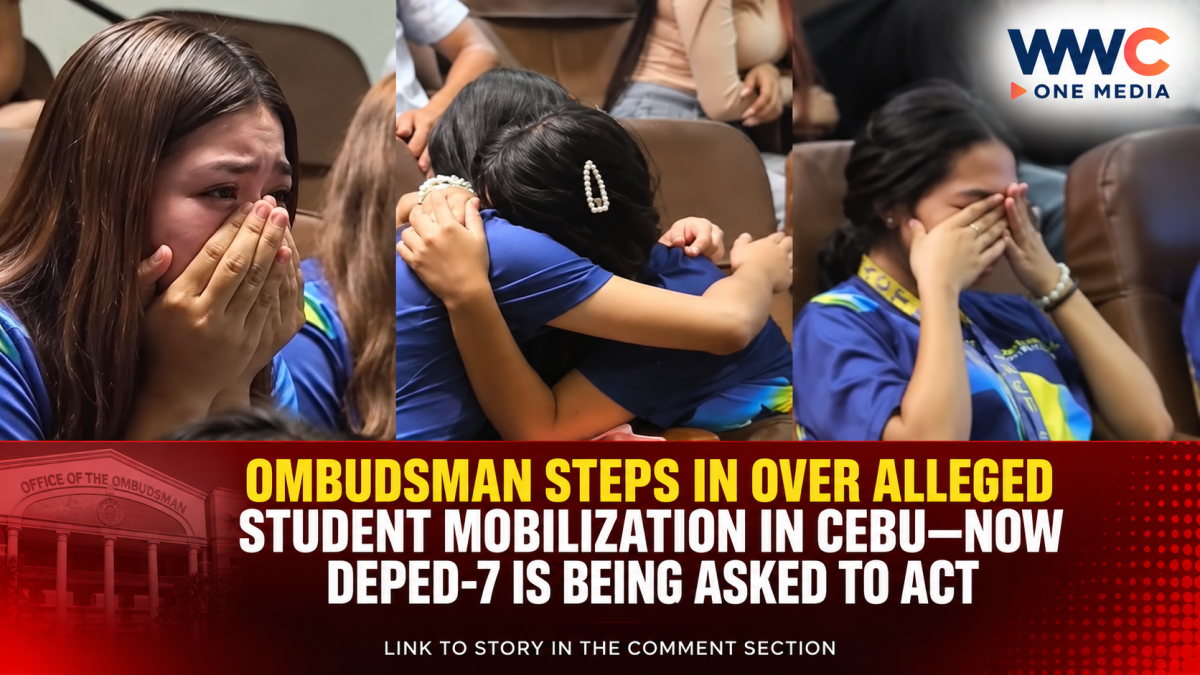
CEBU CITY — The Office of the Ombudsman-Visayas is pressing the Department of Education in Central Visayas (DepEd-7) to take action on a fact-finding request involving the alleged mobilization of students to a Cebu City Council session—an issue that has raised questions about student protection, parental consent and the use of minors in a politically sensitive setting.
The controversy stems from an April 14, 2026 incident at Cebu City Hall, when buses carrying senior high school students arrived while the City Council was deliberating a proposed partnership that would have allowed the Asian College of Technology International Educational Foundation (ACTIEF) Pit-os Campus to participate in Cebu City’s scholarship program.
According to earlier reports, some students said they had been told they were attending a scholarship orientation but were instead brought to the council session. Cebu City Councilor Mikel Rama subsequently sought a multi-agency fact-finding investigation into the circumstances surrounding their presence at City Hall.
The Ombudsman-Visayas has now asked DepEd-7 to act on the matter, placing renewed attention on whether proper safeguards were followed when students were brought to the activity.
What happened at Cebu City Hall?
The students’ appearance coincided with the council’s deliberation on the proposed accreditation of ACTIEF’s Pit-os campus under the city’s scholarship program.
The proposal was ultimately rejected by an 8-7 vote.
The dispute was not simply about the students’ scholarship access. Council members also raised questions about documentation and possible conflict-of-interest concerns because ACTIEF is owned by the family of Councilor Jose Lorenzo Abellanosa.
Following the vote, reports said some students became emotional over the rejection, highlighting the practical difficulties faced by learners from Cebu’s mountain barangays who would have to travel farther to attend other schools.
Why the student mobilization is now under scrutiny
Rama’s earlier resolution questioned whether the students had been properly informed about the purpose of their trip to City Hall and whether the required safeguards for minors had been observed.
The resolution called for fact-finding by several agencies, including the National Bureau of Investigation, Philippine National Police, DepEd and the Office of the Ombudsman. It also raised concerns over photographs or videos of students allegedly being posted online without appropriate consent.
The Freeman reported that the Cebu City Council unanimously approved the resolution seeking investigations into possible issues involving child protection, data privacy and anti-graft rules. It also asked the DepEd Cebu City Schools Division to examine compliance with regulations governing off-campus activities.
Importantly, these are allegations and matters for investigation, not findings that the students were unlawfully exploited or that any specific individual committed a violation.
ACT scholarship dispute adds another layer
The student-mobilization controversy emerged amid a separate dispute over ACTIEF’s bid to join the Cebu City scholarship program.
The proposed agreement would have allowed the city to provide scholarship assistance to students enrolled at ACTIEF’s Pit-os campus. Supporters argued that the school’s location would make higher education more accessible to students from upland communities who face long commutes and transportation costs.
Opponents, however, pointed to documentation issues and possible conflict-of-interest concerns involving the school’s ownership. The council eventually rejected the proposed partnership in the close 8-7 vote.
Cebu City Mayor Nestor Archival later said the issue could still be revisited, arguing that students from the mountain barangays should not be the ones to suffer because of the controversy. Banat reported that Archival intended to pursue the accreditation issue again, while acknowledging the importance of keeping higher education accessible to upland students.
The bigger question: Were students properly protected?
The controversy now goes beyond the scholarship dispute.
At the center of the Ombudsman and DepEd inquiry is whether proper procedures were followed in bringing minors to a legislative proceeding and whether students and their parents were adequately informed about the nature of the activity.
The issue is particularly sensitive because DepEd’s policies place learners at the center of school governance and require schools and stakeholders to observe safeguards in activities involving students. DepEd’s anti-corruption framework also provides mechanisms for addressing allegations involving personnel and government operations.
The Data Privacy Act concerns raised by the council also underscore the need for caution when photographs or other personal information involving minors are recorded and published.
However, whether any law or regulation was actually violated remains a matter for the appropriate investigating agencies to determine.
What happens next?
With the Ombudsman-Visayas now asking DepEd-7 to act, attention shifts to the education agency’s response and the findings of any fact-finding inquiry.
Investigators may need to determine who organized the students’ trip, what the students and their parents were told beforehand, whether the activity received the required school authorization, and whether any government personnel participated in or facilitated the mobilization.
The inquiry could also help establish whether the students were simply attending an educational or scholarship-related activity—or whether they were brought into a political or legislative dispute without fully understanding why they were there.
For Cebu, the case has become a wider test of how government institutions balance students’ right to access education with the obligation to protect minors from being drawn into political controversies.
And as the Ombudsman asks DepEd-7 to move on the probe, the next question is no longer simply why the students were at City Hall—but who authorized their presence, what they were told before they arrived, and whether every safeguard meant to protect them was followed.
WWC ONE MEDIA J.M.S




Leave a Reply