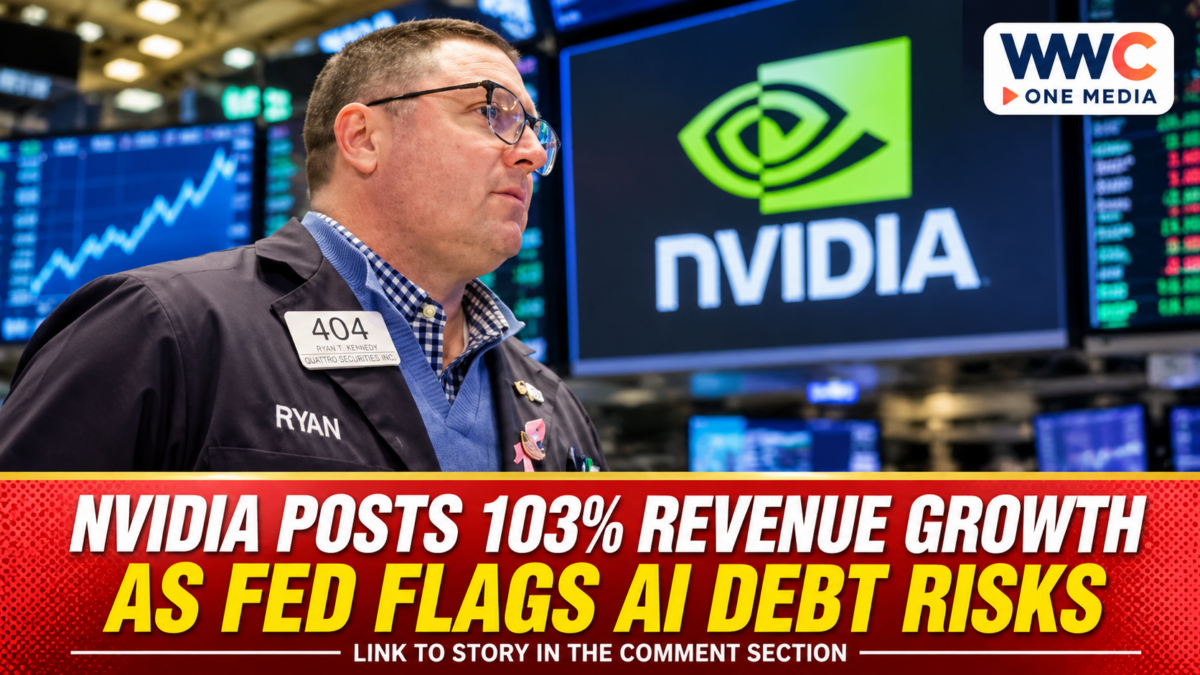
Nvidia reported US$115.8 billion in third-quarter fiscal 2027 revenue, more than doubling its sales from a year earlier, as Wall Street weighed the chipmaker’s results against growing concerns about the financial risks surrounding artificial intelligence investment. The Federal Reserve’s latest meeting minutes, released on Nov. 18, also revealed that policymakers had discussed how rapidly expanding AI-related debt could amplify losses if expected returns fail to materialise.
The contrast puts the Nvidia earnings story into a wider financial context. Strong demand for AI computing is producing extraordinary revenue for major technology suppliers, but the infrastructure supporting that growth increasingly relies on complex financing arrangements, large capital commitments and expectations of future profitability.
US stocks finished mixed on Nov. 18. The S&P 500 and Dow Jones Industrial Average declined, while the Nasdaq Composite closed higher. The different performances underline how investors can remain interested in technology growth while reassessing risks elsewhere in the market. FRED+2
Nvidia earnings show the scale of AI computing demand
Nvidia’s results for the quarter ended Oct. 25 showed revenue of US$115.8 billion, an increase of 103% from the same period a year earlier and 20% from the preceding quarter.
Its data-centre business generated US$107.6 billion, up 110% year on year. That segment includes the computing platforms and related products used in large-scale AI infrastructure and other data-centre operations. NVIDIA Investor Relations
The company reported GAAP net income of US$65.3 billion and diluted earnings per share of US$2.70. Its non-GAAP diluted earnings per share came to US$2.68. These are separate accounting measures and should not be treated as interchangeable. NVIDIA Investor Relations
Nvidia also reported that it had begun shipping its Vera Rubin NVL72 platform. The company identified several cloud and technology partners involved in deploying or preparing infrastructure using its products.
The figures show that demand for AI computing is translating into substantial sales for Nvidia. However, revenue growth alone does not establish whether every company investing in AI infrastructure will earn an adequate return.
That distinction is increasingly important as spending spreads across processors, data centres, electricity supply, cooling systems and supporting networks.
The Federal Reserve identifies risks beyond stock prices
The Federal Reserve’s Oct. 27–28 meeting minutes contain a detailed financial-stability discussion about the expansion of AI investment.
Staff highlighted the rapid growth of debt connected to the AI buildout. The assessment also pointed to off-balance-sheet leasing commitments and circular financing arrangements among AI-related companies as possible ways losses could become larger if investment returns disappoint. Monetary Policy:
Almost all participants discussed risks associated with a scenario in which AI investment returns fell short of investor expectations. Many also considered the potential consequences of an AI-related repricing of assets.
Most participants observed that AI-related debt had grown rapidly, with much of that growth taking place through complex and opaque financing structures. A few also noted that AI-related exposures were becoming increasingly concentrated among a small number of firms. Monetary Policy:
In plain language, the concern is that the AI boom is not financed only through the cash generated by established technology businesses. Some projects and companies are also connected through borrowing, leases and other financial arrangements.
If expected returns weaken, the pressure could extend beyond the company whose investment disappoints. Lenders, investors and other businesses connected to the same financing structures could also face losses.
WWC previously examined the broader financial-stability debate in its coverage of the Federal Reserve’s warning about debt and risks linked to AI infrastructure investment. The newly released minutes add an important detail: these concerns were part of a formal committee discussion, not simply an individual market commentator’s warning.
The Fed did not declare an AI financial crisis
The minutes also contain a qualification that should not be overlooked.
The staff assessment said the financial system remained resilient, with banks well-capitalised and able to withstand losses under the severe scenarios considered. It nevertheless identified elevated asset valuations and hedge-fund leverage as particularly important vulnerabilities. Monetary Policy:
That is a risk assessment, not a forecast that a financial crisis is imminent.
The distinction matters because financial-stability reports examine what could happen under adverse conditions. They do not necessarily predict that those conditions will occur.
The Fed discussion also identified possible channels through which market stress could spread. Hedge-fund leverage, limited dealer intermediation capacity and indirect bank exposure through non-bank financial institutions were among the areas participants said warranted attention. Monetary Policy:
For readers, the practical message is that AI investment risk cannot be assessed by looking only at the share price or quarterly sales of one major technology company.
The financing behind the wider infrastructure buildout is also relevant.
Wall Street finishes with different signals from major indexes
The Nov. 18 closing figures showed a divided market.
The S&P 500 finished at 7,323.63, compared with 7,340.53 in the previous session. The Dow Jones Industrial Average closed at 50,198.17, down from 50,759.42. The Nasdaq Composite ended at 24,429.88. FRED+2
The Nasdaq’s higher closing level, alongside declines in the other two indexes, illustrates why a single description of the entire market can be misleading. Different groups of listed companies can respond differently to the same economic and corporate developments.
Nvidia’s earnings were one major event investors had to assess. The Fed minutes were another. But the available records do not establish that either event alone caused the movements in the indexes.
WWC has also followed the run-up to Nvidia’s results in its report on the market’s expectations ahead of major AI company earnings. The latest results now provide concrete revenue figures against which those broader AI expectations can be evaluated.
Nvidia’s next-quarter forecast raises the stakes
Nvidia expects fourth-quarter fiscal 2027 revenue of US$130 billion, plus or minus 3%. The company also said its outlook does not assume any data-centre compute revenue from China. NVIDIA Investor Relations
That guidance gives investors another measure to assess when the company reports its next results. It also shows that Nvidia expects substantial revenue growth to continue, although forecasts remain subject to business conditions and execution.
The company’s gross-margin outlook is also worth watching. Nvidia expects GAAP and non-GAAP gross margins of between 71% and 72% in the fourth quarter, below the third-quarter reported levels of 74.8% and 74.9%, respectively. NVIDIA Investor Relations
Margins matter because revenue growth does not automatically translate into the same rate of profit growth. Costs, product mix, operating expenses and investment requirements all affect how much revenue becomes earnings.
For context, WWC has previously covered the debate over whether AI stock valuations can withstand higher financing costs. Nvidia’s forecast and the Fed’s financial-stability assessment now put two sides of that debate into sharper focus: the commercial opportunity and the financial commitments required to support it.
What happens next
The next test will come from whether Nvidia can deliver its fourth-quarter revenue outlook and maintain demand for its data-centre products. Investors will also continue assessing the profitability of AI infrastructure spending across the wider technology industry.
For the Federal Reserve, the minutes show that financial-stability vulnerabilities remain an area of attention. They do not announce a new AI-specific policy measure or establish that the central bank intends to intervene in technology markets.
The broader issue is whether the revenue generated by AI products and services can justify the scale of investment and financing now supporting the sector.
Nvidia’s latest figures show that demand is substantial. The Fed’s discussion shows why strong sales at a leading supplier do not, by themselves, settle questions about the financial resilience of the entire AI investment ecosystem.
Frequently asked questions
How much revenue did Nvidia report for its third quarter of fiscal 2027?
Nvidia reported US$115.8 billion in revenue for the quarter ended Oct. 25, 2026, up 103% from a year earlier. NVIDIA Investor Relations
What did the Federal Reserve warn about AI investment?
The Fed’s meeting minutes highlighted rapidly growing AI-related debt, complex financing structures, off-balance-sheet leasing commitments and the possibility of losses if investment returns disappoint. Monetary Policy:
Did the Federal Reserve predict an AI stock market crash?
No. The minutes discuss financial-stability vulnerabilities and possible adverse scenarios. They also say the financial system remained resilient and banks were well-capitalised. Monetary Policy:
What was Nvidia’s revenue forecast for its next quarter?
Nvidia forecast fourth-quarter fiscal 2027 revenue of US$130 billion, plus or minus 3%. NVIDIA Investor Relations
Did Wall Street finish higher on Nov. 18?
The market was mixed. The S&P 500 and Dow Jones Industrial Average closed lower, while the Nasdaq Composite ended at 24,429.88