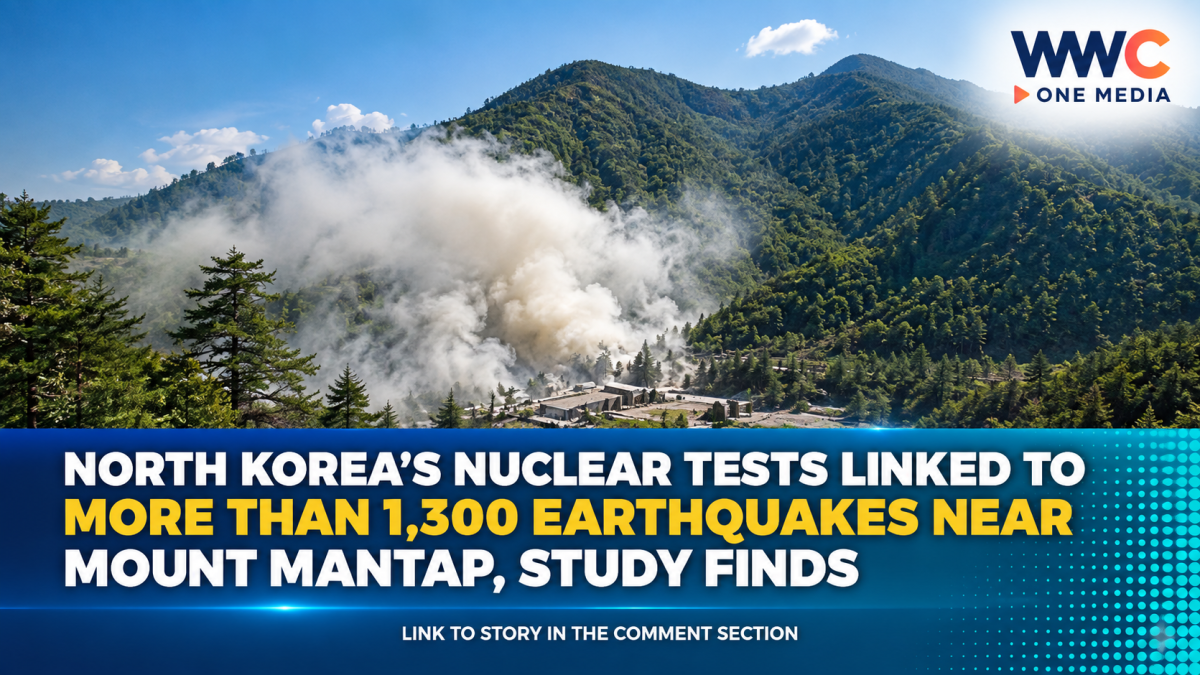
SEOUL — North Korea’s underground nuclear tests appear to have reactivated previously dormant faults beneath Mount Mantap, triggering more than 1,300 earthquakes over the years following the country’s most powerful nuclear test in 2017, according to a new scientific study published in Science.
Researchers led by Pusan National University professor Kim Kwang-hee analyzed 17 years of seismic data from South Korea and northeastern China, covering the period from 2008 through May 2025. Their findings indicate that repeated underground explosions progressively damaged the shallow crust and altered stresses along existing faults.
The study provides new evidence that the geological consequences of underground nuclear testing can continue long after the explosions themselves have stopped.
More Than 1,300 Earthquakes Followed the 2017 Test
North Korea conducted six underground nuclear tests at the Punggye-ri complex between 2006 and 2017, with the final test being by far the most powerful.
Researchers found roughly 60 earthquakes in the area between the first test in 2006 and the sixth test in 2017. But seismic activity changed dramatically after the September 2017 explosion.
About 1,330 earthquakes were detected after the 2017 test, concentrated along two fault zones extending roughly 24 kilometers around Mount Mantap.
The activity also became stronger over time. Earlier earthquakes were generally around magnitude 1.0 to 1.3, while earthquakes exceeding magnitude 3 were recorded in 2023 and 2024.
The strongest earthquake identified in the study reached magnitude 3.4.
Why the 2017 Explosion Matters
The researchers believe repeated nuclear explosions gradually fractured and weakened rocks beneath Mount Mantap.
Those explosions also changed the distribution of underground stresses. As the surrounding rock adjusted after the blasts, existing faults that had previously been quiet could begin slipping.
This process is known as earthquake triggering or induced seismicity, although the researchers emphasize that the geological response can vary depending on local conditions.
Unlike ordinary earthquakes in Korea, which typically occur around 15 kilometers underground, most of the earthquakes detected around Mount Mantap were found within about 1 kilometer of the surface.
That shallow depth is one of the features that made the seismic pattern unusual.
Scientists Warn of a Potentially Larger Earthquake
The researchers estimate that the approximately 24-kilometer fault zone could theoretically generate an earthquake of up to magnitude 6.4 if the entire zone were to reactivate at once.
That is a modeling estimate, not a prediction that a magnitude-6.4 earthquake will occur.
The study does not establish that such an earthquake is imminent, and there is no indication in the research that a major earthquake is currently certain to happen.
Instead, the finding highlights why long-term monitoring of the area is important.
The Seismic Activity Has Lasted Far Longer Than Expected
Underground nuclear explosions can produce immediate seismic effects, including small earthquakes and collapses around underground tunnels.
Researchers have traditionally observed that much of this activity declines relatively quickly after a test.
The Mount Mantap data present a different pattern.
Following the 2017 test, seismic activity not only continued but became more concentrated along existing fault structures and increased in frequency and magnitude over subsequent years.
Researchers say this suggests that underground nuclear testing can produce geological effects that persist for years, depending on the characteristics of the surrounding rock and existing faults.
Mount Mantap Was Already Heavily Damaged
The 2017 nuclear test was so powerful that it caused significant structural damage to Mount Mantap.
Scientific American described the mountain as a heavily fractured nuclear-test environment, with the blast causing the summit area to collapse. The geological damage has also raised questions about whether the site can safely contain future underground explosions.
North Korea has not publicly provided enough information to independently assess the full condition of the Punggye-ri complex.
The country’s nuclear program remains highly secretive, making outside monitoring particularly important.
Could the Activity Affect Mount Paektu?
The findings have also renewed scientific discussion about Mount Paektu, an active volcano located near the North Korea-China border.
Korea JoongAng Daily reported that some scientists have raised concerns about whether a sufficiently large earthquake in the region could influence the volcanic system. However, this remains a potential scenario rather than an established consequence of the study.
The new research itself primarily examines fault activation and earthquake activity around Mount Mantap.
It does not establish that North Korea’s nuclear tests will trigger a Mount Paektu eruption.
That distinction is important because geological systems are complex, and a possible interaction between earthquakes and volcanic activity cannot be treated as a certainty.
Nuclear Tests Could Also Complicate Global Monitoring
The study has implications beyond earthquakes.
Scientists monitoring North Korea’s nuclear program rely heavily on seismic signals to distinguish underground nuclear explosions from natural earthquakes.
Persistent earthquake activity around a former test site could make that task more complicated.
Scientific American reported that the researchers warned that earthquakes occurring years after a nuclear detonation could make it harder to distinguish explosion-related seismic signals from naturally occurring tectonic events.
That means the geological legacy of the Punggye-ri tests could remain relevant to international monitoring even if no additional nuclear explosions occur there.
A Long-Term Warning From the Data
North Korea’s six nuclear tests ended in 2017, but the seismic record around Mount Mantap shows that the physical consequences did not end with the final explosion.
The new research suggests that fractures, stress changes and fault movement can continue evolving underground for years.
For scientists, the findings reinforce the need for sustained seismic monitoring around former nuclear-test sites.
For the region, the research adds another dimension to the consequences of North Korea’s nuclear program: beyond the immediate blast and geopolitical risks, underground testing can leave a long-lasting geological footprint.
The study does not predict an imminent disaster.
But with more than 1,300 earthquakes recorded after the 2017 test and evidence of progressively stronger seismic activity, Mount Mantap remains a site that scientists say warrants close and continued observation.