
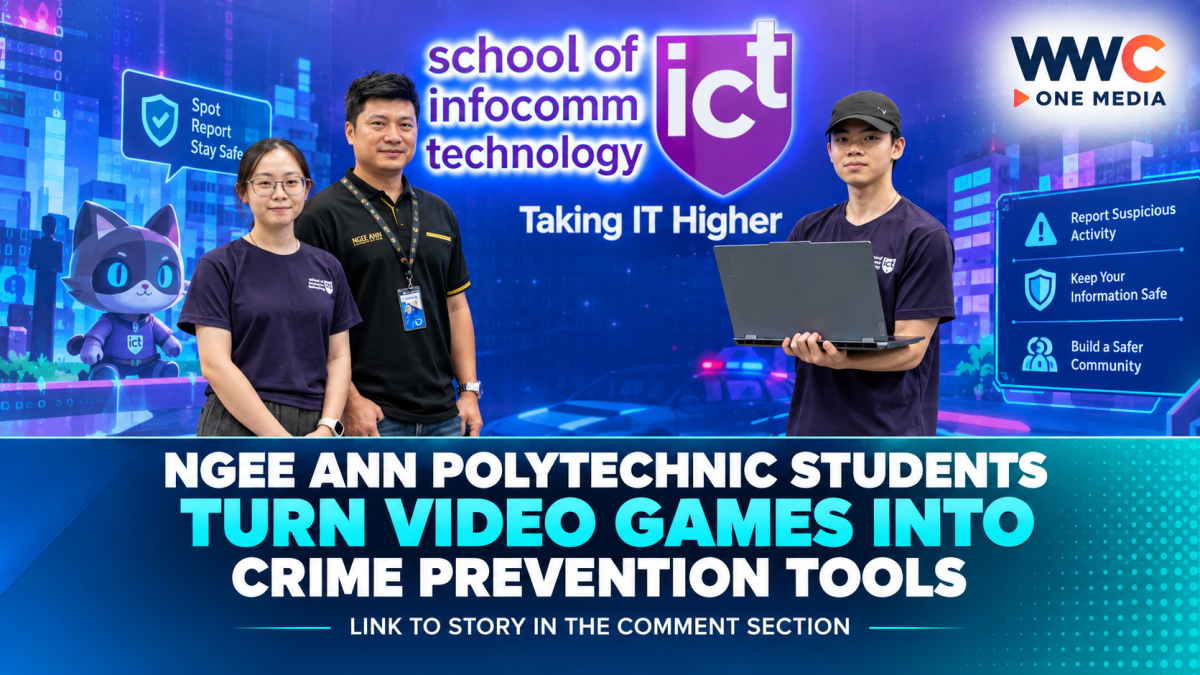
A group of Ngee Ann Polytechnic students is using video games for something far beyond entertainment: teaching the public how to prevent crime.
About 50 students from the polytechnic’s School of InfoComm Technology took part in a four-week game development project this year, creating interactive games based on real-world crime prevention scenarios.
The project was introduced through the Delta Challenge, a youth initiative that encourages young people to use creative ideas to raise awareness about crime prevention.
Students turn real-world risks into gameplay
Rather than simply designing games for entertainment, students were asked to build scenarios around issues such as scams, road safety and other forms of crime prevention.
Players encounter situations where they must follow rules or make decisions to progress through the game.
When players make mistakes, educational prompts appear to explain what went wrong and reinforce the relevant safety lesson.
The students hope this approach can make crime prevention messages more engaging, particularly for younger audiences who are already familiar with gaming and digital media.
Second-year student Low Jia Shen, 18, said the project allowed students to gain experience beyond conventional game development by working with real-world issues.
For fellow student Lam Thong Wan, 21, the project was also an opportunity to research topics such as vaping and road safety while learning how those risks could be prevented.
Delta Challenge encourages youth involvement
The Delta Challenge was launched in 2025 by the Singapore Police Force and the National Crime Prevention Council.
The initiative encourages young people to develop creative projects centred on different crime prevention themes.
Participants can submit projects including online games and digital artworks, with cash prizes of up to $25,000 available.
The programme is designed to move young people beyond simply receiving crime prevention messages and give them an active role in developing ways to communicate those messages to the wider community.
Assistant Superintendent of Police Siti Noraini Binte Shafiee Aloweni said the challenge gives youths an opportunity to contribute directly to community safety.
She highlighted educational games and digital artwork as examples of how crime prevention information can be presented in formats that are more relatable to young people.
Ngee Ann Polytechnic takes the idea into its curriculum
While elements of the Delta Challenge have been incorporated into programmes at several institutes of higher learning, Ngee Ann Polytechnic is currently the only school to have fully integrated the initiative into its curriculum.
The effort was introduced by Professor Ryan Qin, a lead lecturer in the School of InfoComm Technology.
Qin decided to make the challenge a permanent part of students’ coursework because he wanted them to explore how new media could be used for purposes beyond entertainment and classroom assignments.
The project also gives students an opportunity to work on issues that directly affect young people and their communities.
Games teach consequences through interaction
One of the project’s key ideas is to make players experience the consequences of their choices rather than simply reading about crime prevention.
A player who makes an unsafe or unlawful decision can encounter an explanation of what went wrong before continuing.
This turns a conventional game mechanic into an educational tool.
Instead of presenting crime prevention as a list of rules, the students’ approach allows players to learn through decisions, mistakes and consequences.
That could make difficult topics easier to understand and remember, particularly among audiences who may be more accustomed to learning through digital platforms.
Student games are not yet publicly available
Despite being designed for members of the public, the games created by the students are not currently available on gaming platforms.
They could eventually be released if sponsorship is secured.
For now, the projects remain examples of how game development skills can be applied to real-world challenges.
The initiative also gives students practical experience in research, storytelling, programming and user engagement while exposing them to issues outside the traditional boundaries of game development.
A different role for gaming
The project reflects a broader shift in how digital entertainment can be used for education and public awareness.
Video games can place people inside simulated situations and allow them to see the consequences of their decisions immediately.
For crime prevention, that creates opportunities to teach everything from road safety to scam awareness in a format that feels less like a conventional lesson.
For the Ngee Ann Polytechnic students involved, the project has also demonstrated that their technical and creative skills can serve a wider purpose.
What began as a four-week classroom challenge has effectively turned gaming into a tool for community education — showing that a video game can be designed not only to entertain, but also to help people make safer decisions in the real world.




Leave a Reply