
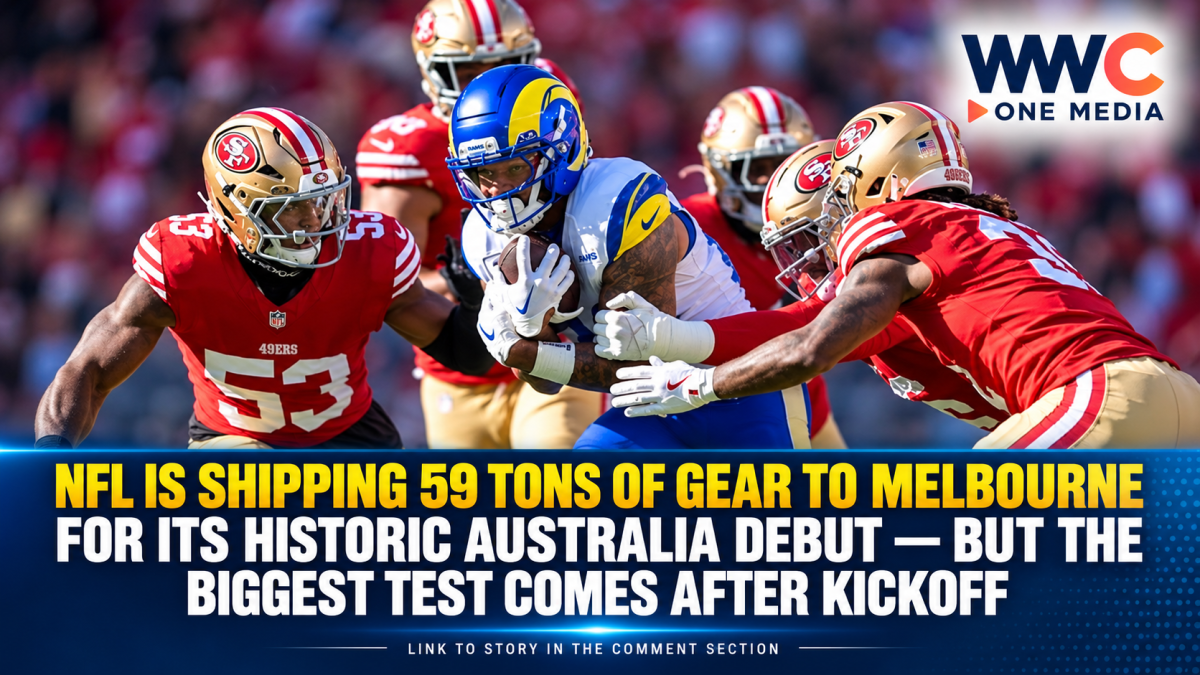
MELBOURNE — The NFL has staged Super Bowls, drafts and blockbuster games around the world.
But its next challenge may be one of its most ambitious yet.
When the Los Angeles Rams and San Francisco 49ers run onto the Melbourne Cricket Ground on September 11, American football will finally stage its first regular-season game in Australia—inside one of the world’s most famous sporting venues and nearly 8,000 miles from the teams’ home cities.
For the NFL, this is not simply another international game.
It is a test.
A test of logistics.
A test of player recovery.
A test of whether Australian curiosity can become lasting fandom.
And ultimately, a test of how far America’s richest sports league can expand beyond the market that made it a financial powerhouse.
Reuters reported that the NFL has spent almost two years planning the Melbourne operation, transforming the 100,000-seat MCG from an Australian-rules and cricket cathedral into a stadium capable of handling the league’s enormous operational demands.
The scale is remarkable.
The Rams and 49ers are expected to bring about 225 players and support staff each, travelling on Qantas A380 aircraft. Together, the teams will transport roughly 32 tons of cargo, while the NFL has separately shipped another 27 tons of equipment to Australia.
That is nearly 59 tons of equipment and team cargo for one regular-season football game.
And the league views every ton as part of a much bigger investment.
The MCG Has to Become an NFL Stadium Almost Overnight
The Melbourne Cricket Ground was not built for American football.
Its enormous oval surface comfortably accommodates cricket and Australian rules football, but an NFL game brings very different infrastructure requirements.
The NFL has been modifying locker-room areas, adding coaching facilities and adapting broadcast operations while the MCG remains in the middle of the Australian Football League’s finals season.
NFL global event operations chief Jon Barker told Reuters that crews regularly have to alter stadiums when the league travels internationally—sometimes changing plumbing, showers, toilets and team facilities so players receive roughly the same experience they would expect at home.
The Rams are technically the designated home team.
The NFL’s goal is therefore to make Melbourne feel as close as possible to an ordinary Rams home game at SoFi Stadium—except the journey to get there is anything but ordinary.
NFL.com calculates that Los Angeles will travel approximately 7,937 miles to Melbourne, the greatest city-to-city distance any team has travelled for a regular-season NFL game. San Francisco’s journey is only slightly shorter at about 7,872 miles.
That distance may become one of the biggest questions hanging over Australia’s NFL experiment.
A 14-Hour Flight Creates a Problem the NFL Cannot Ignore
Melbourne is roughly a 14-hour flight from the U.S. West Coast, and league executives have acknowledged that the travel makes playing Australian games later in the season difficult.
That is why the NFL is currently looking at Australia primarily as a Week 1 destination.
Starting the season there gives teams the offseason and preseason to prepare for the journey rather than inserting a trans-Pacific trip into the middle of a physically punishing regular-season schedule.
Even then, the competitive implications remain controversial.
49ers coach Kyle Shanahan previously questioned the benefit to his team because San Francisco does not receive an immediate bye after returning from Australia.
The clubs are also experimenting with very different preparation strategies.
San Francisco travelled to Australia well ahead of the game to acclimatize, and the team has already arrived in Melbourne after the long flight.
Reuters reported that the Rams planned a much later arrival, illustrating how teams are still figuring out the best way to handle the unprecedented trip.
If one team looks significantly fresher than the other on game day—or struggles badly the following week—it could influence how future Australian games are scheduled.
The NFL Wants Australia Every Year
Whatever the travel complications, NFL executives are already thinking beyond September 11.
The league’s agreement with the state of Victoria covers two confirmed games over four years, with an option for a third, and NFL International managing director Gerrit Meier has said the league would prefer to establish an annual Australian fixture.
That mirrors the NFL’s strategy in Britain.
Rather than treating international games as occasional exhibitions, the league increasingly wants permanent, recurring events capable of building local communities of fans.
Australia has moved quickly up the NFL’s priority list.
The league opened an Australia-New Zealand office in 2022 and later established an international academy on Queensland’s Gold Coast.
The Rams are also among the NFL franchises holding commercial marketing rights in Australia through the league’s Global Markets Program, alongside teams including the Raiders, Eagles and Seahawks.
The NFL now describes Australia as a strategic growth market, not simply an interesting experiment.
The League Claims 8.8 Million Australian Fans — But Even the NFL Admits Measuring Fandom Is Complicated
One number explains much of the league’s enthusiasm.
The NFL says Australia has roughly 8.8 million self-identified NFL fans, based on independent research cited by the league. That would represent nearly one-third of Australia’s population.
Other research offers some support for strong interest.
Reuters reported that a Deakin University survey ranked the NFL second only to England’s Premier League among non-Australian sporting competitions for local fan interest.
But there is an important caveat.
NFL executives themselves acknowledge that defining an international “fan” is difficult.
Someone who watches the Super Bowl once a year is not necessarily comparable to a supporter buying subscriptions, jerseys and tickets every season.
That conversion—from casual interest to committed consumer—is arguably the real business objective behind Melbourne.
NFL International chief Gerrit Meier has openly described a progression from general interest toward measurable engagement through subscriptions, merchandise consumption and media value.
That is why one sold-out stadium cannot by itself prove the Australian strategy has worked.
The real question is what fans do when the teams leave.
Nearly Half the Melbourne Crowd Is Expected to Travel
Early indicators suggest the event itself will be enormous.
The Victorian government says fans from more than 35 countries have purchased tickets and almost half the expected MCG crowd will come from outside Victoria or from overseas.
Reuters reported the NFL expects approximately 10,000 U.S.-based fans among the travelling audience.
Melbourne hotels are already benefiting.
Victoria says hotel occupancy in Melbourne’s central business district for game night is sharply higher, while officials expect restaurants, transport operators and tourism businesses to receive substantial additional spending.
Those estimates come from the Victorian government, which is financially invested in hosting the event, so they should be treated as promotional projections rather than independent evidence of the game’s final economic return.
The actual payoff will only become clear after visitors leave and spending data is measured.
Australia Opens the NFL’s Biggest International Season Ever
Melbourne also launches the most aggressive overseas schedule in NFL history.
The league will play a record nine international regular-season games across four continents and seven countries in 2026.
After Australia, NFL games are scheduled for locations including Rio de Janeiro, London, Paris, Madrid, Munich and Mexico City.
Before 2026, the league had staged 62 regular-season games outside the United States.
Melbourne, Rio and Paris are all new NFL host cities this season.
And the expansion may accelerate further.
NFL team owners have authorized as many as 10 international games per season beginning in 2027, although going beyond that number would require agreement with the NFL Players Association.
That makes Melbourne part of a broader transformation.
The NFL is no longer experimenting with whether international games can work.
It is trying to determine how many it can sustainably stage.
The NFL Says Its Next 50 Million Fans Are Overseas
Perhaps the clearest explanation for the international push came from Meier.
He told Reuters that the league believes its next 50 million fans will come from outside the United States.
That is an extraordinary ambition for a sport whose rules, equipment and playing traditions remain overwhelmingly American.
But the domestic NFL business is already enormous.
International expansion offers another route to television revenue, sponsorships, merchandise, streaming subscriptions and eventually new generations of supporters.
Australia appears particularly attractive because of its established sporting culture.
The country already supports Australian rules football, rugby league, rugby union, cricket, soccer, Formula One and Grand Slam tennis.
That creates opportunity—but also intense competition for people’s time and money.
The NFL therefore cannot simply arrive once, sell 100,000 tickets and declare victory.
Its challenge is creating habits.
Melbourne May Be the Easy Part
The MCG is expected to provide everything the NFL wants from its Australian debut: a huge crowd, an iconic setting, global television exposure and the spectacle of two major franchises playing a meaningful divisional game.
The Rams and 49ers are not playing an exhibition.
The result counts.
Both clubs were playoff teams last season, and they remain division rivals. NFL.com has described the matchup as one of the marquee games in the league’s 2026 international schedule.
That gives the Australian audience something previous overseas experiments sometimes lacked: genuine competitive stakes.
But the harder test begins after the final whistle.
Will viewers who tune in for the novelty still watch NFL games months later?
Will Australians buy subscriptions and merchandise?
Will teams willingly repeat a 14-hour flight?
Will players accept the recovery burden?
Will Melbourne’s AFL calendar continue to accommodate Week 1 NFL games?
And will the enormous logistical operation ultimately generate enough value to justify repeating it every year?
Those questions will determine whether September 11 becomes remembered as a spectacular one-off—or as the day the NFL truly established itself in Australia.
Getting two teams to Melbourne requires nearly 60 tons of gear, hundreds of staff and almost two years of planning. Getting Australia to keep watching after they leave may be the harder job.
WWC ONE MEDIA M.J.E




Leave a Reply