
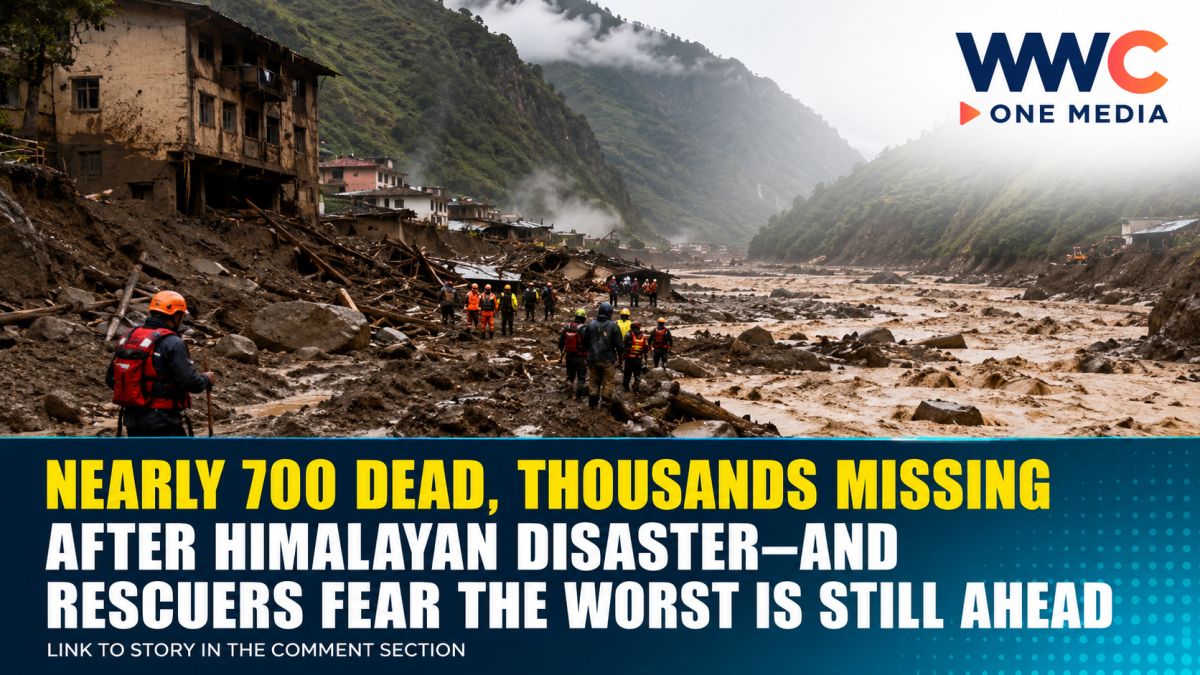
KATHMANDU/BEIJING — The death toll from the catastrophic Himalayan disaster along the Nepal-China border has climbed to nearly 700, while more than 3,000 people remain missing as rescuers battle treacherous terrain, damaged infrastructure and the growing fear that many victims may never be found.
Chinese authorities said Sunday that 16 people have been confirmed dead and 546 remain missing in Tibet’s Gyirong County, according to state media. Across the border in Nepal, authorities have reported 675 deaths and 2,498 people missing, bringing the combined confirmed death toll to 691 and the number of missing to more than 3,000, based on the latest figures reported by international news agencies.
The disaster was triggered on Aug. 26 after a glacier on the southern slope of Lirung Peak in Nepal fractured, unleashing an ice-rock avalanche that sent a destructive torrent of water, mud and debris through the Himalayan border region.
Foreign Nationals Among Hundreds Still Unaccounted For
The scale of the tragedy has become increasingly international.
Of the 546 people still missing on the Tibetan side, Chinese state broadcaster CCTV said 261 are foreign nationals, including 104 Nepalese, 49 Indians, 33 Latvians and 18 Americans. Chinese authorities said they had notified the relevant embassies and consulates as efforts to account for those missing continue.
The region is a major route for tourists and pilgrims travelling through the Himalayas, including those heading toward Mount Kailash, complicating efforts to establish exactly who was in the disaster zone when the flood struck.
Entire Communities Swept Away
Survivors have described a sudden and terrifying wall of mud, water and debris tearing through settlements with devastating force.
Homes, roads, bridges and hydropower facilities were swept away as floodwaters surged through narrow valleys. The destruction has also isolated communities and made it difficult for emergency crews to reach some of the hardest-hit areas. AP reported that more than 3,700 people have been rescued in Nepal, but the search continues for thousands whose whereabouts remain unknown.
At Nepal’s Trishuli 3A and 3B hydropower sites, rescuers have been racing to reach workers believed trapped inside tunnels filled or blocked by mud and debris. Nepal’s army recently managed to insert a pipe into one tunnel to provide air as excavation operations continued, raising hopes that some survivors could still be rescued.
Why So Many Are Still Missing
The huge gap between the confirmed death toll and the number of missing underscores the extraordinary challenge facing rescue teams.
Landslide and flood experts told CNA that victims may be buried beneath enormous volumes of debris or carried kilometres downstream, making recovery and identification extremely difficult. Some of those missing may never be located, meaning the final human toll could take considerable time to establish.
Bad weather, unstable slopes and damaged roads have further slowed search operations. Authorities have also monitored the risk posed by debris-blocked waterways and newly formed bodies of water upstream, which could potentially create additional flooding hazards.
A Humanitarian and Economic Crisis
The disaster has affected tens of thousands of people and dealt a severe blow to Nepal’s infrastructure and economy.
Nepal’s finance minister has estimated that reconstruction could cost between US$4 billion and US$5 billion, as floodwaters damaged communities, transportation networks and hydropower facilities. Reuters reported that the destruction could represent a major setback for an economy that depends heavily on tourism, remittances and hydropower.
China has sent emergency relief supplies to Nepal, including tents, blankets, food and medical necessities, as well as tunnel rescue specialists to support the response. Other countries and international partners have also offered assistance as the humanitarian operation expands.
The Search Is Far From Over
For now, families across Nepal, Tibet and countries around the world are waiting for answers.
Rescue teams continue to search through mud-covered valleys, damaged tunnels and isolated mountain communities. But with more than 3,000 people still unaccounted for, officials face an increasingly difficult question: how many survivors are still waiting to be found—and how many may be buried beneath the devastation?
As the search enters another critical phase, the Himalayan disaster stands as one of the region’s most devastating cross-border tragedies in recent years—and the final toll may still be far from known.
This is a developing story. Official casualty figures are expected to change as search, rescue and identification efforts continue.

Leave a Reply