
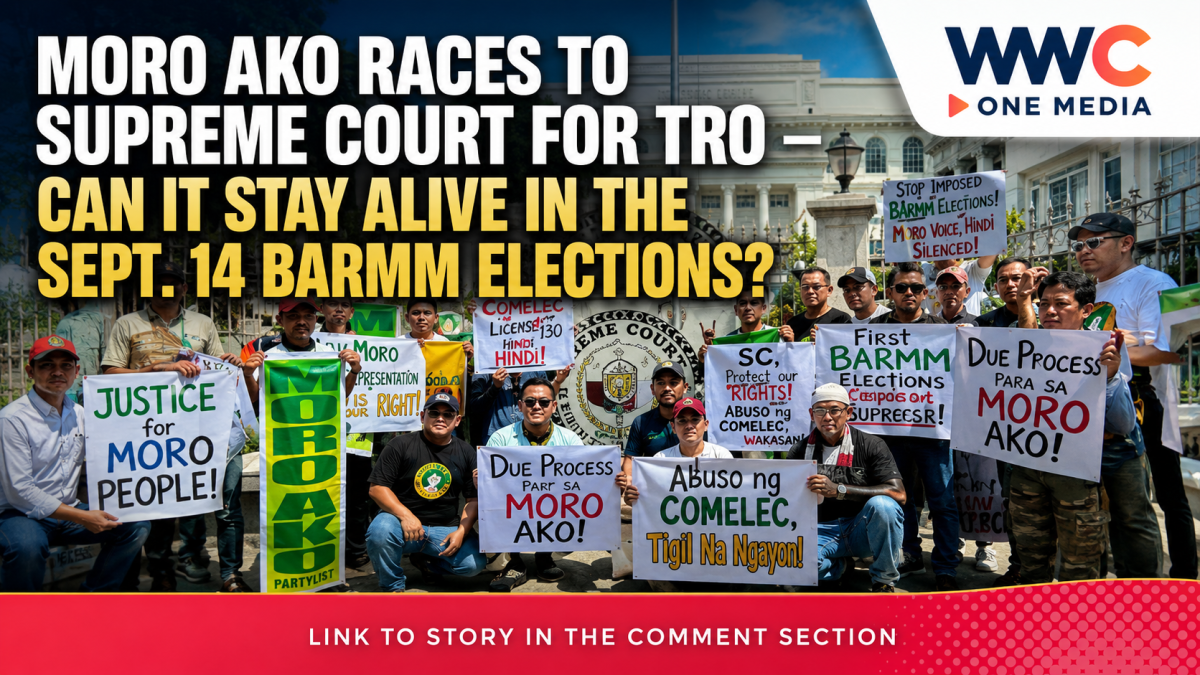
With the historic September 14 Bangsamoro parliamentary elections just days away, Moro Ako Party is taking its battle with the Commission on Elections to the Supreme Court—where emergency relief could determine whether votes cast for the party will ultimately count.
MANILA, Philippines — The legal battle over Moro Ako Party’s participation in the September 14, 2026 Bangsamoro parliamentary elections has moved to the Supreme Court after the Commission on Elections cancelled the regional party’s registration and rejected its bid to reverse the ruling.
Moro Ako has sought a temporary restraining order (TRO) against the Comelec decision, raising the stakes in an election that will choose the first regularly elected parliament of the Bangsamoro Autonomous Region in Muslim Mindanao.
The court challenge comes after the Comelec en banc upheld the cancellation of Moro Ako’s registration and accreditation as a Regional Parliamentary Political Party, or RPPP, following allegations that the organization made material misrepresentations in documents submitted as part of its accreditation.
The controversy could have an unusually direct effect on voters: Moro Ako’s name is still printed on the official BARMM ballot.
Comelec’s certified regional candidate list identifies Moro Ako as ballot number 8, while MindaNews reported that all 13 regional parliamentary parties originally included in the ballot layout remain printed there—including Moro Ako despite the subsequent cancellation of its accreditation.
That means the Supreme Court battle is no longer simply about whether the party can campaign. It could determine whether votes already available for voters to select will have legal effect.
Why Comelec Cancelled Moro Ako
The dispute began after Aladin Abdul filed a petition on May 5 seeking the cancellation of Moro Ako’s accreditation.
In an August 4 resolution, the Comelec en banc granted the petition.
The poll body said Moro Ako had made untruthful representations concerning the chapters it claimed to have established across BARMM. Under Comelec’s accreditation requirements, a regional parliamentary political party must demonstrate the required organizational presence across provinces, cities and municipalities in the autonomous region.
Comelec concluded that Moro Ako failed to comply with requirements under Sections 30 and 39 of Comelec Resolution No. 11203 and had made an inaccurate declaration that it had established chapters throughout the required areas.
Among the problems cited during the proceedings were allegedly non-existent or incorrectly identified chapters in Cotabato City and Lamitan City, as well as questions surrounding chapters in Maguindanao del Norte and Maguindanao del Sur.
Other records cited by local reporting showed apparent geographical inconsistencies, including a Lamitan chapter listed under Sulu and a Cotabato City chapter associated with Lanao del Norte, along with conflicting addresses attributed to some chapters in Maguindanao del Sur.
Moro Ako Says the Errors Were Typographical
Moro Ako challenged the findings.
The party argued that some of the disputed provincial designations were merely typographical errors, rather than deliberate attempts to deceive election authorities.
It also maintained that its local chapters existed and submitted supporting documents, including affidavits concerning the existence of chapters in Maguindanao del Norte and Maguindanao del Sur.
Comelec was unconvinced.
In rejecting Moro Ako’s motion for reconsideration, the commission described the typographical-error explanation as insufficient and upheld its finding of material misrepresentation.
The Comelec en banc’s resolution denying reconsideration was promulgated on August 27, leaving the Supreme Court as the party’s remaining avenue for immediate judicial relief before election day.
The Biggest Risk: Moro Ako Votes Could Become ‘Stray’
This is where the legal battle becomes particularly significant for voters.
Comelec Chairman George Erwin Garcia said on August 28 that if the commission’s ruling becomes final and there is no restraining order from the Supreme Court, votes cast for a candidate or regional parliamentary political party whose registration has been finally cancelled would be considered stray votes.
In other words, voters could still see Moro Ako on the ballot and shade the corresponding oval—but those votes may ultimately not be credited if the cancellation becomes final without judicial intervention.
That possibility explains why obtaining a TRO before the September 14 election is critical to Moro Ako.
The party had already signaled after losing its Comelec appeal that it intended to bring its case before the Supreme Court while continuing its campaign activities.
Moro Ako Continues to Make Its Case to BARMM Voters
Despite the legal uncertainty, Moro Ako has continued participating in election-related activities.
At the first BARMM political-party election debate, lawyer Najeeb Taib represented Moro Ako, telling voters that the organization seeks to represent ordinary Bangsamoro communities.
MindaNews reported that Taib also acknowledged the legal challenges confronting the party while maintaining its campaign message to voters.
The dispute therefore creates an extraordinary situation less than two weeks before voting: a regional party remains visible on the ballot and active on the campaign trail even though Comelec has cancelled its accreditation and denied reconsideration.
Why the Sept. 14 Election Matters
The September 14, 2026 election is a landmark political event for the Bangsamoro region.
Voters will choose representatives for an 80-member Bangsamoro Parliament, replacing the transition-era arrangement with the first parliament formed through regular regional elections.
Comelec has repeatedly said the elections will proceed on schedule.
For Moro Ako, however, the decisive battle may now take place not at a campaign rally but before the Supreme Court.
Its immediate objective is clear: stop the Comelec cancellation from taking full effect while the legal dispute is reviewed.
Without judicial relief, Comelec’s warning creates a potentially severe consequence—the party could remain visible on millions of printed ballots while votes cast for it risk being classified as stray once the cancellation becomes final.
With election day approaching, the question is no longer merely whether Moro Ako can overturn its disqualification.
The bigger question for BARMM voters is whether a vote for Moro Ako on September 14 will ultimately count.
WWC ONE MEDIA MJE




Leave a Reply