
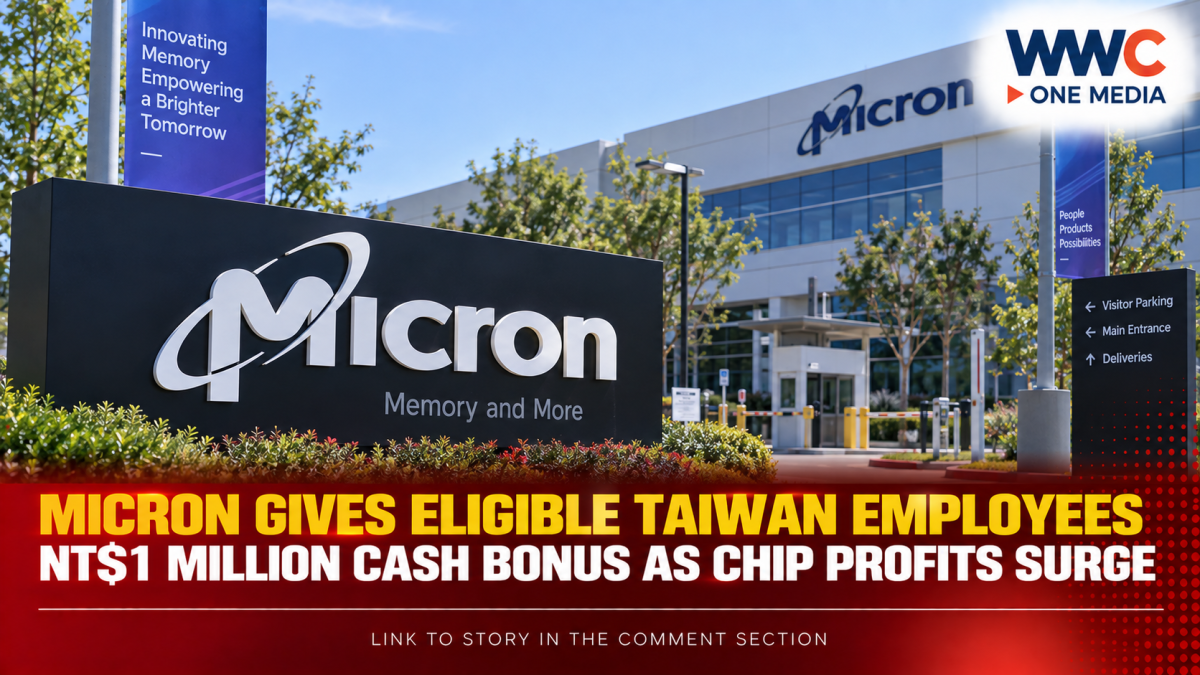
TAIPEI, Taiwan — U.S. memory-chip giant Micron Technology is rolling out its biggest employee reward package in company history, with eligible workers in Taiwan set to receive a NT$1 million (about US$31,600) cash appreciation bonus as the company rewards employees following a strong year for the memory-chip industry.
The announcement has put Micron’s Taiwan operations in the spotlight, with the company also offering performance bonuses and additional equity awards that could push total compensation for some production workers to the equivalent of 35 to 68 months of salary.
Who qualifies for the NT$1 million bonus?
Micron said Taiwan employees who joined the company on or before August 29, 2025 will receive the NT$1 million appreciation payment.
Employees who joined during Micron’s fiscal 2026 will receive the cash award on a pro-rated basis according to their time with the company.
The cash payment is only one component of the broader compensation package.
Micron said its Taiwan employees can also receive annual performance incentives worth as much as 500% of the original target, along with additional stock awards.
Taiwan production workers could receive up to 68 months of pay
The scale of the package is particularly striking for Micron’s production workforce in Taiwan.
According to Reuters and Taiwanese media reports, the combination of compensation and rewards for Taiwan-based direct labor employees is equivalent to approximately 35 to 68 months of salary, depending on the employee and applicable rewards.
Micron also said FY2026 cash compensation for its Taiwan employees starts at NT$1.7 million.
For entry-level engineers, average cash compensation is about NT$2.9 million, while the average total compensation rises to approximately NT$3.4 million when equity awards are included.
Why is Micron paying so much?
The announcement comes as the global memory-chip market benefits from strong demand associated with artificial intelligence and advanced computing.
Micron has been expanding its production capacity and investing heavily in high-value memory technologies, including products used in AI data centers.
The company said more than 60,000 employees worldwide will receive FY2026 rewards, making the overall package the largest in Micron’s history.
Taiwan is particularly important to Micron’s global manufacturing and technology operations. The company has approximately 15,000 employees in Taiwan and says its cumulative investment in the market has surpassed NT$1.6 trillion.
The bonus comes amid a Taiwan labor dispute
The unusually large reward package also arrives against the backdrop of a labor dispute involving Micron’s Taiwan workforce.
Reuters reported that unions representing roughly two-thirds of Micron’s 15,000 Taiwan employees have been pushing for a new bonus structure linked to company operating profit. Workers have argued that Taiwan employees should receive compensation more comparable with bonus systems used by major South Korean memory-chip rivals.
The union pressure has made compensation a major issue as Micron benefits from the current memory-chip boom.
Despite the new rewards, Reuters reported that Micron had not reached an agreement with the unions on their demands.
Taiwan becomes even more important to Micron’s global strategy
Micron’s decision underscores the strategic importance of Taiwan to the company’s semiconductor operations.
Taiwan is one of Micron’s major locations for DRAM manufacturing and technology development, while the company continues investing in local talent and production capacity.
For employees, the new package represents a significant financial reward. For Micron, however, it also highlights the intense competition for semiconductor talent at a time when companies worldwide are racing to expand AI-related chip production.
The bigger question is whether record compensation will be enough to ease tensions between Micron and its Taiwan workforce.
For now, the message from Micron is clear: as the memory-chip boom generates record opportunities, the company is putting more money on the table to retain the people producing the technology behind it.




Leave a Reply