
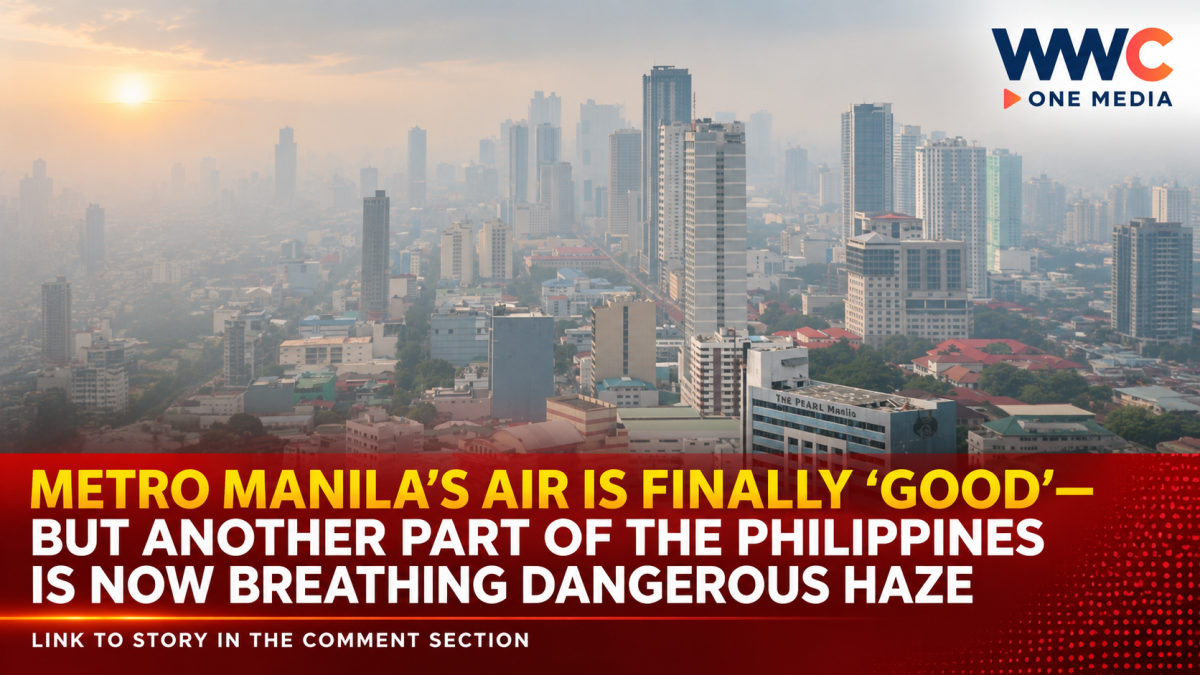
MANILA, Philippines — Metro Manila residents may finally have some breathing room.
After days of haze linked to forest and peat fires in Kalimantan, Indonesia, the air quality across monitored areas of Metro Manila was classified as “good” on Friday, September 5, according to the Department of Environment and Natural Resources–Environmental Management Bureau (DENR-EMB).
But the improvement in the capital comes as a warning elsewhere: several areas in the Visayas and Mindanao were still recording “acutely unhealthy” air quality, with authorities continuing to monitor the movement of smoke across the country.
Haze shifts toward the south
DENR-EMB monitoring showed that PM10 and PM2.5 levels in Metro Manila were in the “good” category as of Friday morning.
Meanwhile, Talisay City, Zamboanga City, Iligan City, Sta. Cruz in Misamis Oriental, and Koronadal City were among areas reporting “acutely unhealthy” air quality.
Other locations were also affected. Bacolod City and La Castellana in the Negros Island Region recorded “very unhealthy” levels, while Iloilo City, La Carlota City, Toledo City, Cagayan de Oro City and Butuan City were classified as “unhealthy for sensitive groups.”
The situation is connected to smoke from ongoing fires in Kalimantan, Indonesia, which has been carried toward the Philippines by prevailing winds.
Earlier monitoring showed that the haze had reached Metro Manila at significantly more dangerous levels. Several NCR locations recorded “very unhealthy” to “acutely unhealthy” conditions earlier in the week before conditions improved.
Why did Metro Manila improve?
The improvement was largely attributed to changing wind patterns.
GMA News reported that DENR-EMB observed substantially lower PM2.5 concentrations in Metro Manila beginning Wednesday, with 15 monitoring stations registering “good” air quality by Thursday noon. Officials said the smoke plume was being dispersed more toward the Visayas and Mindanao instead.
The Philippine Information Agency likewise reported that satellite observations showed the smoke plume from Indonesian fires being transported toward the Philippines by the southwest monsoon, or habagat.
Manila Observatory scientist Dr. Maria Obiminda Cambaliza explained that the situation can change depending on wind patterns, rainfall and the continued intensity of the fires in Indonesia.
That means the improvement in Metro Manila should not necessarily be interpreted as the end of the haze episode.
What makes PM2.5 dangerous?
The main concern is PM2.5, or fine particulate matter measuring 2.5 micrometers or smaller.
Because these particles are extremely small, they can penetrate deep into the respiratory system and may enter the bloodstream. Exposure can aggravate respiratory problems and pose greater risks to vulnerable groups.
The Department of Health previously advised residents to minimize prolonged outdoor activities during periods of poor air quality and recommended wearing an N95 mask when going outside. Children, older adults and people with respiratory or heart conditions were urged to take extra precautions.
The haze can cause symptoms such as coughing, breathing difficulty, chest discomfort and irritation of the eyes and nose, while potentially worsening existing respiratory conditions.
Not just an imported pollution problem
Although the current haze originated from fires in Indonesia, experts have also emphasized that Metro Manila already has significant local sources of air pollution, particularly vehicle emissions.
The additional smoke therefore creates an added pollution burden when it reaches the region, according to the Philippine Information Agency’s report on the government’s air-quality monitoring efforts.
For now, the latest readings provide welcome relief for Metro Manila—but conditions remain dynamic.
With smoke still affecting parts of the Visayas and Mindanao, and atmospheric conditions capable of changing quickly, authorities continue to urge the public to monitor official DENR-EMB advisories rather than relying solely on how clear or hazy the sky appears.
The capital may be breathing easier today. The bigger question is where the haze will move next.
WWC ONE MEDIA J.M.D




Leave a Reply