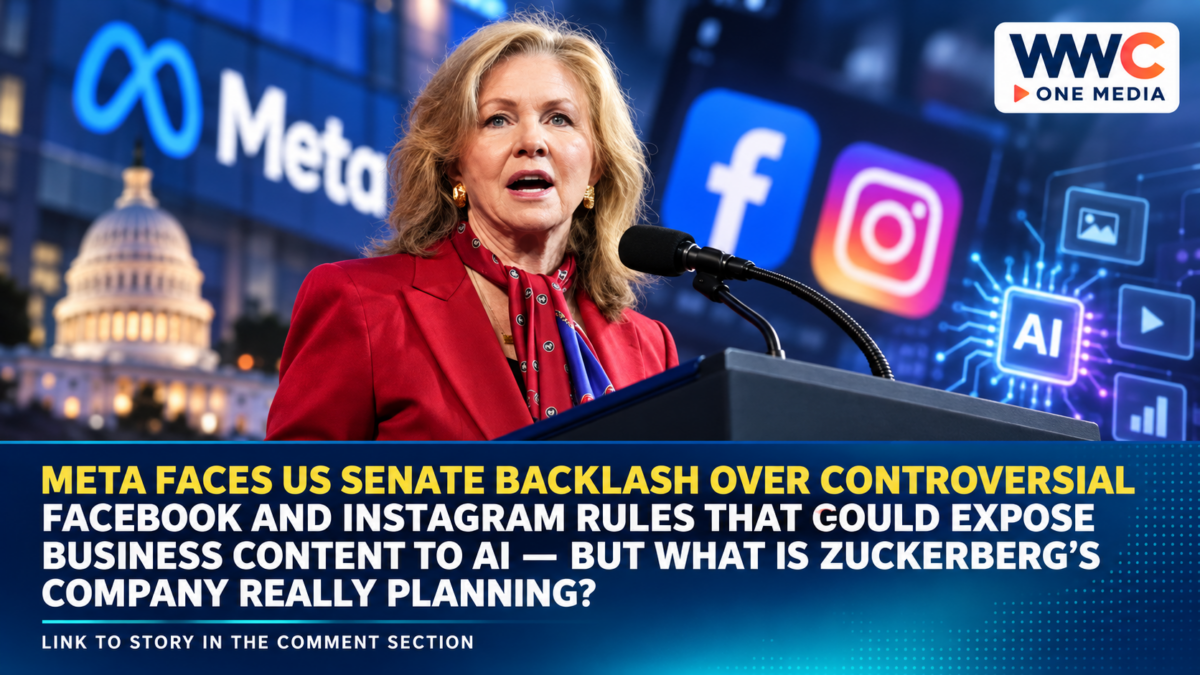
Washington, October 24, 2026 — Meta Platforms, the technology giant behind Facebook and Instagram, is facing mounting political and regulatory pressure after a senior United States senator warned that its proposed commercial terms could undermine the rights of American businesses, digital creators and news publishers.
The controversy has raised a potentially far-reaching question: Could businesses that depend on Facebook and Instagram for advertising and customer engagement inadvertently expose their website content to broader use by Meta, including possible artificial intelligence development?
Republican Senator Marsha Blackburn of Tennessee, who chairs the Senate Judiciary Subcommittee on Privacy, Technology and the Law, challenged Meta’s proposed changes on Friday, October 23, arguing that they could grant the company excessive control over content belonging to businesses using its platforms.
The warning came as Meta announced it would postpone the implementation of its revised commercial terms from October 30 to November 20, 2026, following objections from publishers, advertisers and industry organizations.
US senator warns Meta’s proposed rules could threaten businesses and creators
At the center of the dispute is the scope of Meta’s revised Commercial Terms and Self-Serve Ad Terms, which govern aspects of how businesses use its advertising and commercial services.
Blackburn argues that the updated language could allow Meta to collect information from external websites associated with Facebook and Instagram business accounts.
Her concern is that companies using Meta’s platforms to promote products, distribute articles or connect with customers could face uncertainty about how their website content might subsequently be used.
The senator also questioned whether Meta’s revisions provide sufficient protection for intellectual property.
Although Meta previously removed language explicitly referring to AI training, Blackburn said the remaining provisions still raise concerns about the collection and use of business content.
In particular, she argued that broad permissions relating to the development of Meta’s business products could potentially encompass AI-related applications unless clearer restrictions are introduced.
Blackburn called on the company to withdraw the proposed terms and negotiate stronger protections for content creators, publishers and small businesses.
Meta postpones controversial changes until November 20
Facing escalating criticism, Meta confirmed that its updated commercial terms would take effect on November 20 instead of October 30.
The company said the additional time would allow it to explain the revisions to businesses, advertisers and other stakeholders.
But Meta strongly rejected claims that the changes would automatically grant it unrestricted control over publishers’ material or permit unlimited AI training using business-owned content.
According to the company, the revised terms apply specifically to advertising and business products, rather than introducing a sweeping expansion of its web-crawling activities.
Meta also maintained that website operators would continue to be able to communicate crawling preferences through robots.txt, a widely used technical mechanism for giving instructions to automated web crawlers.
That distinction matters because the existence of broad contractual language does not, by itself, establish that Meta has begun collecting or training AI systems on the content in question.
The dispute remains centered on how the terms should be interpreted, what permissions they actually provide, and whether additional safeguards are necessary.
European and British regulators drawn into the growing dispute
The controversy has also crossed the Atlantic, with publishers and digital advertising groups approaching competition authorities in the European Union and United Kingdom.
The Movement for an Open Web, an organization representing interests in the digital advertising and publishing sectors, has urged regulators to intervene over concerns that the terms could unfairly disadvantage companies dependent on Meta’s platforms.
Critics contend that Meta’s commercial reach could place smaller businesses in a difficult negotiating position: accept the company’s contractual terms or potentially lose access to important advertising and audience-development tools.
The European Commission has received complaints, while Britain’s Competition and Markets Authority has engaged with Meta over the concerns.
The complaints do not establish that Meta has violated competition law. Any finding of unlawful conduct would require regulatory assessment and supporting evidence.
News publishers fear losing control of valuable digital content
For media organizations, the dispute represents another chapter in the growing conflict between artificial intelligence developers and copyright owners.
News publishers invest substantial resources in gathering information, producing journalism, managing archives and building original digital content.
As generative AI systems become more sophisticated, the potential commercial value of such material has increased.
Publishers fear that broad content-use permissions could allow technology companies to develop products that compete with the original publishers without providing adequate compensation.
The News/Media Alliance, a US publishing trade association, has separately pressed Meta to revise the disputed terms.
According to reporting by The Verge, the organization warned Meta chief executive Mark Zuckerberg that the changes could cause significant harm to publishers.
The European Publishers Council has likewise argued that operating a business page or promoting a publication through Meta should not automatically amount to granting unrestricted permission to use a publisher’s entire website or content archive.
These objections reflect a wider debate over whether existing contracts, copyright protections and technical controls are sufficient in an AI-driven digital economy.
What could the changes mean for small businesses in the Philippines and Asia?
Although the immediate political confrontation involves US lawmakers and European regulators, the controversy may also attract attention from businesses across Southeast Asia.
Companies in the Philippines, Singapore, Malaysia, Indonesia and elsewhere commonly use Facebook and Instagram for advertising, e-commerce promotion and customer acquisition.
For businesses operating their own websites, the dispute highlights the importance of understanding the relationship between platform agreements and independently owned digital content.
Potential concerns include website articles, photographs, product descriptions, promotional materials, customer-facing content and other intellectual property.
However, there is currently no verified finding that the proposed terms automatically authorize Meta to take ownership of such material or that the company has used these revised terms to train AI models on affected businesses’ websites.
Business owners should therefore distinguish between the concerns raised by critics and the narrower interpretation presented by Meta.
Reviewing commercial agreements, website-crawling settings and content licensing arrangements may help businesses assess their exposure.
The bigger battle: Who controls the content powering artificial intelligence?
The conflict comes as major technology companies invest heavily in artificial intelligence systems capable of generating text, images, summaries and other forms of digital output.
The rapid development of these technologies has intensified questions about who should control the underlying content used to build them.
Technology companies argue that automated collection and analysis of information can support innovation, while publishers and creators increasingly demand stronger licensing arrangements, transparency and compensation.
Meta’s proposed commercial terms have consequently become a flashpoint in a much larger debate about the relationship between dominant digital platforms and the businesses relying on them.
For regulators, the issue extends beyond copyright to include bargaining power, market competition and the obligations of companies operating essential advertising services.
For businesses and creators, the concern is more immediate: protecting commercially valuable content while maintaining access to the online platforms that help them reach customers.
What happens next?
Meta now has until November 20, 2026, under its announced timetable to address stakeholder concerns before the revised commercial terms are scheduled to take effect.
Blackburn has called for the company to withdraw the changes, while industry groups continue to press for stronger safeguards.
Whether Meta will introduce further amendments remains uncertain.
The ultimate significance of the dispute could depend on how regulators interpret the proposed contractual language and whether Meta can convince publishers and advertisers that their intellectual property remains protected.
For now, one question remains unresolved: Will Meta’s delayed policy update strengthen protections for businesses and creators, or will it intensify the global struggle over who gets to control the content feeding the next generation of artificial intelligence?