
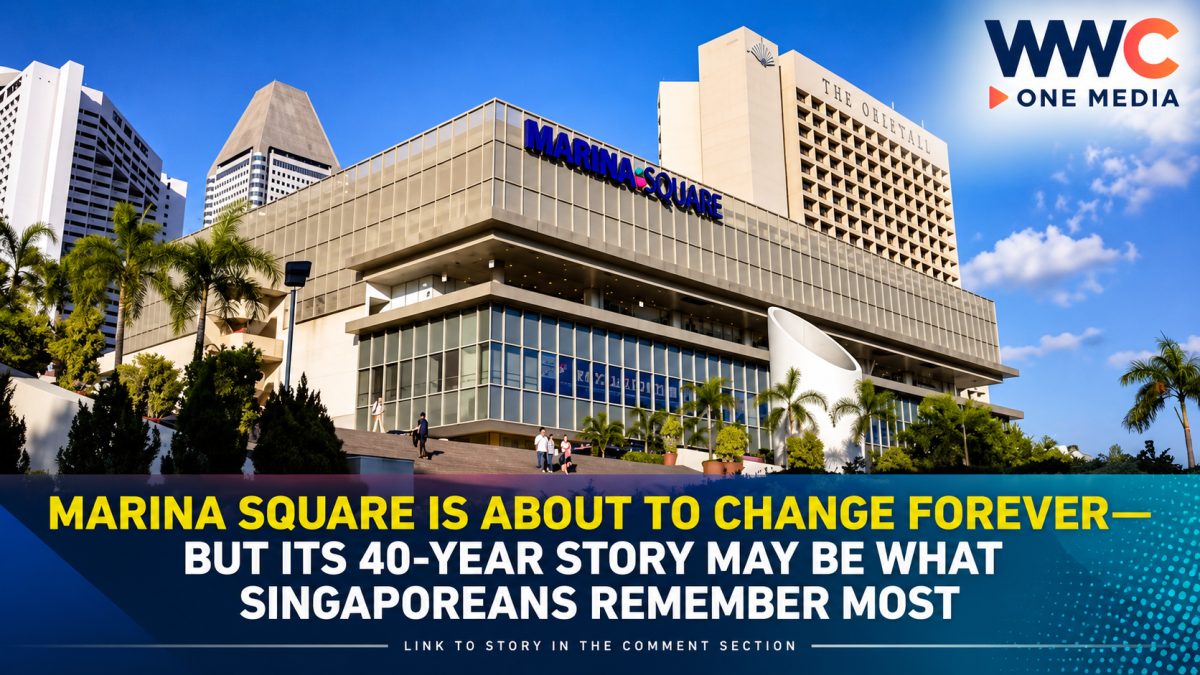
SINGAPORE — For generations of Singaporeans, Marina Square was more than a shopping mall. It was a meeting point, an entertainment destination, a vantage point for major national events and one of the most recognizable pieces of Singapore’s transformation into a modern waterfront city.
Now, that chapter is approaching its final pages.
Marina Square Shopping Mall is scheduled to close on March 31, 2027, as part of a major redevelopment that will reshape the wider complex with new residences, a hotel, serviced apartments, offices, retail spaces and public areas. The redevelopment is expected to be completed in 2031.
But before the cranes arrive, Marina Square’s history is worth remembering—because the mall was itself once a symbol of Singapore’s future.
FROM RECLAIMED SEA TO SHOPPING LANDMARK
Marina Square stands on land created through Singapore’s ambitious land-reclamation programme.
The National Heritage Board’s National Museum collection records Marina Square as part of a shopping, hotel and recreational complex constructed on reclaimed land beside the Esplanade waterfront. The complex was originally associated with the name Marina Centre, after the reclaimed tract on which it was built.
Singapore’s broader Marina Bay transformation was the result of decades of planning and reclamation. According to the Urban Redevelopment Authority, Singapore began major reclamation work in the Marina area in 1971, eventually creating the extensive waterfront development zone that would become one of the city’s defining urban landscapes.
Marina Square emerged during this transformation.
The complex was completed in 1986, with its components opening in stages before a final grand opening in January 1988, according to the National Heritage Board.
At the time, this was not simply another shopping centre.
It was part of a bold experiment in creating a self-contained destination where shopping, hotels, entertainment and public spaces could operate together.
WHEN MARINA SQUARE WAS A SHOPPING GIANT
When it arrived in the 1980s, Marina Square was considered enormous by Singapore standards.
The complex initially featured major department-store names including Japan’s Tokyu and Singapore’s Metro, which became important retail anchors during its early years.
The architectural concept was equally ambitious.
DP Architects, which worked with John Portman Associates on the original building, describes Marina Square as the first phase of the larger self-contained Marina Centre mega-development. The original complex connected three hotels and featured a landscaped roof and elevated pedestrian circulation above the roads.
In other words, Marina Square was designed around an idea that still drives major urban developments today: people should be able to shop, stay, dine and move around a district without feeling that these are separate destinations.
THE MALL THAT BECAME A SOCIAL MEETING POINT
Marina Square eventually became about much more than department stores.
Its large steps became a familiar gathering place, particularly in the late 1990s and early 2000s. The Straits Times recalls the steps as a popular spot for people to meet, relax and watch the sunset.
The mall also offered spectators an unusual advantage during major events in the Marina area.
People without tickets to the National Day Parade gathered around Marina Square to watch portions of the celebrations, while Formula One spectators used the mall’s outdoor staircase as a viewing point for sections of the Singapore Grand Prix circuit.
That helped give the mall a role that went beyond retail.
For some Singaporeans, Marina Square became part of the backdrop of national celebrations and major city events.
FROM CINEMAS TO PLAYGROUNDS
Entertainment was another important part of Marina Square’s evolution.
In 1996, the mall expanded its entertainment offering with Marina Leisureplex, which included a six-screen Golden Village cinema. Golden Village later moved out in 2014.
Over the years, the mall continued changing with consumer habits.
Its food and lifestyle offering expanded, while family-oriented attractions such as Pororo Park and Kiztopia helped reinforce its position as a destination for families and children.
The mall underwent a major refurbishment beginning in 2004, costing about S$100 million, before reopening with a refreshed appearance in 2006. The National Heritage Board notes that the works added retail space and introduced features including glass facades and larger skylights.
Later improvements continued.
The mall’s Dining Edition was launched in 2013, while another retail wing and additional outdoor spaces were completed in 2015.
Yet even after successive upgrades, the retail landscape around Marina Square continued to evolve.
WHY THE NEXT TRANSFORMATION IS DIFFERENT
The redevelopment announced in September 2026 is much larger in scale than a conventional mall renovation.
Singapore Land Group, or SingLand, plans to transform the 9.2-hectare complex into a more integrated mixed-use destination.
The plans include:
- a 49-storey residential tower with 204 luxury homes;
- a 19-storey mixed-use building containing a 304-room hotel and about 13,000 sq m of Grade A office space;
- a 24-storey serviced apartment building with 260 units;
- an extensively upgraded Marina Square mall;
- new landscaped public spaces;
- a new public park above Stamford Canal;
- improved pedestrian connections across the surrounding Marina precinct.
The three existing hotels—Pan Pacific Singapore, PARKROYAL COLLECTION Marina Bay and Mandarin Oriental Singapore—are expected to remain open during construction.
The mall itself will undergo an asset-enhancement programme covering more than 76,000 sq m of gross floor area.
The future retail mix is expected to place greater emphasis on food and beverage, sports, wellness, lifestyle and experience-led concepts rather than relying primarily on traditional retail.
A NEW MARINA SQUARE, BUT NOT JUST A NEW MALL
Perhaps the most significant change is that the project is being positioned as something larger than a shopping-centre makeover.
The redevelopment is designed to connect residences, hotels, offices, retail, sports and wellness facilities, arts and cultural spaces and public areas into a single precinct.
New pedestrian links are planned to connect Marina Square with nearby developments including One Raffles Link, Millenia Walk, Suntec City and the upcoming NS Square.
A new 6,500 sq m public park above Stamford Canal is also planned, alongside privately owned public spaces and new event areas.
Property industry analysts have described the project as part of a broader shift in how older city-centre developments are being repositioned—from traditional retail destinations into mixed-use places where people can live, work, stay and spend leisure time.
BUT THE CLOSURE HAS A HUMAN SIDE
While the redevelopment promises a new future for the precinct, the announcement has also created uncertainty for businesses that have built their identities around Marina Square.
CNA reported that several tenants were surprised by the timing of the closure, with some saying they learned about the March 2027 deadline through customers or news reports before receiving formal communication.
Some businesses also have leases extending beyond March 2027 and have raised questions about relocation and associated costs.
For long-time operators, the issue is not simply finding another shop.
Some have spent years building a customer base at Marina Square, while others have invested heavily in renovations or established themselves as recognizable fixtures within the mall.
The impending closure therefore represents not just a property redevelopment, but a disruption to a small ecosystem of businesses and communities that grew alongside the mall.
40 YEARS OF MEMORIES BEFORE THE NEXT CHAPTER
There is an interesting symmetry to Marina Square’s story.
The mall was born during one of Singapore’s most dramatic periods of physical transformation, when reclaimed land was being turned into a new downtown district.
Four decades later, it is once again being transformed because the city around it has changed.
Marina Bay is now home to a globally recognized skyline, major cultural institutions, hotels, offices, entertainment venues and public spaces. The Urban Redevelopment Authority describes Marina Bay today as a major financial, civic and community hub—far removed from the waterfront landscape that existed before decades of reclamation and development.
Marina Square was there near the beginning of that transformation.
And now it is being redesigned for what comes next.
For shoppers, families and businesses, March 31, 2027, will mark the end of the current Marina Square mall.
For Singapore’s urban story, however, it may be the beginning of another chapter.
The question is no longer whether Marina Square will change.
The real question is what parts of the Marina Square that Singaporeans remember will survive when the doors finally close.




Leave a Reply