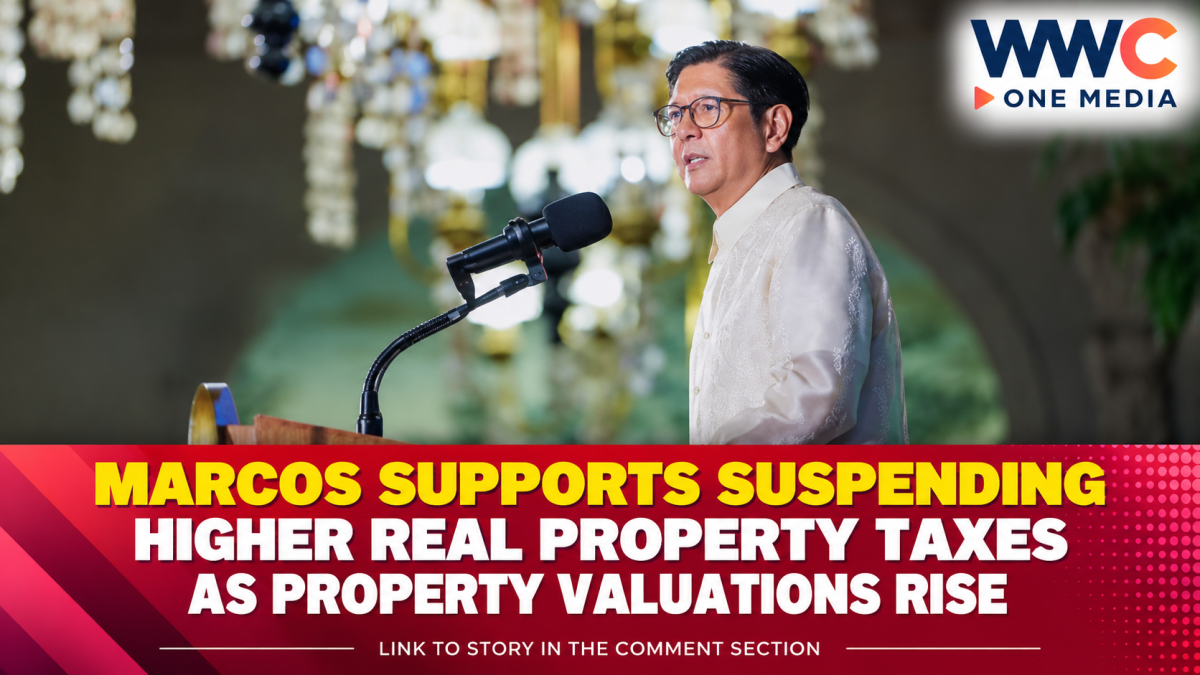
President Ferdinand Marcos Jr. is supporting a proposal to temporarily suspend increases in real property taxes as the government moves to implement a new system for valuing land and buildings.
Palace Press Officer Claire Castro said the proposal was raised during Marcos’ meeting with the Private Sector Advisory Council (PSAC) Infrastructure Sector Group–Real Estate at Malacañang on September 22. Private-sector representatives asked for a temporary suspension of higher property valuations, citing current economic difficulties and concerns that additional costs could place greater pressure on property owners.
Castro said the President is open to the proposal, while the Department of Finance has already begun working on the matter. The discussions include the possible effects of new Schedules of Market Values and whether property assessments should be increased, reduced or maintained at current levels.
The issue is closely tied to Republic Act 12001, or the Real Property Valuation and Assessment Reform Act (RPVARA), which seeks to establish a more standardized and market-based system for valuing real property nationwide.
The reform is designed to replace outdated and inconsistent valuation practices with a more uniform framework. Under the system, local assessors prepare schedules of market values that undergo review and approval through the Department of Finance, with valuations scheduled for regular updating.
However, the Department of Finance has emphasized that higher market valuations do not automatically mean taxpayers will face an equivalent increase in their real property tax bills. Local governments retain authority over assessment levels and tax rates and can reduce either or both under RPVARA.
The distinction is significant because the final tax due depends on several factors, including the property’s market value, assessment level and applicable local tax rate. As a result, changes in market valuation alone do not determine the final amount a property owner pays.
The proposed suspension comes as businesses and property developers assess the potential effects of the valuation reform on landholding costs, housing projects and investment decisions. Industry representatives have raised concerns that higher property valuations could affect project feasibility and the cost of developing housing.
Marcos had already called for a temporary suspension of aspects of RPVARA implementation during a Legislative-Executive Development Advisory Council meeting in August, citing the need to avoid additional property-related costs and allow a gradual transition to the new valuation system.
For property owners, the immediate issue is whether the proposed suspension will delay higher assessments and how local governments will adjust their assessment levels and tax rates during the transition.
The Department of Finance is now studying the proposal, while the implementation of the broader valuation reform remains under scrutiny. Any suspension or adjustment could affect how property values and related taxes are determined as the government moves toward a more standardized valuation system.