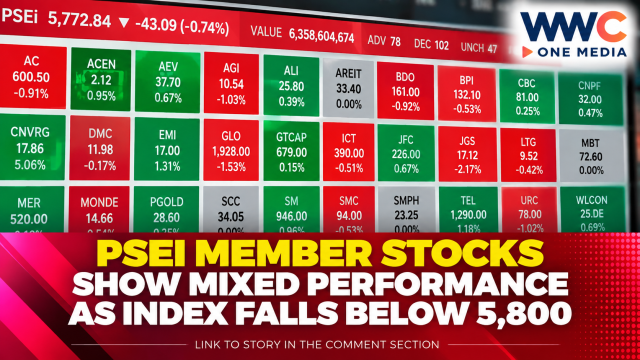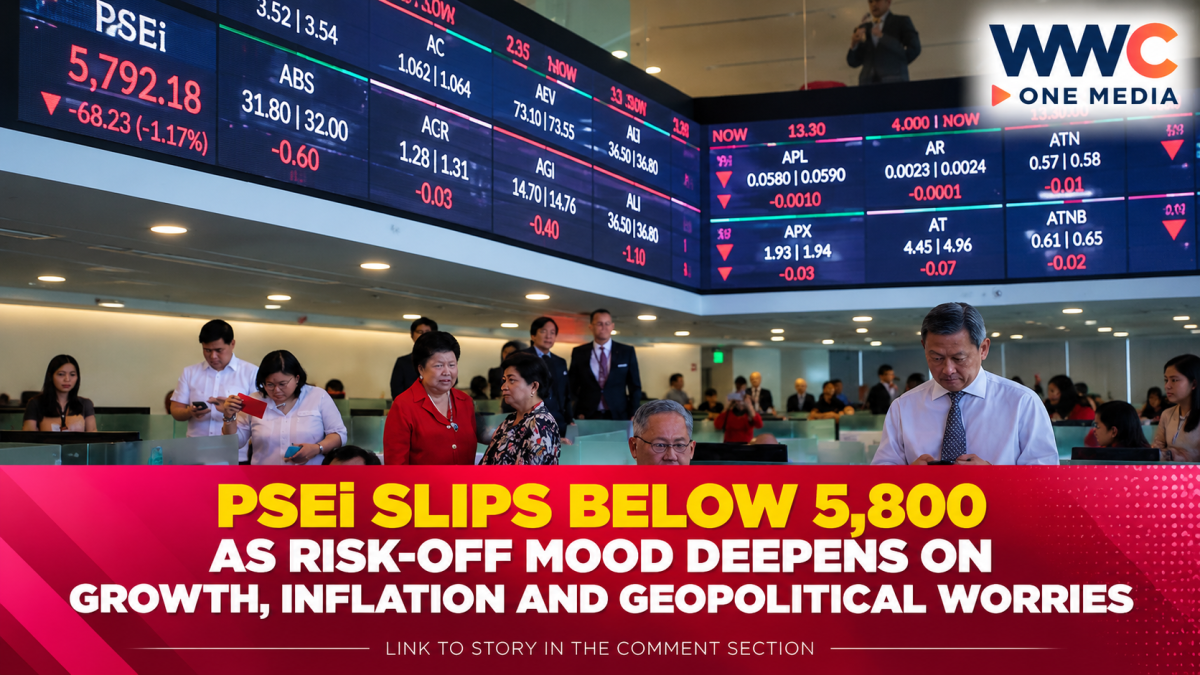
The Philippine Stock Exchange index (PSEi) extended its losing streak to a fourth consecutive session on Wednesday, falling below the 5,800 level as investors remained cautious amid concerns over economic growth, inflation, rising local Treasury yields and geopolitical uncertainty.
The benchmark index dropped 19.42 points, or 0.33 percent, to close at 5,795.14. It was the PSEi’s lowest closing level in nearly five months, or since May 29, when it ended at 5,768.76. The broader All Shares index also declined 0.21 percent to 3,246.44.
Market sentiment remained under pressure as investors assessed the Philippines’ weaker economic outlook. S&P Global Ratings and the Asian Development Bank recently lowered their 2026 Philippine growth forecasts, adding to concerns about sluggish domestic activity and the pace of investment recovery.
Analysts also pointed to persistent inflation concerns and higher local government bond yields as factors weighing on equities. Higher Treasury yields can make fixed-income investments relatively more attractive while increasing financing costs, adding another consideration for stock investors.
Geopolitical uncertainty also remained a major factor. Continued tensions surrounding the US-Iran conflict have kept investors cautious about energy prices, global trade and the broader economic outlook. Market analysts said uncertainty over the conflict continued to weigh on risk appetite.
Trading activity remained relatively subdued, with about 839.56 million shares changing hands for total turnover of roughly P8.9 billion. Decliners outnumbered advancers 105 to 77, while 62 companies ended unchanged.
Most sectoral indices finished lower. Services posted the biggest decline at 0.73 percent, followed by mining and oil at 0.57 percent, holding firms at 0.49 percent, financials at 0.11 percent and industrials at 0.02 percent. Property was the only sector to advance, gaining 0.45 percent.
Foreign investors also remained a source of selling pressure, with reports showing continued net foreign outflows during the session. The combination of local economic concerns and external uncertainty has kept investors more defensive in recent trading.
The market decline came even as the peso strengthened during the session. The Philippine currency closed at around P62.58 per US dollar, compared with P62.72 on the previous day, helped in part by easing oil prices and renewed hopes for diplomatic progress between the United States and Iran.
The PSEi’s move below 5,800 places renewed attention on whether investors will regain confidence as economic data, inflation developments, interest-rate expectations and geopolitical conditions unfold. For now, the latest trading session reflects continued caution across the Philippine market as investors weigh both domestic economic weakness and global risks.