
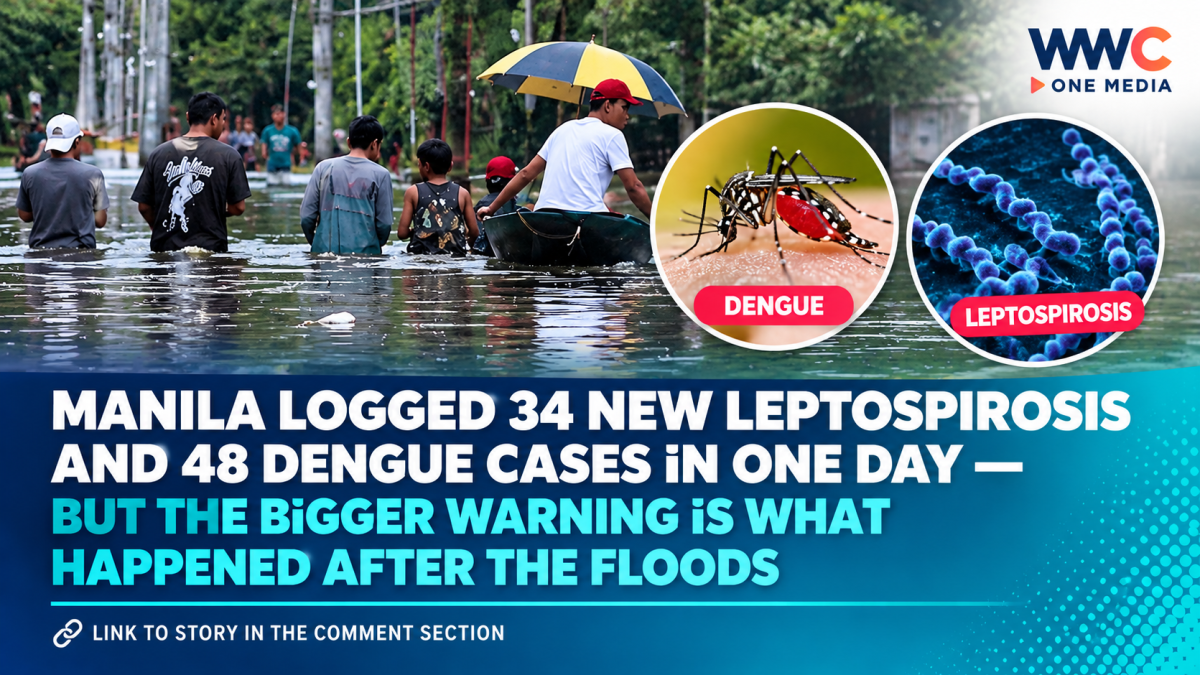
MANILA, Philippines — Manila recorded another 34 leptospirosis cases and 48 dengue infections on Wednesday, September 16, as health authorities continue battling two diseases that thrive under very different conditions but share one powerful trigger: the rainy season.
The Manila Health Department said the 34 new leptospirosis cases brought the city’s cumulative 2026 total to 1,354, while 48 additional dengue infections pushed the dengue tally to 3,049.
Wednesday’s leptospirosis count was slightly higher than the 33 cases reported Tuesday.
Dengue moved in the opposite direction, dropping from 74 new cases Tuesday to 48 Wednesday. But a one-day decline should not be read as proof that the outbreak risk has disappeared. Health officials nationally have continued to report an upward dengue trend during recent weeks of the rainy season.
And for leptospirosis, Manila is already well beyond the point of an ordinary seasonal warning.
Manila declared a leptospirosis epidemic last week
On September 7, Manila declared a leptospirosis epidemic after infections rose above the city’s epidemiologic threshold.
At that point, the city had recorded 982 cases, including 12 newly reported infections, according to health officials quoted by Philippine News Agency and Philstar.
By September 9, the total had risen to 1,094, prompting Manila to expand free doxycycline access and community outreach.
Now, just one week later, the cumulative count stands at 1,354.
That rapid rise explains why city officials have continued treating the situation as a serious public-health problem even as daily numbers fluctuate.
GMA reported that Manila has also recorded 41 “casualties” associated with leptospirosis. Because the report uses the broader term “casualties” rather than explicitly labeling all 41 as deaths, that wording should be preserved unless the Manila Health Department issues a more specific breakdown.
The floods came first — then the illnesses
The leptospirosis surge followed weeks of heavy monsoon rainfall and repeated flooding across Metro Manila.
The disease is caused by Leptospira bacteria, which can be present in water or soil contaminated by the urine of infected animals, particularly rats.
The bacteria can enter the body through cuts or abrasions in the skin as well as through the eyes, nose or mouth.
That makes flood exposure particularly dangerous.
DOH data reported earlier this month showed that 72% of Metro Manila leptospirosis cases were associated with flood exposure.
The timing also explains why cases can continue appearing after floodwater disappears.
DOH has said leptospirosis cases frequently emerge days or even weeks after exposure, meaning hospitals can face a second health emergency after the rain itself has stopped.
Symptoms can include fever, headache, muscle pain, chills, vomiting, diarrhea, red eyes and jaundice. Severe infections can damage the kidneys, liver and other organs.
Manila hospitals have already felt the pressure
The rise has not remained confined to surveillance reports.
Earlier this month, Manila health officials said major city hospitals—including Ospital ng Maynila, Sta. Ana Hospital and Justice Jose Abad Santos General Hospital—had reached full capacity as leptospirosis admissions increased.
Ospital ng Maynila separately warned in August that its emergency room had reached what it described as 300% capacity, with suspected and confirmed leptospirosis patients among those contributing to the surge.
The national government subsequently expanded surge capacity.
As of September 3, the DOH said 20 department-run hospitals in Metro Manila had 602 beds assigned or made available for leptospirosis patients, including 260 additional surge beds. Of those, 562 were occupied at the time.
The Health Department has also been redistributing patients between hospitals when facilities with dialysis capability or specialized care become crowded.
That matters because serious leptospirosis can lead to kidney failure requiring dialysis.
Manila went door-to-door with preventive medicine
The city’s response escalated after the epidemic declaration.
Mayor Francisco “Isko Moreno” Domagoso directed Manila’s health teams and barangays to bring preventive services directly into flood-affected communities.
The city began a door-to-door doxycycline campaign across its 896 barangays, targeting residents who had been exposed to floodwater.
Manila also expanded free access through health centers.
But health authorities have repeatedly stressed one important warning:
People should not simply take doxycycline on their own.
DOH says anyone exposed to potentially contaminated floodwater should consult a health center or clinic so medical personnel can assess the nature of the exposure and determine whether antibiotic prophylaxis is appropriate.
DOH has specifically warned against self-medication because doxycycline is a prescription antibiotic and the need for it depends on factors such as the type and duration of exposure.
The medicine supply is not the main problem right now
Health Secretary Edwin Mercado said earlier this month that the government had enough medication to respond to the surge.
The DOH reported having roughly 3.1 million doxycycline capsules in its central warehouse at the beginning of September, in addition to supplies already distributed to affected areas.
By September 4, more than 1.2 million capsules were being augmented in regions affected by leptospirosis, while another 2.6 million remained available through Centers for Health Development.
The bigger challenge is reaching exposed residents early enough—and identifying infections before they progress into severe illness.
Manila is not facing the leptospirosis problem alone
The surge is part of a much wider national problem.
As of August 29, the Philippines had recorded 6,253 leptospirosis cases and 378 deaths, according to DOH figures carried by the Philippine News Agency and Philstar.
Interestingly, that nationwide case total was still 12% below the comparable 2025 figure.
That sounds reassuring until the recent trajectory is considered.
Health officials have repeatedly emphasized that the national year-to-date number can be lower than last year while particular cities or regions simultaneously experience sudden local epidemics after flooding.
Manila is a clear example.
By early September, several areas of Metro Manila had breached epidemic thresholds even though the nationwide cumulative count remained below the previous year.
In other words:
“Lower than 2025” does not mean “low.”
Dengue is behaving differently
Dengue presents a separate challenge.
Unlike leptospirosis, it is not acquired by contact with contaminated floodwater.
It is caused by viruses transmitted through bites from infected Aedes mosquitoes.
But heavy rain can create the standing-water containers mosquitoes need to breed.
That is why dengue risk can rise during and after prolonged rainy periods even though its transmission mechanism is completely different from leptospirosis.
Manila recorded 74 new dengue cases on September 15, bringing its cumulative total to 3,001.
Wednesday’s additional 48 infections lifted that number to 3,049.
The decline from 74 cases one day to 48 the next is welcome, but daily figures can fluctuate significantly.
The more meaningful trend is seen over several weeks.
National dengue cases are down sharply from last year — but rising again recently
Across the Philippines, the dengue picture is mixed.
DOH data reported Wednesday showed 138,538 dengue cases from January 4 through September 5, which was about 36% lower than the 217,693 infections recorded during the comparable period in 2025.
That is a substantial year-on-year improvement.
But health officials also detected a more recent increase.
The country recorded 17,788 dengue cases from August 9 to August 22, up 17% from the 15,211 cases recorded in the preceding two-week period.
Central Luzon, Calabarzon and the National Capital Region were among the areas contributing significant numbers of cases.
Earlier DOH data showed the same direction, with 15,763 infections from August 2 to 15—9% above the preceding fortnight.
So both statements are true:
Dengue is substantially lower than last year overall, but cases have recently been climbing again.
That nuance is especially important when reporting Manila’s daily figures.
Dengue has no specific antiviral treatment
DOH advises people with symptoms such as sudden high fever and severe body aches to seek medical assessment promptly.
There is no specific antiviral medicine that eliminates dengue.
Treatment focuses on managing symptoms, maintaining hydration and identifying warning signs before severe dengue develops.
The most important community prevention remains mosquito control—especially removing or covering containers that hold standing water.
That includes discarded tires, plant pots, buckets and other objects where Aedes mosquitoes can breed.
One rainy season, two very different disease threats
The simultaneous rise in leptospirosis and dengue can make the diseases seem like a single “flood illness” problem.
They are not.
Leptospirosis risk increases when people come into contact with water or soil contaminated by infected animal urine.
Dengue spreads through infected mosquitoes, whose breeding opportunities can increase when rain leaves stagnant water behind.
The connection is therefore environmental rather than biological.
Heavy rain creates the conditions for both risks—but through different pathways.
That means prevention must also be different.
Avoiding unnecessary floodwater exposure reduces leptospirosis risk.
Removing mosquito breeding sites helps control dengue.
And in both cases, early medical attention can matter when symptoms appear.
The headline numbers may keep changing
Wednesday’s figures—34 new leptospirosis cases and 48 dengue cases—are only a snapshot.
A day earlier, Manila had 33 new leptospirosis cases and 74 dengue cases.
On September 11, the city reported 46 new leptospirosis infections and 53 dengue cases.
Those swings are why epidemiologists look beyond individual daily reports.
The larger pattern is harder to ignore.
Manila’s leptospirosis tally has moved from 982 when the city declared an epidemic on September 7 to 1,354 by September 16.
Dengue has crossed 3,000 cases for the year, even as nationwide infections remain well below 2025 levels.
And the rainy season is not over.
That is why Wednesday’s 34 and 48 are not merely two daily statistics.
They are reminders that after floodwater recedes, Manila’s health emergency can keep unfolding—in hospital wards, neighborhood clinics and mosquito breeding sites long after the streets look dry again.



Leave a Reply