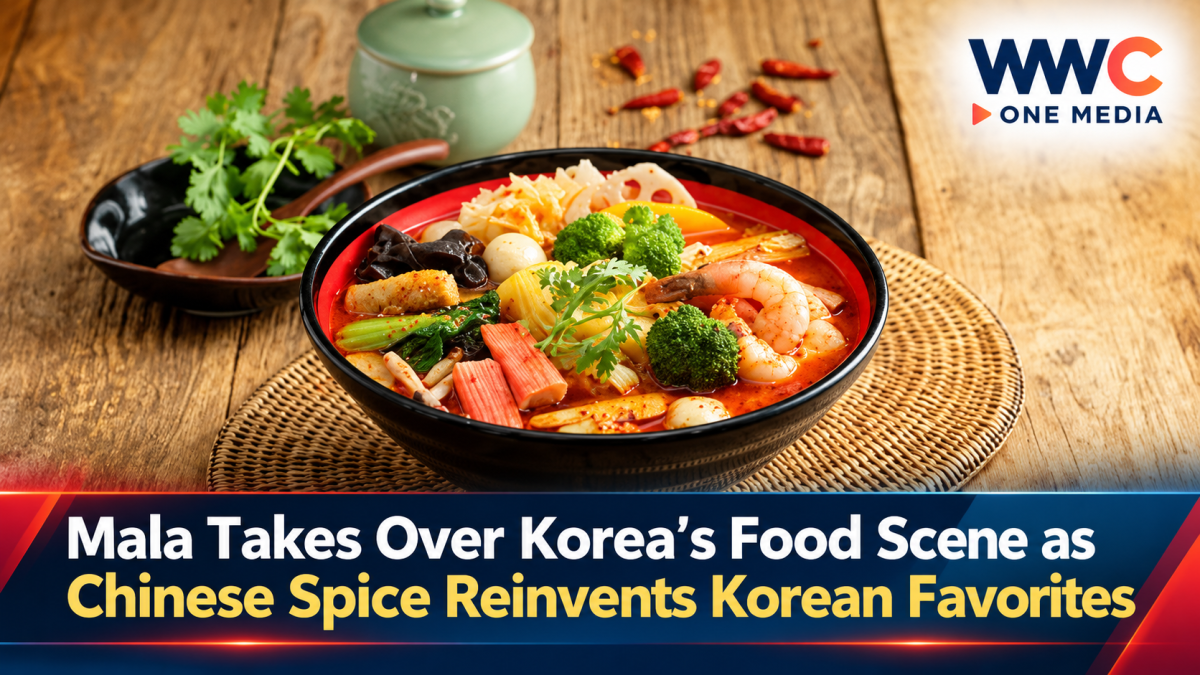
SEOUL — A distinctly Chinese flavor is finding an increasingly familiar place on Korean menus.
Mala — the spicy, numbing seasoning associated with Sichuan cuisine — has expanded far beyond traditional Chinese dishes in South Korea, appearing in everything from malatang and noodles to fried chicken, hamburgers, tteokbokki and even gukbap.
What began as a niche taste has evolved into a broader food trend, with restaurants and food companies adapting mala to Korean eating habits and experimenting with new combinations.
From malatang to everyday Korean food
Mala’s rise in Korea is closely connected to the popularity of malatang, a customizable spicy soup that became particularly popular among younger consumers before spreading to older generations.
The flavor comes from the combination of chili peppers and Sichuan peppercorns. The chili provides heat, while Sichuan pepper creates the characteristic tingling or numbing sensation associated with mala.
Korea JoongAng Daily reported that malatang arrived in Korea more than a decade ago and has developed into a mainstream food trend rather than remaining a niche Chinese dish.
But the Korean version has evolved.
Some restaurants have toned down the numbing sensation and adjusted the spice profile toward flavors more familiar to Korean diners. Others have incorporated gochujang, creating dishes that combine Sichuan-style mala with distinctly Korean flavors.
Mala is now crossing culinary boundaries
The biggest change may be where mala is appearing.
According to the Korea Times, restaurants and food businesses are increasingly using the seasoning in dishes that have little connection to traditional Sichuan cuisine. Mala-flavored ramyeon, fried chicken and hamburgers have joined Korean dishes such as jokbal, braised chicken and tteokbokki.
One particularly notable example is mala gukbap, which combines the spicy, numbing seasoning with Korea’s familiar rice-and-soup format.
This experimentation illustrates how international flavors can become localized: rather than simply reproducing Chinese dishes, Korean food businesses are incorporating mala into formats consumers already recognize.
Convenience stores are joining the trend
The mala boom is also moving beyond restaurants.
Seoul Economic Daily reported that Emart24’s mala xiang guo product developed with chef Park Eun-young saw sales increase by 180 percent, with social media and online-community discussions contributing to interest.
The product was designed as an accessible convenience-store version of mala xiang guo, giving consumers another way to experience the flavor without visiting a specialty restaurant.
The development suggests that mala is becoming more than a restaurant trend: food companies are also testing whether the flavor can succeed in mainstream packaged and ready-to-eat products.
Chinese restaurant brands expand across Korea
Mala’s popularity is occurring alongside a broader expansion of Chinese food businesses in South Korea.
The Korea Times reported in March that Tanghuo Kungfu, a Chinese malatang restaurant brand, had surpassed 560 restaurants in Korea by the end of March, counting franchise and directly operated locations.
Other Chinese restaurant brands, including Haidilao, have also gained visibility among Korean consumers.
The expansion is particularly noticeable in Seoul’s major commercial districts, where younger diners increasingly encounter Chinese cuisine as part of the city’s everyday restaurant landscape.
Why mala has connected with younger Koreans
Several factors appear to have helped drive the trend.
Social media made highly customizable and visually distinctive foods easy to share. At the same time, younger Koreans have increasingly encountered Chinese cuisine through travel, restaurants and online content.
The Korea Times reported that Chinese food has become increasingly familiar to Korean consumers in their 20s and 30s, with mala serving as an important gateway into a wider range of Chinese dishes.
The appeal also comes from participation. At malatang restaurants, customers can choose their own ingredients and adjust the meal to their preferences, turning the dining experience into something interactive rather than simply ordering a fixed dish.
A flavor that is becoming Koreanized
Mala’s story in Korea is not simply about Chinese cuisine replacing Korean food.
Instead, the trend shows how a foreign flavor can be adapted to local tastes.
The result is a growing collection of hybrid dishes that combine Sichuan’s signature numbing spice with familiar Korean ingredients, cooking styles and meal formats.
That transformation has already reached some of Korea’s most recognizable comfort foods, including tteokbokki, ramyeon and gukbap.
And the experimentation is not stopping there.
As restaurants, convenience stores and food companies continue looking for new ways to use mala, the seasoning is increasingly functioning less like a specialty Chinese ingredient and more like a versatile flavor platform.
For Korea’s food industry, that could be the most significant development of all: mala is no longer simply something Koreans order at a Chinese restaurant — it is becoming a flavor that can be reinvented almost anywhere.
WWC ONE MEDIA G,A