
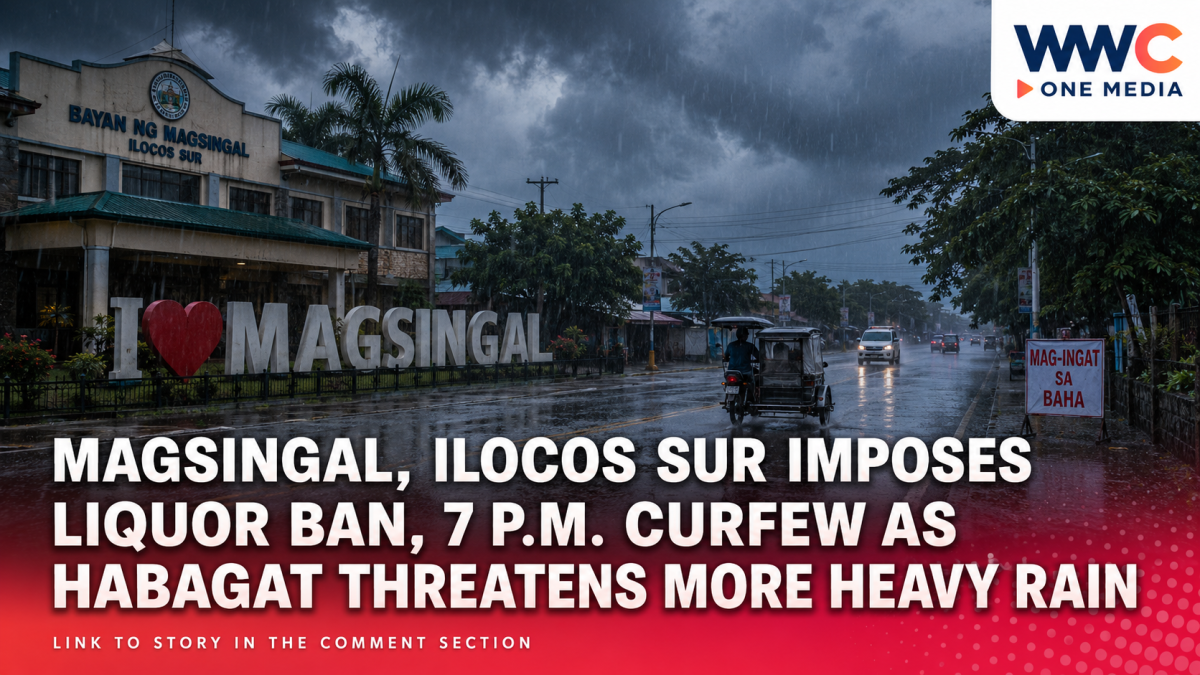
MAGSINGAL, ILOCOS SUR — Authorities in Magsingal have imposed a temporary liquor ban and a nighttime curfew as persistent monsoon rains continue to raise the risk of flooding, landslides and other weather-related emergencies across Ilocos Sur.
Acting Municipal Mayor Alrico Favis signed Executive Order No. 55, Series of 2026, on Sunday, August 30, putting the emergency restrictions into effect immediately as the southwest monsoon, locally known as the habagat, continued to batter Northern Luzon.
Under the order, the sale, distribution, purchase, serving and consumption of alcoholic beverages are temporarily prohibited throughout Magsingal while the severe weather situation persists. The ban will remain in force until local authorities officially lift it.
At the same time, residents are subject to a 7 p.m. to 4 a.m. curfew in public places, a move intended to limit unnecessary movement during hours when poor visibility, flooding, fallen trees and other hazards may become more difficult to manage.
Who Is Exempted From the Curfew?
The order does not prevent essential personnel from carrying out emergency or critical work.
Among those exempted are government personnel on official duty, doctors and veterinarians who must report for work, public utility workers conducting emergency, maintenance or construction operations, and people responding to medical, disaster or other urgent situations.
Police officers, barangay officials and barangay chairpersons have also been instructed to patrol public areas, keep watch over coastal communities and enforce the temporary restrictions.
The municipal government cited the Philippine Disaster Risk Reduction and Management Act of 2010 and the Local Government Code as legal bases for the precautionary measures.
Ilocos Sur Faces Up to 200 mm of Rain
The restrictions come as PAGASA warns that Ilocos Sur remains among the areas facing significant rainfall from the habagat.
In its August 30 heavy-rainfall outlook, PAGASA placed Ilocos Sur, Pangasinan, La Union, Benguet, Bataan, Zambales, Tarlac and Pampanga under an orange-level rainfall outlook, with 100 to 200 millimeters of rain possible within 24 hours.
PAGASA warned that heavy to intense rainfall could trigger flash floods and rain-induced landslides, particularly in communities near rivers, steep slopes and other vulnerable locations. The weather bureau has also cautioned that rainfall totals can be higher in mountainous areas and that the impact can worsen where the ground is already saturated from previous weeks of rain.
The danger is not theoretical. The Ilocos Region has been dealing with repeated rounds of bad weather in recent weeks.
The Department of Social Welfare and Development’s Field Office 1 reported on August 28 that the combined effects of previous tropical cyclones and the habagat had already affected approximately 451,792 families, or more than 1.63 million people, across 1,290 barangays in the Ilocos Region. The agency said more than 10,000 food and non-food relief items had been distributed in Ilocos Sur alone at that point.
On Sunday, DSWD also said another 24,029 family food packs had been brought into strategic warehouses and prepositioning sites across the Ilocos Region, including supplies delivered to Vigan City, as authorities prepared for possible further relief operations.
Meanwhile, the Office of Civil Defense reported Sunday morning that 429 areas remained flooded across the Ilocos Region, Metro Manila, Central Luzon and Calabarzon, illustrating the wide reach of the continuing monsoon rains.
Tropical Depression Pilandok Adds Another Weather Concern
Adding to the weather threat, a low-pressure area east of Northern Luzon developed into Tropical Depression Pilandok on Sunday.
PAGASA reported that Pilandok was still more than 1,200 kilometers east of Extreme Northern Luzon during its late-morning monitoring, with maximum sustained winds of around 45 kilometers per hour.
The cyclone itself was considered unlikely to make landfall in the Philippines and was forecast to remain far from the country’s landmass. But its position and circulation could continue strengthening the southwest monsoon, meaning communities in western and northern Luzon may still experience significant rainfall even without a direct tropical-cyclone hit.
That distinction is important: Magsingal’s immediate threat is primarily the continuing habagat and its associated heavy rainfall, not a direct strike from Pilandok.
For residents, the municipal government’s liquor ban and nighttime curfew are therefore precautionary measures designed to reduce unnecessary movement and allow police, barangay officials and disaster-response personnel to concentrate on communities most vulnerable to flooding, coastal hazards and other emergencies.
Authorities are urging residents to follow official PAGASA and local government advisories, avoid flooded roads and swollen waterways, and be prepared to evacuate if conditions deteriorate.
With the ground already saturated from weeks of rain and another weather system helping reinforce the monsoon flow, Magsingal’s restrictions may remain in place until officials determine that conditions are safe enough to lift them.



Leave a Reply