
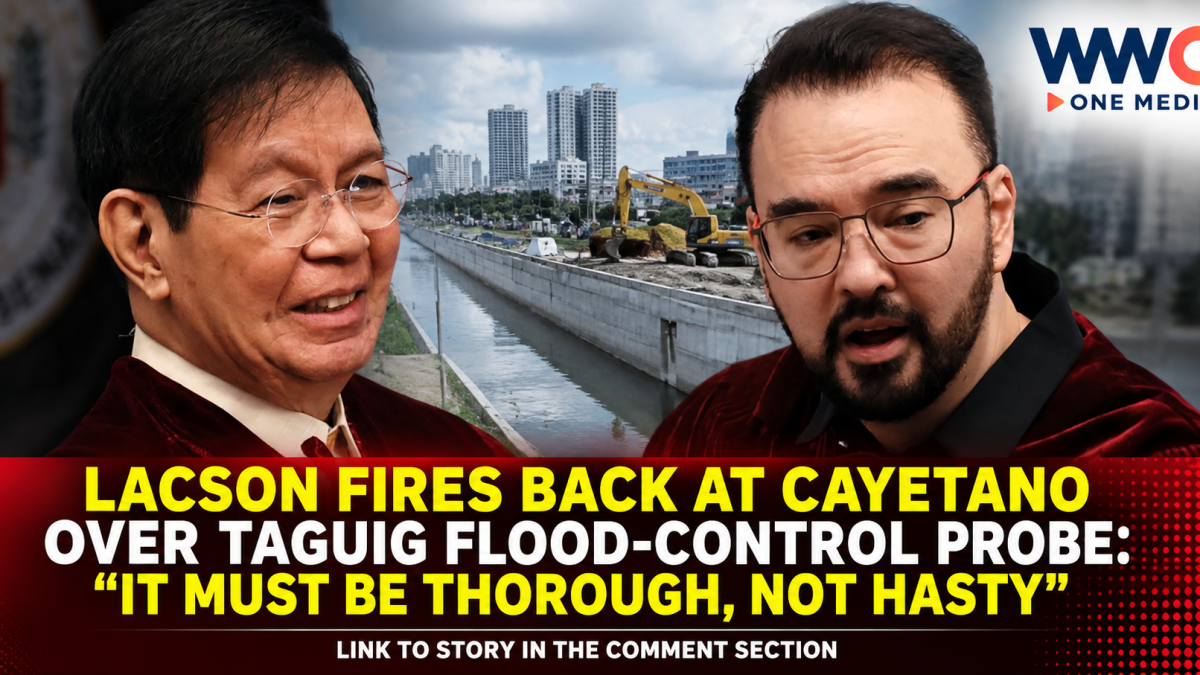
MANILA, Philippines — Senator Panfilo “Ping” Lacson has pushed back against Senate Minority Leader Alan Peter Cayetano’s criticism of his investigation into alleged irregularities involving flood-control, infrastructure and reclamation projects in Taguig City, insisting that the probe must be handled deliberately and backed by evidence.
Lacson said an investigation involving alleged corruption in major government projects cannot be rushed simply to satisfy political pressure.
“It must be deliberate, methodical and thorough; not hasty nor sloppy,” Lacson said in response to Cayetano’s criticism.
The exchange marks another escalation in the increasingly heated dispute between the two senators, whose disagreement has centered on allegations surrounding infrastructure projects in Taguig, including developments along the Laguna Lake shoreline.
Cayetano challenges Lacson to present evidence
Cayetano previously criticized Lacson for what he described as a pattern of releasing allegations gradually without immediately presenting all the evidence.
He accused Lacson of engaging in what he called “trial by publicity” and argued that allegations should be brought before the proper investigative and judicial authorities.
Cayetano has maintained that there are no “ghost projects” in Taguig and challenged Lacson to present evidence against the Department of Public Works and Highways (DPWH), the Taguig government or himself.
He also said allegations should be investigated regardless of political affiliation, but warned that investigations should focus on establishing the truth rather than becoming political battles.
Lacson says evidence has already reached the Ombudsman
Lacson, however, has pointed out that his office has already turned over documentary and testimonial evidence to the Office of the Ombudsman.
According to GMA News, Lacson said the evidence was submitted for evaluation and possible action, including a potential motu proprio investigation.
He has alleged that the evidence involves possible irregularities such as allegedly duplicated appropriations, unfinished projects, recycled photographs used in project documentation and infrastructure activities connected to reclamation areas. These claims have not been established as fact and remain subject to investigation.
Lacson has also said his investigation could involve possible violations carrying serious criminal and administrative consequences, although any liability would have to be determined by the proper authorities based on evidence and due process.
P3.713 billion in projects questioned
The controversy intensified after Lacson said his team had identified completed, ongoing and suspended DPWH flood-control and multipurpose projects in Taguig with a combined value of approximately P3.713 billion.
Lacson described the spending as potentially “wasted” and questioned projects located in reclamation areas along Laguna Lake.
Cayetano, however, rejected the characterization and defended the Lakeshore development, saying the project should not automatically be considered wasted simply because Lacson has raised questions about it.
Lacson’s team says 32 projects have been flagged
The Philippine News Agency reported that Lacson said his team had identified 32 allegedly anomalous flood-control projects in Taguig.
Among the projects he cited were a flood-control project in Lower Bicutan, a multipurpose building at the Lakeshore Complex, a Laguna Lakeshore improvement project and flood-mitigation rehabilitation projects.
The investigation has also raised questions about whether proper coordination, consultations, permits and clearances were obtained for projects within the Laguna Lake area.
The Laguna Lake Development Authority has reportedly raised concerns about the implementation of projects without the required coordination and procedures.
Importantly, the designation of these projects as “anomalous” or “ghost” projects remains part of the allegations being investigated. The existence of documentation or mapping discrepancies does not by itself establish that a project was fraudulent.
Mapping errors add another layer to the controversy
The Senate’s own reporting has also highlighted a complication in the broader flood-control investigation: some projects initially identified as “ghost” projects may actually exist but were assigned incorrect geographical coordinates in official records.
According to Senate reporting, mapping and documentation errors may have caused investigators to believe that certain completed structures did not exist because they were recorded at incorrect locations.
That development underscores Lacson’s argument that the investigation needs to be methodical and evidence-based before conclusions are reached.
The bigger question: where did the money go?
Beyond the political clash between Lacson and Cayetano, the investigation raises a larger public-interest question: Were billions of pesos allocated for flood control and infrastructure actually used for projects that were completed, properly documented and capable of delivering their intended benefits?
That question is particularly significant because flood-control spending directly affects communities vulnerable to flooding, especially during severe rains and typhoons.
The Senate Blue Ribbon Committee has jurisdiction over investigations involving alleged malfeasance, misfeasance and nonfeasance by government officials and agencies, including matters of public interest.
Cayetano: Let the proper agencies investigate
Cayetano has repeatedly said that if evidence exists, it should be submitted to the appropriate investigative bodies.
He welcomed the submission of Lacson’s evidence to the Ombudsman and said he was prepared to answer the accusations in the proper venue.
Lacson, meanwhile, has maintained that his investigation is not finished and that additional evidence and witnesses may still emerge.
The two senators therefore appear to agree on one basic principle — that allegations must ultimately be tested through evidence and due process — but remain sharply divided over how the investigation is being conducted and communicated publicly.
What happens next?
The next critical stage will likely be the evaluation of the evidence submitted to the Ombudsman and the continuing examination of the questioned projects, government records, contracts, appropriations and implementing agencies.
For now, neither Lacson’s allegations nor Cayetano’s defenses should be treated as final findings.
What could ultimately determine the controversy is not the senators’ increasingly heated exchange, but the documentary trail: appropriation records, project contracts, completion documents, permits, photographs, geographic coordinates, inspection reports and actual physical verification of the projects.
As Lacson has emphasized, a probe of this scale cannot afford to be rushed.
And with billions of pesos in public funds potentially at stake, the public will be watching whether the investigation produces evidence strong enough to establish accountability — or exposes errors that require the allegations themselves to be corrected.
WWC ONE MEDIA J.M.S



Leave a Reply