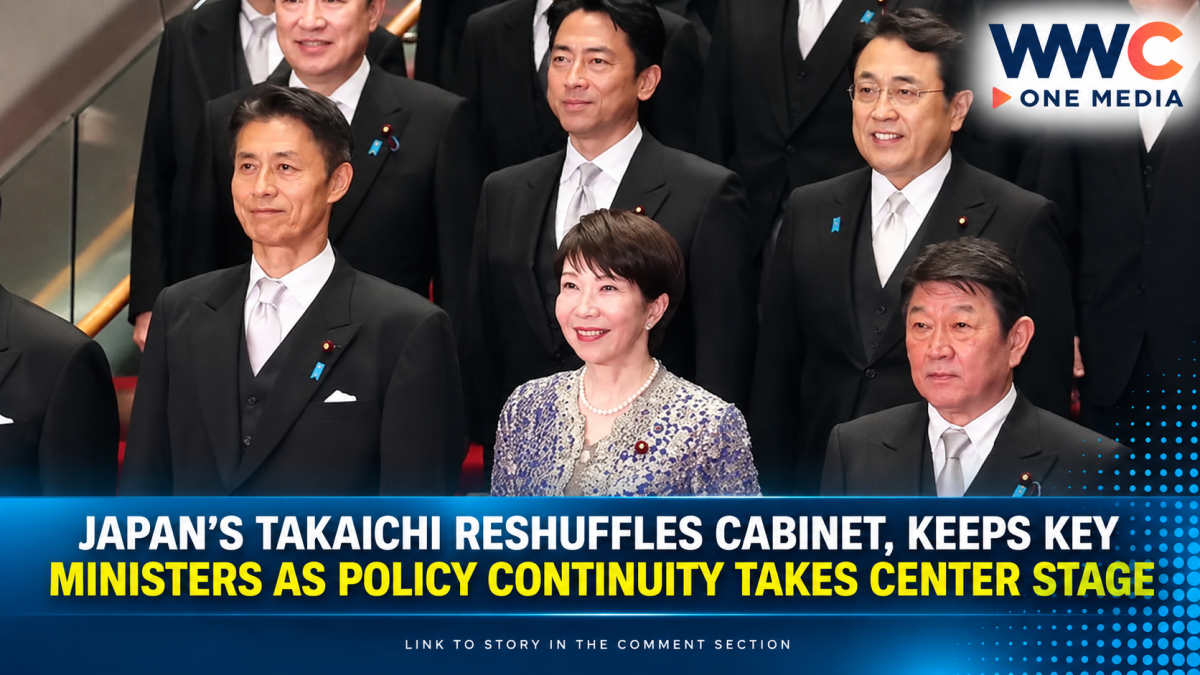
TOKYO — Japanese Prime Minister Sanae Takaichi carried out her first Cabinet reshuffle on Thursday, September 17, 2026, retaining several of the government’s most important ministers while making changes aimed at strengthening her administration and advancing its economic and political agenda.
The reshuffle comes as Takaichi faces competing pressures over government spending, inflation, public finances and Japan’s strategic relationship with the United States.
Key Ministers Stay in Place
Among the most significant features of the reshuffle was the decision to retain several senior ministers.
Finance Minister Satsuki Katayama and Economy Minister Minoru Kiuchi remained in their positions, preserving continuity in the government’s economic team. Defense Minister Shinjiro Koizumi and Foreign Minister Toshimitsu Motegi were also retained.
Reuters reported that keeping Katayama and Kiuchi signals continuity in Takaichi’s approach to economic policy, including efforts to combine economic growth with fiscal management.
The appointments also come as Japan confronts rising government bond yields and concerns over the cost of financing its spending plans.
Ten of 18 Ministers Replaced
Although several key figures remained, the reshuffle was not merely cosmetic.
According to AP, 10 of the 18 Cabinet ministers were replaced, giving Takaichi an opportunity to change part of her team while maintaining continuity in several critical portfolios.
The reshuffle also includes a new role for the Japan Innovation Party, with Hiroshi Nakatsuka appointed minister responsible for deregulation, according to Reuters. The move comes as Takaichi works with the party as part of her governing arrangement.
Economic Policy Remains Under the Spotlight
One of the biggest challenges facing the reshuffled Cabinet is Takaichi’s economic agenda.
The government has proposed reducing Japan’s 8% consumption tax on food to 1% for two years beginning in April 2027, alongside measures intended to ease the burden of rising living costs. Reuters previously reported that the plan could create a revenue shortfall of around ¥5 trillion, while the government has not yet fully detailed the financing arrangements.
The issue has attracted attention from financial markets because Japan already carries one of the highest debt burdens among advanced economies.
At the same time, Takaichi’s government has pledged to maintain fiscal discipline, including a goal of limiting new government bond issuance to roughly ¥40 trillion in fiscal 2027.
Japan’s Yen and Interest Rates Add More Pressure
The reshuffle also comes as Japan deals with renewed pressure on the yen.
Reuters reported Thursday that the yen had weakened to around ¥155.50 per U.S. dollar, after earlier strengthening to a seven-month high. Japanese officials reiterated their commitment to addressing excessive currency volatility and maintaining close communication with U.S. authorities.
Finance Minister Katayama, who was retained in the reshuffle, reaffirmed Japan’s stance on excessive currency movements.
Meanwhile, the Bank of Japan is being closely watched over the possibility of another interest-rate increase, adding another layer of complexity to the government’s economic policy.
Defense and U.S. Relations Remain Important
Keeping Koizumi as defense minister and Motegi as foreign minister also preserves continuity in Japan’s security and diplomatic policy.
AP reported that Takaichi’s government is preparing to strengthen Japan’s defense strategy, including increased attention to technologies such as artificial intelligence and drones. The administration is also considering higher defense spending.
The United States remains a central element of Tokyo’s foreign-policy calculations, particularly as Japan manages its security relationship with Washington alongside increasingly complicated regional dynamics.
What the Reshuffle Means
The September 17 reshuffle therefore combines personnel changes with significant policy continuity.
Takaichi has replaced a substantial number of ministers while keeping several figures responsible for the government’s economic, diplomatic and defense priorities.
The new Cabinet now faces several immediate challenges: managing inflation and the yen, determining how to finance proposed tax reductions, controlling government borrowing and maintaining Japan’s strategic relationships.
For Takaichi, the reshuffle provides a new team—but the major policy questions facing her government remain largely the same.
The next test will be whether the reshuffled Cabinet can translate that continuity into concrete progress on Japan’s economic and political agenda.
WWC ONE MEDIA G,A