
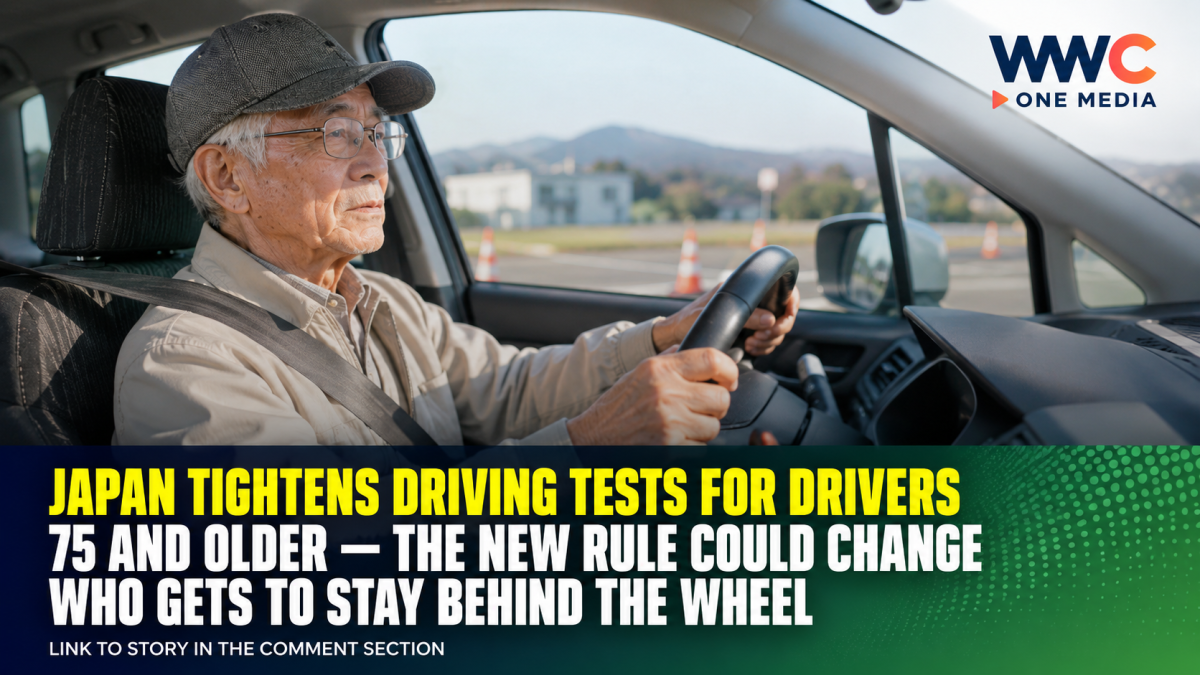
TOKYO — Japan is preparing to tighten its driving skills test for motorists aged 75 and older who have certain traffic violations, as authorities move to address a troubling pattern of crashes involving elderly drivers.
The National Police Agency (NPA) plans to introduce stricter testing requirements as early as fiscal 2027 after an expert panel concluded that the current system has not done enough to identify drivers at higher risk of causing accidents.
The proposed changes will specifically target drivers aged 75 or older who have committed designated traffic violations during the three years before renewing their licenses.
These violations include offenses such as running red lights, speeding and failing to follow traffic rules at intersections. Drivers in this category already have to pass a practical driving skills test before they can renew their licenses.
A tougher test is coming
Under the proposed revisions, the practical test will add a new “direction change” maneuver designed to examine whether drivers can properly coordinate steering, braking and acceleration.
The maneuver requires the driver to reverse while steering, stop, and then turn the steering wheel in the opposite direction before moving forward.
The change is aimed in part at addressing accidents in which older motorists mistakenly press the accelerator instead of the brake.
The scoring system will also become tougher.
For example, failing to check traffic in both directions when stopping could result in a 10-point deduction. Crossing a stop line at an intersection could carry a 40-point penalty — double the current penalty, according to reports on the proposed revisions.
The current first-class license skills test requires a score of at least 70 points to pass.
Why Japan is changing the rules
Japan’s move comes as the country continues to grapple with an aging population and a growing number of older motorists.
According to the NPA, drivers aged 75 and above were responsible for about 18 percent of fatal traffic accidents in 2025, even as Japan’s overall traffic fatalities and accidents have generally declined.
The problem became even clearer in an NPA follow-up study released earlier this year.
The Japan Times reported that elderly drivers who had taken the existing skills test had an accident rate 2.8 times higher than older drivers who attended the relevant training course but did not have the same traffic-violation history. Among drivers aged 75 to 79, the accident rate was 4.5 times higher.
In 2025, more than 156,000 people took the skills test, with about 93 percent passing, according to the report.
The findings raised questions about whether the current test is sufficiently effective at identifying motorists who remain at elevated risk even after passing.
The test already exists — but authorities say it needs strengthening
Japan introduced the mandatory driving skills test in 2022 for drivers aged 75 and above with certain traffic violations.
The test evaluates practical driving abilities, including stopping, steering and following traffic signals and road signs.
Japan also has additional requirements for older drivers. Motorists aged 70 and above must undergo senior-driver training when renewing their licenses, while those aged 75 and above must undergo a cognitive assessment.
The cognitive assessment evaluates areas such as memory and awareness of time. It is separate from a medical diagnosis, and drivers identified as potentially having cognitive impairment may face additional procedures, including medical evaluation.
Recent crashes have kept the issue in focus
Concerns over elderly-driver safety have been reinforced by several serious crashes.
In May, an 85-year-old man driving a shuttle bus in Nagoya reportedly struck and killed a man and a woman in their 30s, according to local media reports cited by CNA.
The issue has also been highlighted by the 2019 Tokyo crash involving an 87-year-old driver who mistakenly accelerated instead of braking. The crash killed a three-year-old girl and her mother and injured nine other people.
Authorities are now attempting to close what they see as a gap between passing the existing test and actually demonstrating safe driving behavior on the road.
What happens next?
The NPA is expected to proceed with regulatory changes after gathering public opinions, with the tougher testing system targeted for implementation as early as fiscal 2027.
The changes do not mean that all Japanese drivers aged 75 and older will automatically face the tougher practical test.
Instead, the stricter requirements are aimed at the group already subject to the skills test because of certain traffic violations.
Japan’s broader challenge, however, is becoming increasingly difficult to ignore: how to preserve mobility for an aging population while preventing mistakes behind the wheel from turning into fatal accidents.
And as the country prepares to tighten the rules, the question is no longer simply whether an older driver can pass a test — but whether that test can accurately identify who is still safe to drive.
WWC ONE MEDIA MJE




Leave a Reply