
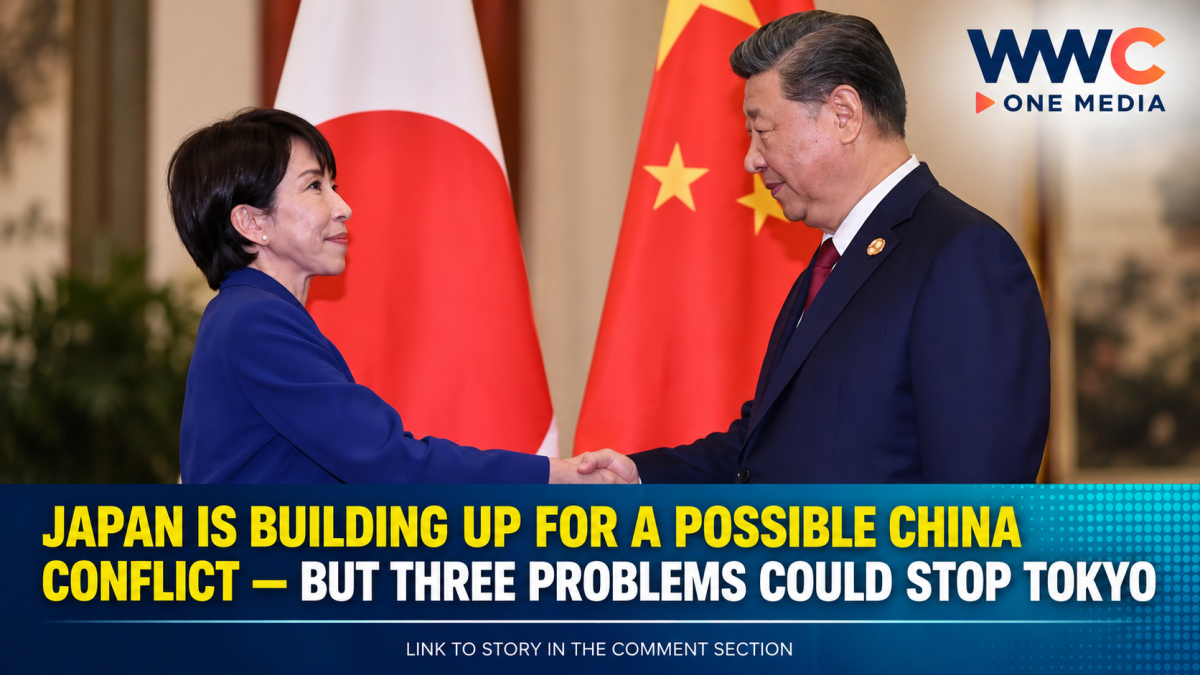
TOKYO — Japan is accelerating its biggest military transformation in decades as concerns over China, Taiwan and the wider Indo-Pacific security environment reshape Tokyo’s defense strategy.
But there is a problem that money and advanced weapons alone cannot easily solve: Japan is running short of people capable of operating the military it is building.
The country is simultaneously confronting a shrinking population, recruitment difficulties, rising fiscal pressure, limits on its defense-industrial capacity and questions about how much further the Japanese public is willing to go in abandoning its traditionally restrained postwar security posture.
The challenge comes as Prime Minister Sanae Takaichi’s government prepares to revise Japan’s three key security documents and potentially push defense capabilities even further.
Tokyo is preparing for a much more dangerous region
Japan increasingly views China as its most serious strategic challenge, particularly because of Beijing’s expanding military capabilities and the possibility that a conflict involving Taiwan could directly threaten Japan.
Japan’s 2026 defense white paper described China’s military activities as the country’s “greatest strategic challenge.” Tokyo has consequently been investing heavily in long-range missiles, drones, artificial intelligence, intelligence, surveillance and other capabilities designed to give the Self-Defense Forces greater ability to respond to a regional crisis.
The transformation represents a significant departure from the more restrained defense posture Japan maintained for much of the postwar era.
Since 2022, Tokyo has dramatically increased defense spending and adopted policies allowing it to acquire longer-range strike capabilities while expanding security cooperation with the United States, Britain, Australia and other partners.
Japan has already reached its goal of spending roughly 2% of GDP on defense-related capabilities, according to Reuters, with the government now considering further expansion.
The next military budget could get even bigger
Japan’s Defense Ministry requested a record ¥8.9 trillion, or about US$55.6 billion, for the next fiscal year.
The proposal emphasizes artificial intelligence, unmanned systems, missiles and other technologies designed to compensate for changing battlefield conditions and improve the military’s ability to operate despite manpower constraints.
Japan’s existing FY2026 defense budget already provides ¥8.809 trillion in expenditure for implementation of its Defense Buildup Program. The Defense Ministry says it is prioritizing unmanned systems, stand-off weapons, integrated air and missile defense, cross-domain operations, ammunition stocks and more resilient military facilities.
But expanding the budget raises another question:
How much can Japan continue spending without putting additional pressure on already stretched public finances?
Japan’s budget pressures are being watched closely by credit-rating agencies. Fitch has warned that the composition of the government’s expanding fiscal program will be important in determining whether Tokyo can balance growth ambitions with fiscal discipline.
Japan has the weapons plan. It needs the people.
Perhaps the biggest obstacle is personnel.
Japan’s Self-Defense Forces had 217,701 personnel against an authorized strength of 247,154 as of March 31, 2026, giving the force an overall staffing rate of just 88.1%.
The shortage is especially concerning because Japan’s population is aging and the pool of young people available for military recruitment is shrinking.
A Defense Ministry analysis projects that the population eligible for recruitment could fall by roughly 30% by 2045 compared with the end of fiscal 2024. A mechanical projection based on current personnel trends could see SDF numbers fall to roughly 130,000 by that time.
That creates a fundamental dilemma.
Japan can buy more missiles, aircraft, ships, drones and AI systems — but those systems still require people to operate, maintain and integrate them into military operations.
Tokyo is trying to make military service more attractive
The government is not ignoring the recruitment problem.
Defense Minister Shinjiro Koizumi said the SDF recruited 11,177 people in fiscal 2025, an increase of 1,453 from the previous year.
The Defense Ministry attributes the improvement partly to better working and living conditions, improved treatment of personnel and new career-support measures.
But officials recognize that recruitment improvements alone cannot fully overcome Japan’s demographic decline.
The Defense Ministry has therefore emphasized automation, unmanned systems and organizational reforms as ways of generating greater military capability with a smaller workforce.
Japan has even rejected one controversial solution
One proposal to address the manpower crisis was to allow foreign nationals to serve in the Japanese military.
Tokyo rejected that idea.
Koizumi said Japan is not considering recruiting foreign nationals into the Self-Defense Forces, instead focusing on better treatment of personnel, recruitment reforms and greater use of technology.
The decision highlights just how difficult Japan’s demographic problem has become.
The country wants a more capable military while simultaneously operating with a shrinking population and a labor market where businesses are already competing aggressively for young workers.
Public support is complicated
Japan’s security shift also faces a political challenge.
Public opinion is not simply divided between people who support a stronger military and those who oppose it.
A 2026 survey by the Japan Institute of International Affairs found that 74% supported strengthening Japan’s defense capabilities, but support dropped to 58% when the question specifically concerned increasing defense spending.
Among Japanese 18-year-olds surveyed by the Nippon Foundation, 34.5% either approved or somewhat approved of increased defense spending, while 24.4% either somewhat disapproved or disapproved; a large 41.1% said they did not know.
That distinction matters.
Many Japanese appear increasingly concerned about the country’s security environment, but that does not automatically translate into unlimited support for higher taxes, larger military budgets or a more aggressive defense posture.
Japan’s security shift is also changing its role in Asia
Tokyo’s military expansion is not happening in isolation.
Japan is strengthening security relationships with Australia, Britain, the Philippines and other Indo-Pacific partners while deepening coordination with the United States.
The country has also relaxed restrictions on defense-equipment exports, allowing Japanese companies to play a larger role in regional defense supply chains.
For countries such as the Philippines, this development is particularly significant because Japan has become an increasingly important security partner amid rising tensions in the South China Sea and around Taiwan.
But China’s government views Japan’s military transformation very differently.
Beijing has repeatedly accused Tokyo of using the China threat to justify what it describes as remilitarization, while Tokyo argues that its expanding capabilities are necessary to protect Japan and respond to a deteriorating regional security environment.
The bigger problem Tokyo cannot ignore
Japan’s military buildup is therefore entering a crucial phase.
The country has money, technology, sophisticated industries and powerful allies.
But it faces three structural constraints at the same time:
People. Japan does not have an unlimited pool of young recruits.
Money. Further defense expansion must compete with other demands on government finances.
Politics. Japanese leaders must convince voters that a larger and more capable military is necessary without triggering a backlash against the country’s postwar security identity.
And that is why Japan’s military transformation may ultimately be determined not by how many missiles Tokyo can purchase, but by whether Japan can build a sustainable defense system around a shrinking population and a divided political landscape.
The China challenge is pushing Japan toward a stronger military.
But the hardest battle for Tokyo may be happening inside Japan itself.


Leave a Reply