
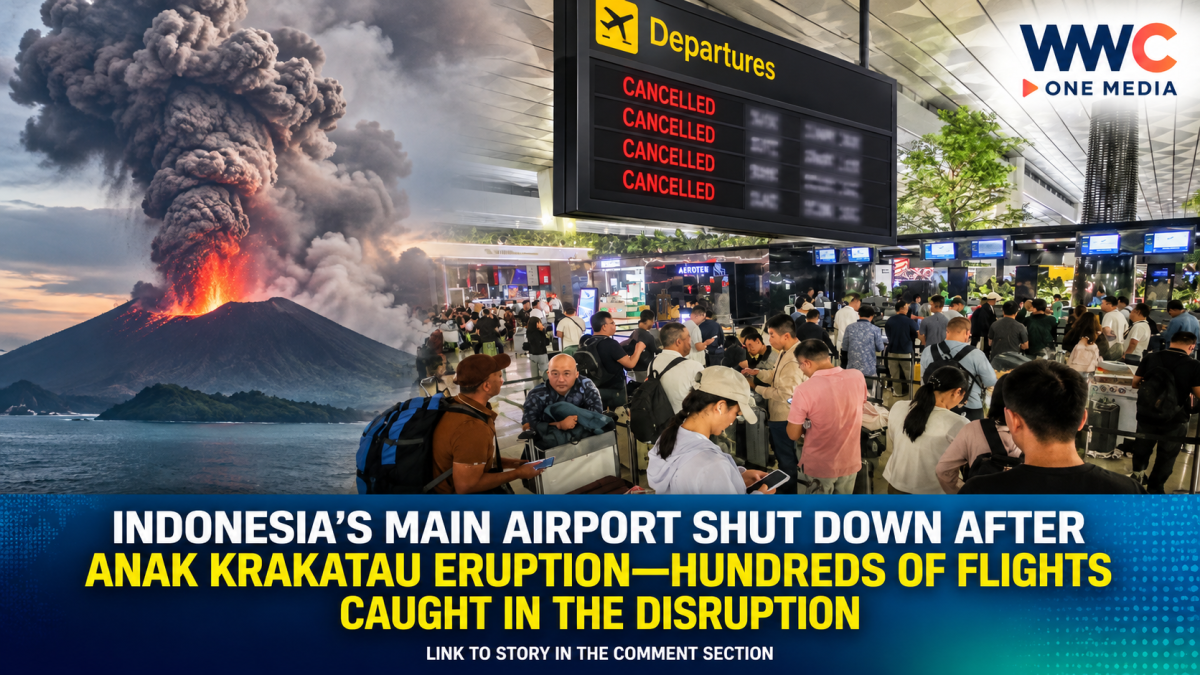
JAKARTA — Indonesia temporarily suspended flight operations at Soekarno-Hatta International Airport on Sunday after volcanic ash from an eruption of Mount Anak Krakatau spread into the airport area, disrupting hundreds of flights and affecting thousands of passengers.
The eruption of Anak Krakatau, the volcano located in the Sunda Strait between Java and Sumatra, sent ash plumes across parts of western Indonesia, prompting aviation authorities to halt operations at the country’s busiest airport as a precautionary safety measure.
Indonesia’s Ministry of Transportation said the airport closure was extended until 9:30 a.m. local time on September 6 after testing detected volcanic ash in the Soekarno-Hatta area.
The airport initially faced a temporary suspension beginning in the early hours of Sunday, but authorities extended the shutdown as ash continued to pose a potential risk to aircraft operations.
More than 200 flight movements affected
According to Indonesia’s ANTARA news agency, 209 flight movements involving approximately 22,798 passengers were affected during the closure period.
The disruption included both international and domestic services.
International routes affected included flights involving Singapore, Hong Kong, Sydney, Seoul/Incheon, Doha, Amsterdam and Kuala Lumpur. Domestic services involving destinations such as Lampung, Denpasar and Surabaya were also affected.
Reuters similarly reported that the suspension affected 209 flights, including international services.
The impact was also felt outside Jakarta. ANTARA reported that 21 flights involving Sultan Hasanuddin International Airport in Makassar were affected, with 12 cancellations and nine delays.
Why volcanic ash is dangerous for aircraft
Volcanic ash can pose a serious threat to aviation because fine particles can enter aircraft engines and potentially cause engine failure. Ash can also reduce visibility and interfere with other aircraft systems.
That is why Indonesian aviation authorities moved quickly after testing indicated the presence of volcanic ash around Soekarno-Hatta.
Authorities have been coordinating with Indonesia’s meteorological agency, aviation navigation services, airport operators and airlines to track the movement of the ash cloud and determine when flights can safely resume.
Ash spread across several parts of western Indonesia
Indonesia’s BMKG said satellite analysis on Sunday identified two clusters of volcanic ash extending across areas including Banten, Jakarta, West Java and Bengkulu.
Reuters reported that one ash plume reached roughly 20,000 feet, while another plume climbed as high as 50,000 feet, spreading over portions of Java and Sumatra and surrounding waters.
The scale and direction of the ash prompted authorities to maintain close monitoring of the atmosphere and aviation routes.
Eruption was among Anak Krakatau’s strongest activity of 2026
Indonesia’s volcanology authorities said the latest sequence of activity began on September 4 and included signs of a lava fountain. ANTARA reported that the eruption sequence had reached the highest intensity recorded at Anak Krakatau so far in 2026, with an eruption-related seismic event lasting for an extended period.
The eruption did not result in reported casualties, according to AP, and authorities did not order a general evacuation because the nearest settlement is more than 16 kilometers from the volcano.
Authorities nevertheless warned residents and visitors to maintain a safe distance from the active crater.
No immediate tsunami threat reported
Despite Anak Krakatau’s history, authorities said there was no immediate tsunami threat associated with the latest eruption, according to Reuters.
Anak Krakatau is particularly well known because its 2018 activity and partial collapse generated a tsunami that killed hundreds of people along coastal areas of Java and Sumatra. AP reported that the 2018 disaster killed at least 430 people.
Passengers urged to check flights before heading to the airport
Indonesian aviation authorities advised passengers traveling through Soekarno-Hatta to check directly with their airlines for the latest flight status rather than relying on previous schedules.
Officials warned that even after the airport reopens, the disruption could continue to affect flights because of aircraft rotations, crew assignments, connecting services and terminal capacity.
The situation remains subject to change depending on the movement of volcanic ash and further activity from Anak Krakatau.
For travelers connecting through Jakarta, the safest approach is to confirm the flight status with the airline before leaving for the airport.
This is a developing story.
WWC ONE MEDIA J.M.S




Leave a Reply