
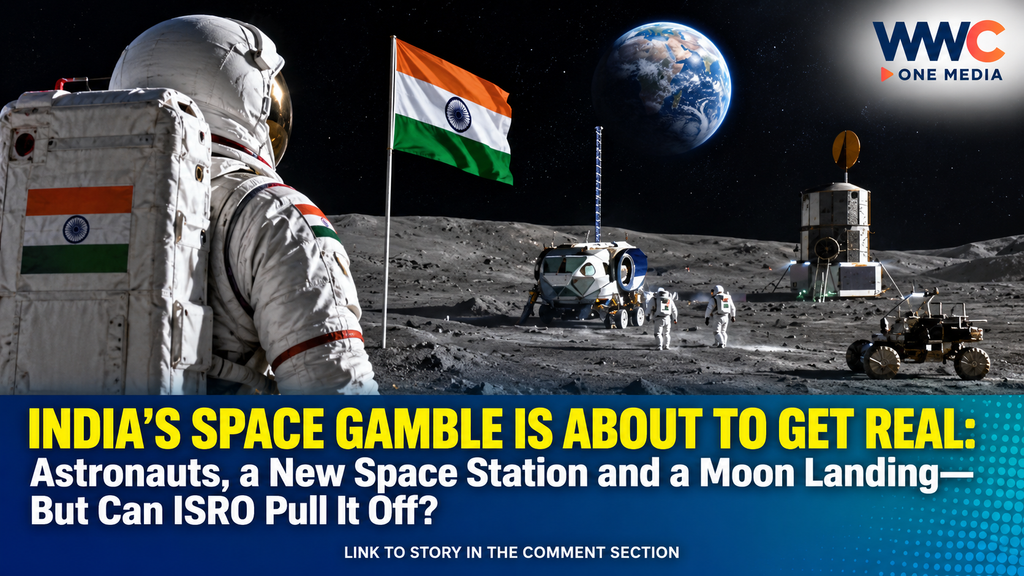
India is preparing for one of the most ambitious chapters in its space programme yet — a push that could see the country send astronauts into orbit on an Indian rocket, begin building its own space station and eventually put an Indian astronaut on the Moon.
The immediate test is Gaganyaan, India’s first indigenous human-spaceflight programme. According to the latest information from the Indian government and ISRO, the first uncrewed Gaganyaan mission is targeted for the fourth quarter of 2026, followed by additional uncrewed missions before the first planned crewed flight in 2027.
If successful, India would become only the fourth country after the United States, Russia and China to independently send humans into orbit using its own launch system and spacecraft.
Gaganyaan is the critical first step
The challenge is considerably greater than simply launching another satellite.
Human missions require spacecraft and launch systems capable of protecting astronauts through launch, orbit and the return journey — including what happens when something goes wrong.
Indian astronauts involved in the programme have emphasized that human spaceflight requires a fundamentally different safety mindset. Group Captain Shubhanshu Shukla, who became the first Indian to visit the International Space Station during the Axiom Mission 4 mission in 2025, told CNA that human missions require designers to plan not only for whether a system will fail, but what happens when it does.
India says major pieces of the programme are already progressing. The human-rated launch vehicle has completed development and ground testing of its propulsion stages and structures, while crew-escape, communications, recovery and other critical systems are undergoing qualification.
The government has also approved ₹20,193 crore for eight missions under the broader Human Spaceflight Programme.
Then comes India’s own space station
Gaganyaan isn’t intended to be a one-off achievement.
India is targeting the establishment of the Bharatiya Antariksh Station (BAS) by 2035. The planned station consists of five modules, with the first module, BAS-01, targeted for launch by 2028.
That would give India a permanent platform for conducting scientific experiments, testing technologies and developing the experience required for increasingly complex human missions.
ISRO Chairman V. Narayanan has also said India is targeting hundreds of satellite launches over the next several years while pursuing the space-station programme and Gaganyaan.
The Moon is the bigger prize
And India’s ambitions don’t stop in low-Earth orbit.
The country’s long-term roadmap calls for an Indian crewed lunar mission by 2040. Before that, India is pursuing additional robotic lunar missions, including Chandrayaan-4, which is targeted for 2027 and is designed around collecting lunar samples and bringing them back to Earth.
The progression is therefore deliberate:
Gaganyaan → Space Station → Advanced lunar missions → Indian astronaut on the Moon.
But every stage depends on India first demonstrating that it can repeatedly and safely operate human-rated spacecraft.
India is also opening its space sector to private companies
Another major change happening alongside the human-spaceflight programme is the expansion of India’s private space industry.
Since reforms introduced in 2020, India has increasingly encouraged private companies to participate in rocket manufacturing, satellite development and other space activities.
ISRO recently clarified that this does not mean the agency is being privatized.
In a September 6 statement, ISRO said it would remain India’s principal institution for advanced space research, national and strategic missions, space science and exploration. The agency said private-sector participation is intended to allow industry to scale mature technologies while ISRO concentrates more heavily on advanced capabilities and frontier missions.
That clarification came after concerns were raised by ISRO employee associations over the direction of India’s space-sector reforms. Reuters reported that the agency has reassured employees that ISRO’s importance will not be diminished.
Why this matters
India has already demonstrated that it can compete with established space powers.
Its Chandrayaan-3 mission made history in 2023 by achieving a successful soft landing near the Moon’s south polar region. Now, the country is attempting something considerably more difficult: developing the capability to routinely send people into space and eventually support human exploration beyond Earth orbit.
The next major milestone could arrive before the end of 2026, when the first uncrewed Gaganyaan mission is targeted to fly.
If those tests succeed, 2027 could mark the beginning of a new era for India’s space programme — one in which Indian astronauts finally ride an Indian spacecraft into orbit.
And if India can master that first step, the ultimate destination is no longer just Earth orbit.
It is the Moon.
Leave a Reply