
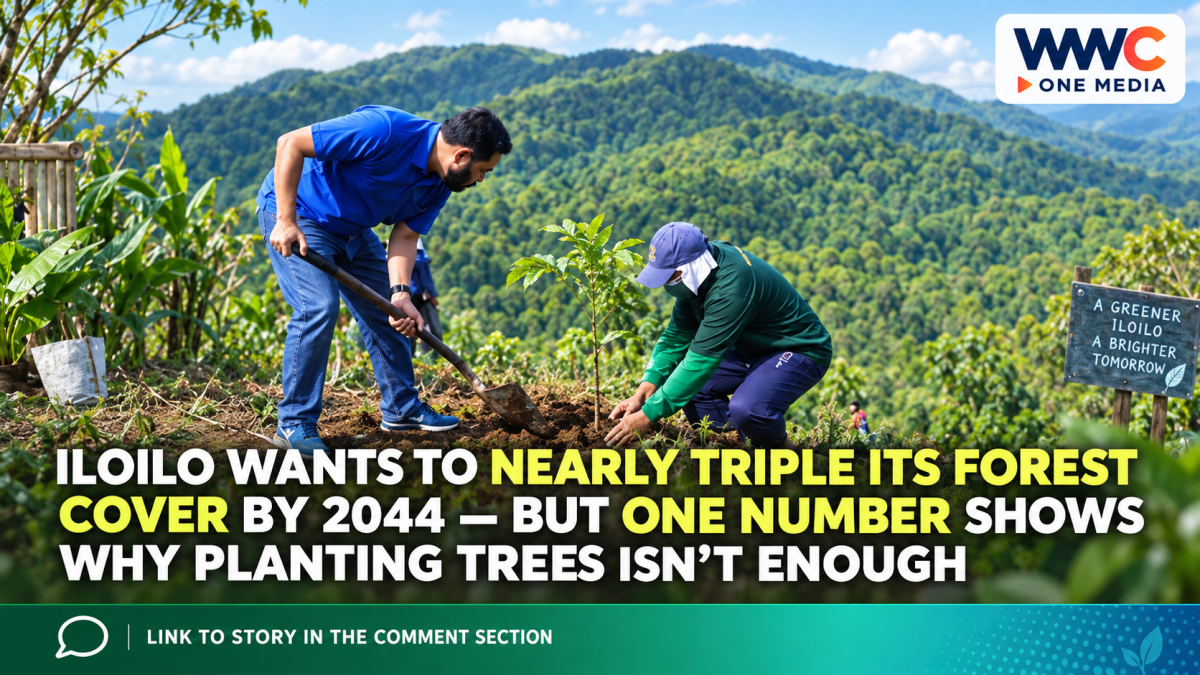
ILOILO, Philippines — Iloilo is asking communities across the province to help transform one of Western Visayas’ most heavily cultivated landscapes into something dramatically greener: a province with 33% forest cover by 2044.
The provincial government says its current forest-cover figure stands at about 12%, and reaching its long-term “Forest Province” goal would require developing roughly 37,000 to 38,000 hectares of forest, according to the Provincial Government Environment and Natural Resources Office. Iloilo has about 114,000 hectares identified by PGENRO as timberland or forestland.
The target is ambitious.
But the province insists it is not starting from zero.
Officials say Iloilo’s forest cover was only around 2% in the 1990s and early 2000s, meaning decades of rehabilitation have already produced significant gains.
Now, however, the government is trying to move from scattered planting activities toward something much harder:
creating forests that actually survive.
2,000 more trees are going into the ground
The next major push comes on Saturday, September 19, when PGENRO holds the province-wide Piyesta sa Kakahuyan tree-growing activity.
The main planting site will be in Barangay Balabag, Anilao, where participants are expected to plant about 2,000 seedlings, including jackfruit, cacao, coffee and native and fruit-bearing species.
PGENRO is calling on local government units, barangays, schools, civil-society organizations, businesses, Integrated Social Forestry communities and people’s organizations to participate.
But provincial officials are deliberately using the language of “tree growing” rather than simply “tree planting.”
That difference could determine whether the entire 2044 plan succeeds.
Planting a seedling takes minutes.
Growing it into a mature tree can take decades.
Iloilo has already planted more than 8 million seedlings
The province launched Tanum Iloilo in 2020 as its flagship province-wide tree-growing initiative.
By October 2024, official provincial data showed 8,391,587 seedlings had been planted, while Iloilo was regularly meeting an annual target of around 1.5 million seedlings.
That sounds impressive.
Then comes the number that explains why officials are now talking so much about maintenance.
The reported survival rate was only 44.42%.
Put differently, planting totals alone tell only part of the story.
Seedlings can die because of drought, fires, grazing, unsuitable planting locations, poor species selection, weeds, lack of maintenance or simply because nobody returns after the ceremonial planting day.
Panay News itself highlighted that problem after Iloilo’s June Arbor Day campaign, arguing that the true measure of reforestation should be how many trees remain alive years later rather than how many are photographed going into the soil.
That is arguably the central challenge behind Iloilo’s entire Forest Province campaign.
More than 10,000 trees went into the ground in June
The province has already staged another significant planting drive this year.
On June 25, around 2,505 Barangay Service Point Officers helped plant more than 10,000 mangrove, indigenous and fruit-bearing trees across Iloilo municipalities as part of the Arbor Day observance.
At the time, PGENRO senior environmental management specialist Mitzi Peñaflorida said the province was targeting roughly 2,000 to 3,000 hectares of planting each year in pursuit of the 2044 goal.
The strategy extends beyond remote mountains.
Gov. Arthur Defensor Jr. said Tanum Iloilo also targets secondary forests, Integrated Social Forestry sites and available public and private spaces such as schools, universities, parks, subdivisions and commercial properties.
That means the campaign is increasingly becoming less about one giant forest and more about rebuilding green cover across multiple types of land.
Schools are now part of the strategy
The provincial government formally brought another major partner into the effort in June: DepEd Iloilo.
Under a memorandum between the province and the Schools Division of Iloilo, schools will work with PGENRO through Tanum Iloilo and DepEd’s Eco Champions initiative.
The province will provide seedlings, technical guidance and training on growing and maintaining trees, with an emphasis on native, endemic and fruit-bearing species.
Earlier planning also introduced a seed-exchange system in which school communities help collect seeds that can be developed into future planting material.
That approach potentially solves two problems at once.
Schools can create greener campuses.
At the same time, students grow up seeing forest restoration as a long-term responsibility rather than an annual government ceremony.
Iloilo is experimenting with drones and seedballs
The province is also trying to modernize how reforestation is done.
In July, PGENRO met with the Sulu Garden Foundation, DENR Region VI, University of the Philippines Visayas, and the municipalities of Miag-ao and Igbaras to work on what the province described as evidence-based reforestation.
One initiative under discussion combines seedballs with drone technology to help restore difficult-to-reach areas.
Such approaches could potentially make planting on steep or inaccessible terrain faster.
But drones cannot solve the survival problem by themselves.
Seeds still need suitable soil, moisture and protection, and restored land has to be monitored.
That explains why provincial planners say they are also considering assisted natural regeneration and rewilding, approaches that protect degraded land so existing vegetation and naturally regenerating trees can recover rather than relying exclusively on newly planted seedlings.
Bamboo is being treated as another weapon
Provincial planners have also identified bamboo as one component of the long-term strategy.
Earlier this year, officials discussed establishing large bamboo nurseries because the plant grows quickly and can help stabilize riverbanks while supporting livelihoods.
DENR has separately been working with forest-dependent communities in Maasin to turn bamboo into higher-value products such as handicrafts rather than relying solely on selling raw material.
That livelihood component is important.
Forest protection becomes considerably harder when upland residents must choose between conservation and earning an income.
A sustainable forest strategy therefore has to answer a practical question:
How can communities make money while keeping trees standing?
Jalaur offers evidence that community forestry can work
Iloilo already has one major case study.
The DENR-Japan International Cooperation Agency Forestland Management Project worked with communities in the Jalaur River Basin, particularly in Calinog, Lambunao and Janiuay.
A joint monitoring assessment found about 13,027 hectares of new tree and agroforestry plantations and a 16.44% increase in vegetative cover between 2015 and 2021 within project areas.
The initiative involved 22 people’s organizations and combined forest rehabilitation with livelihoods and infrastructure.
Communities grew crops including coffee while the project provided roads, pathways, bridges and irrigation facilities.
Some beneficiaries reported higher incomes and improved access to education and health services.
That experience matters because it demonstrates why forest restoration cannot simply be imposed from the provincial capitol.
People who live inside and around forestlands must have a reason to protect them.
Forests are also part of Iloilo’s water strategy
Iloilo’s reforestation drive is closely connected to another increasingly urgent problem: water security.
The province launched a long-term Integrated Water Security Plan this year after identifying recurring problems including depleted water sources, poor water quality, drought and rising treatment costs.
Only 11 of the province’s 43 local government units currently have household access to safely managed drinking-water services meeting the cited 62% national target, according to provincial figures.
Healthy upland forests and watersheds can help regulate runoff, reduce erosion and protect water sources.
That means a tree growing today may eventually affect whether downstream communities have cleaner and more reliable water during increasingly severe dry periods.
The forest campaign is therefore not simply about making Iloilo greener.
It is also about making it more resilient.
Coastal forests matter too
The province’s definition of restoration extends all the way to the coast.
In July, Iloilo signed a partnership with the Zoological Society of London-Philippines covering mangrove and beach-forest rehabilitation, marine protected areas and blue-carbon research.
Under the agreement, communities will take part in restoration while ZSL provides scientific and technical support.
Mangroves are particularly important in a typhoon-prone country because they can help reduce coastal erosion and wave impacts while serving as nursery areas for fish and other marine life.
So when Iloilo talks about becoming a Forest Province, it is not referring solely to mountains covered with hardwood trees.
The strategy includes upland forests, watersheds, bamboo, agroforestry, urban spaces and coastal mangroves.
One number, however, needs clarification
There is an unresolved inconsistency in the province’s publicly reported forest-cover baseline.
The September 15 Panay News report, citing PGENRO, says Iloilo is currently at 12% forest cover and wants to reach 33%.
Official provincial and PIA reports from 2024 also used the 12% figure.
However, on June 25, 2026, Philippine News Agency quoted PGENRO’s Peñaflorida as saying Iloilo’s current forest cover was 18%, also with a 33% target.
The available reports do not explain whether the difference reflects updated mapping, a different land-area denominator, reclassification, or simply inconsistent reporting.
Until PGENRO publishes a clearly defined and updated forest-cover inventory, the exact starting percentage should therefore be treated with caution.
The 33% target and 2044 deadline, however, have remained consistent across provincial reporting.
The real race is not to plant 38,000 hectares
The headline ambition is easy to understand:
Turn roughly 12% forest cover, according to the latest provincial report, into 33%.
Restore around 37,000 to 38,000 hectares.
Do it by 2044.
But the millions of seedlings Iloilo has already planted reveal why that headline target is only the beginning.
A seedling recorded in a government accomplishment report is not yet a forest.
A forest must survive dry seasons, fires, land conversion and human pressure.
It must regenerate.
It must protect soil and water.
It must support biodiversity.
And if communities depend on it, it must somehow coexist with their economic needs.
That is why the most important message coming from PGENRO ahead of this year’s Piyesta sa Kakahuyan may also be the simplest:
Planting is not enough. The trees have to live.
Iloilo has already shown that it can mobilize thousands of residents and put millions of seedlings into the ground.



Leave a Reply