
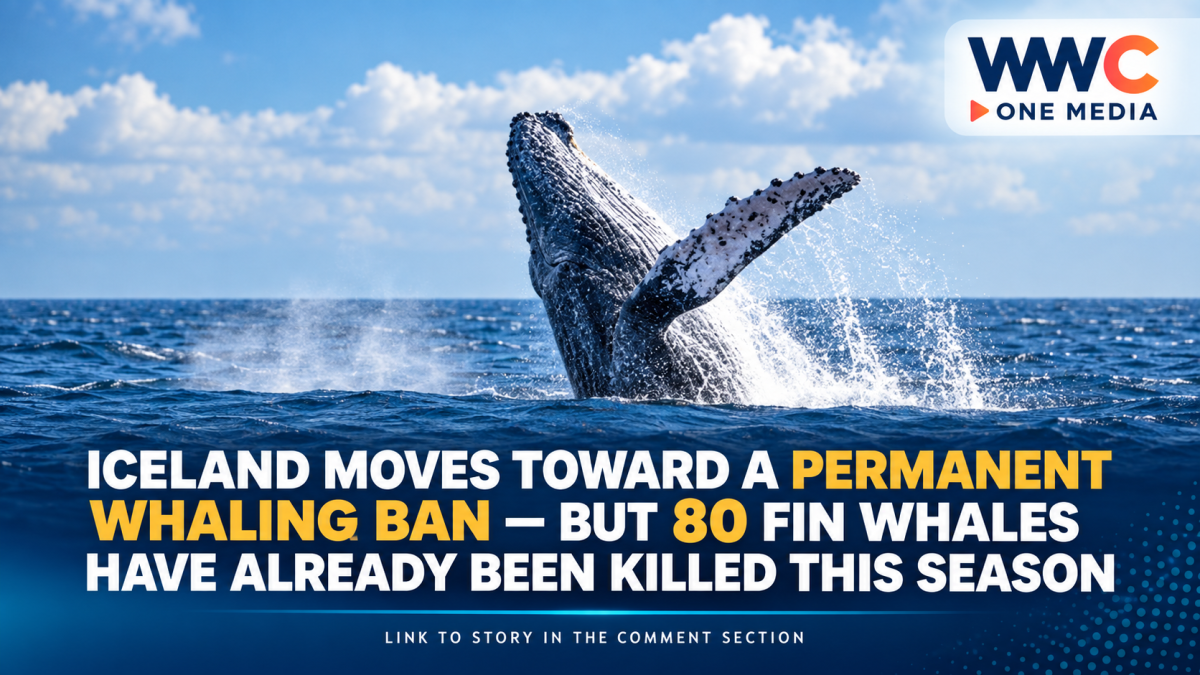
REYKJAVIK — Iceland is moving closer to ending one of its most controversial maritime traditions, with the government preparing legislation that could permanently outlaw commercial whaling and dramatically shrink the already small group of countries that still permit the practice.
The Icelandic government is expected to submit amendments to the country’s Whaling Act in February 2027, with a permanent prohibition on whaling among the measures being advanced. Because the governing coalition holds a parliamentary majority, the proposal has significant political momentum — although it must still pass through Iceland’s legislative process before any ban becomes law.
If approved, the change would leave Norway and Japan as the principal countries continuing commercial whale hunts, according to records from the International Whaling Commission.
For conservation groups, that would mark a major shift in a decades-long international dispute.
But the announcement comes while Icelandic whalers are still at sea.
As of September 9, 80 fin whales had been killed during Iceland’s 2026 season, according to Humane World for Animals, which has been tracking the hunt. The country’s quota permits up to 150 fin whales this season.
That creates a striking contrast: Iceland may be preparing to consign commercial whaling to history, even as the country’s current licensing system continues to permit the killing of whales classified as vulnerable.
Why fin whales are at the centre of the debate
Fin whales are the primary target of Iceland’s commercial industry and are the world’s second-largest whale species.
The International Union for Conservation of Nature classifies the species as Vulnerable, a status reflecting the enormous historical impact of industrial whaling even though some populations have recovered significantly since large-scale hunting declined.
Animal-welfare concerns have increasingly become just as important as conservation arguments.
The Guardian reported that a government-commissioned investigation into Iceland’s whale hunts found serious welfare problems, including cases in which harpooned whales remained alive for extended periods — in some instances for as long as two hours. Those findings contributed to the temporary suspension of hunting in 2023.
The controversy intensified debate inside Iceland over whether commercial whaling can meet modern animal-welfare standards at all.
Iceland still has whaling licences running through 2029
One complication is that Iceland’s existing commercial whaling permits extend well beyond the proposed legislation.
In December 2024, Iceland’s outgoing government granted five-year licences covering fin and minke whale hunting. Government records said the licences were subject to quotas based on scientific advice and included monitoring, equipment and training requirements.
Hvalur hf., Iceland’s principal fin-whaling company, consequently holds authorization extending through the period covered by those permits.
That means lawmakers may eventually have to determine how a new prohibition would interact with licences already issued.
It also explains why activists are treating the February bill as a major step rather than declaring Icelandic whaling finished already.
The economics of whaling have also weakened
The pressure on Iceland’s whaling industry has not come solely from environmental campaigners.
Its commercial foundation has also become less secure.
Hvalur cancelled its 2025 fin-whale hunt after saying that prices in Japan — historically the company’s main export market — had fallen to levels that made hunting economically unattractive. Reporting at the time said almost all of Hvalur’s whale meat was exported to Japan.
That creates an unusual relationship between two of the world’s remaining whaling nations.
Japan is simultaneously one of the most important markets for Icelandic whale products and one of the countries that could become increasingly isolated if Iceland leaves the commercial hunt.
How Iceland, Norway and Japan remained outside the global mainstream
The modern dispute dates back more than four decades.
The International Whaling Commission agreed in 1982 to establish a pause on commercial whaling, with the moratorium taking full effect during the 1985-86 season. It remains in force today.
Norway lodged a formal objection and later resumed commercial hunting in 1993.
Iceland left the IWC in 1992, then rejoined in 2002 with a reservation to the moratorium. Iceland resumed commercial whaling in 2006, allowing it to set national catch limits rather than follow the IWC’s zero commercial-catch rule.
Japan followed a different route.
Tokyo formally withdrew from the International Whaling Commission in 2019 and resumed commercial hunting that year within its territorial waters and exclusive economic zone. Because Japan is no longer an IWC member, it is no longer bound by the organisation’s commercial-whaling moratorium.
If Iceland now exits commercial whaling, that decades-old alignment would be reduced further.
A ban would not mean all whale hunting worldwide ends
There is an important distinction.
The international commercial-whaling moratorium does not eliminate every form of whale hunting.
The IWC separately recognises aboriginal subsistence whaling, under which certain Indigenous communities may hunt specified whale populations because whales remain important for nutrition, culture and community life.
That includes hunts in places such as Greenland and Alaska.
So saying that Norway and Japan would become the “only countries that hunt whales” would be inaccurate.
The more precise statement is that, if Iceland adopts the proposed prohibition, Norway and Japan would remain the major states conducting commercial whaling outside the IWC moratorium framework.
The February 2027 vote could become the real turning point
For decades, Iceland defended commercial whaling as a regulated use of marine resources.
Its 2024 government said its licensing system was based on scientific assessments, sustainable exploitation and a precautionary approach.
But the political environment has changed.
Animal-welfare findings have raised questions about how quickly whales die after being struck. Conservation groups continue to focus attention on the vulnerable status of fin whales. The industry’s export economics have weakened. And the current government now appears prepared to put a permanent ban before lawmakers.
That combination makes the coming legislation much more than another argument over annual hunting quotas.
It could determine whether Iceland remains one of commercial whaling’s final holdouts — or becomes the latest former whaling nation to walk away from the industry entirely.
And should Iceland choose the latter, the global map of commercial whaling would narrow dramatically.
Norway and Japan would find themselves increasingly alone.




Leave a Reply