
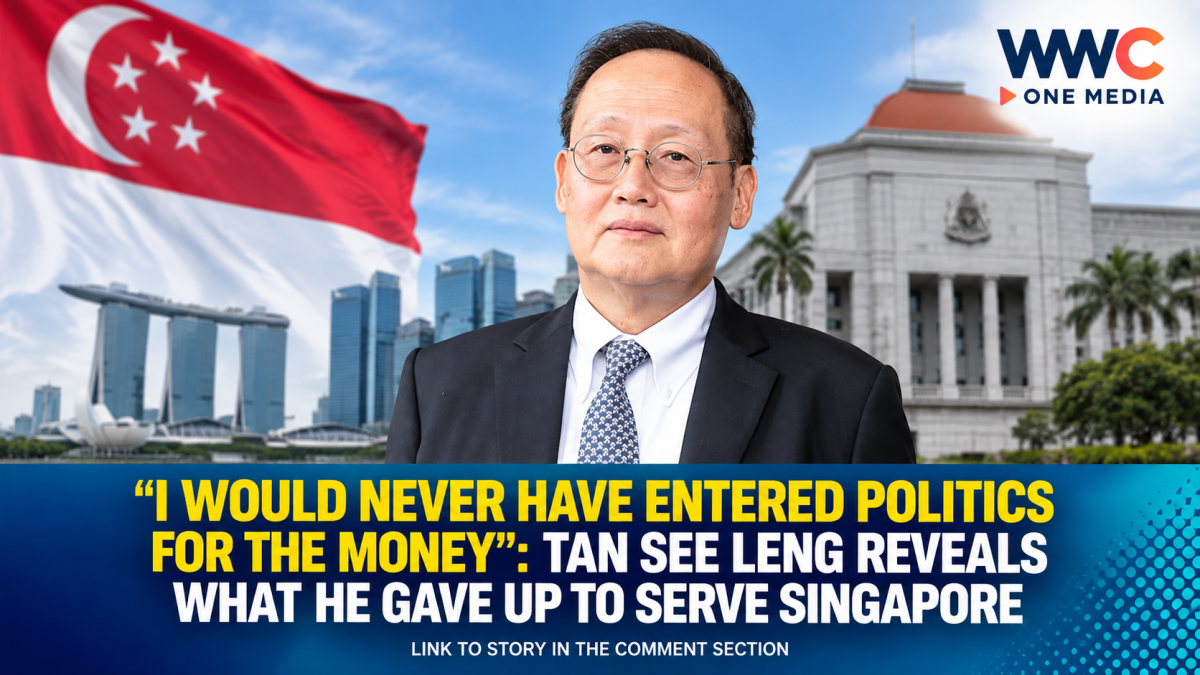
SINGAPORE — Singapore’s heated debate over ministerial salaries became deeply personal on Thursday after Tan See Leng opened up about what he gave up when he left a lucrative private-sector career to enter politics.
Speaking in Parliament during the debate on Singapore’s political salary framework, Dr Tan said that if money had been his primary consideration, he would not have entered politics in the first place.
Instead, he said he felt compelled to give back to Singapore and the people who had contributed to his life and career.
“If money had been his primary consideration, he would never have entered politics,” was the central message of Dr Tan’s speech, according to CNA.
FROM DOCTOR TO HEALTHCARE EXECUTIVE — THEN POLITICIAN
Tan’s argument carries particular weight because of his own career path.
Before entering politics in 2020, he was a practicing doctor and built a lengthy career in healthcare management.
He founded Healthway Medical Group and served as its CEO from 1993 to 2002. Under his leadership, the group expanded to 40 locations and recorded turnover of S$20 million.
He later held senior leadership positions at Parkway Pantai and IHH Healthcare, including serving as group CEO and managing director.
Singapore’s Prime Minister Lawrence Wong has also pointed to the value of attracting people with substantial private-sector experience into government, highlighting Tan as an example of the kind of professional background that can strengthen the Cabinet.
“THE PERSONAL PRICE BECOMES TOO GREAT”
Tan said political service involves sacrifices that extend beyond the individual politician.
Those considering public office, he said, must consider the impact on their spouses and children, while giving up time, privacy, personal goals and potentially significant financial opportunities.
Some potential candidates could ultimately conclude that the total personal cost is simply too high.
And if that happens repeatedly, Tan warned, Singapore could lose talented people not because they lack the desire to serve, but because the personal price becomes too heavy.
That argument goes to the heart of Singapore’s political-pay system: whether remuneration should be sufficiently competitive to persuade capable professionals to enter public service without turning politics into a financially motivated career.
HIS PRIVATE-SECTOR INCOME COULD NOT HAVE BEEN MATCHED
Tan was particularly direct about his own experience.
He said no realistic ministerial salary could have matched what he was earning before entering government — or what he might have continued earning had he remained in the private sector.
That distinction is important.
The government’s argument for competitive political salaries is not that ministers should be paid exactly what they could command in the private sector.
Instead, Singapore’s salary framework is designed to benchmark political remuneration against the private sector while applying a discount to reflect the ethos of public service.
SO HOW DOES SINGAPORE’S NEW SALARY SYSTEM WORK?
The government has accepted recommendations from an independent review committee to update the political salary framework.
Under the revised system, the MR4 reference salary for a minister will rise from S$1.1 million to S$1.8 million.
But that does not mean every minister will immediately receive S$1.8 million.
Existing political office holders will instead receive a one-off adjustment of up to 9% from Oct. 15, 2026, depending on individual circumstances, including performance.
For example, a minister currently receiving the S$1.1 million MR4 reference salary who receives the full 9% adjustment would earn about S$1.2 million.
The government says there will not be an immediate move to the new S$1.8 million benchmark.
Prime Minister Wong expects most ministers who remain at MR4 to be at the lower end of the revised salary range — around S$1.35 million by the end of the current government term.
THE S$1.8 MILLION FIGURE IS NOT A GUARANTEED PAYCHECK
This is one of the most important points to clarify.
The S$1.8 million figure is a reference benchmark, not an automatic salary target.
Under the revised framework, ministerial salaries will sit within prescribed ranges, with individual positioning influenced by performance and responsibilities.
The government has also widened the salary range for ministerial grades to between 75% and 125% of the relevant reference salary.
The framework also merges the MR2 and MR3 grades, reducing the number of ministerial grades from four to three.
WHY THE GOVERNMENT SAYS THE CHANGE IS NECESSARY
The independent review committee reaffirmed three principles behind Singapore’s political salary framework:
Calibre — remuneration should be benchmarked against the market so capable Singaporeans are not discouraged from entering political service.
Commitment — politicians should receive a meaningful discount compared with comparable private-sector benchmarks.
Clean — political office holders should receive transparent remuneration without hidden perks.
The government says the framework has remained largely unchanged for 15 years, despite the country’s economy and private-sector earnings changing significantly.
MP ALLOWANCES ARE ALSO GOING UP
The changes extend beyond ministers.
From Oct. 15, 2026, the monthly allowance for Members of Parliament will rise from S$13,750 to S$18,500.
Allowances for Non-Constituency MPs and Nominated MPs will also be revised.
The revised framework also updates the salaries pegged to the President, Prime Minister, Speaker and Deputy Speaker.
The Prime Minister’s annual salary package, for example, will be set at S$3.6 million under the revised framework. Wong has said he will donate the increase resulting from the adjustment to charity for five years.
TAN: POLITICS MUST NEVER BE ABOUT PROFIT
Despite defending the need to make political service financially viable, Tan was explicit about where he believes the line should be drawn.
He said public service must never be motivated by financial profit.
The objective, he argued, is not to make ministers financially equivalent to their private-sector counterparts.
Rather, Singapore needs to ensure that talented people — including professionals and executives still in the prime of their careers — are not automatically excluded from public service because the personal and financial sacrifice is too large.
Tan said this could include entrepreneurs whose businesses are beginning to succeed, finance professionals entering their highest-earning years, and mid-career executives simultaneously supporting children and ageing parents.
These are precisely the people, he argued, whose experience could benefit Singapore if they choose to serve.
THE BIGGER QUESTION BEHIND THE SALARY DEBATE
The controversy ultimately goes beyond the size of a minister’s paycheck.
Singapore already has one of the world’s highest-paid political leadership teams, and the issue has long generated public debate over whether high salaries are justified by the need to recruit talent, maintain integrity and discourage corruption. Reuters noted that the existing salary framework had remained unchanged since the 2012 implementation despite Singapore’s leaders already ranking among the world’s highest-paid political figures.
The government’s response is that the framework must remain competitive enough to attract people with the calibre, experience and integrity needed to govern Singapore.
Tan’s argument adds another dimension: the country is not merely competing with private-sector salaries — it is asking individuals and their families to accept a very different way of life.
And for Singapore, he suggested, the bigger danger may not be paying capable leaders too much.
It could be making public service so personally costly that some of the people Singapore most needs never answer the call.

Leave a Reply