
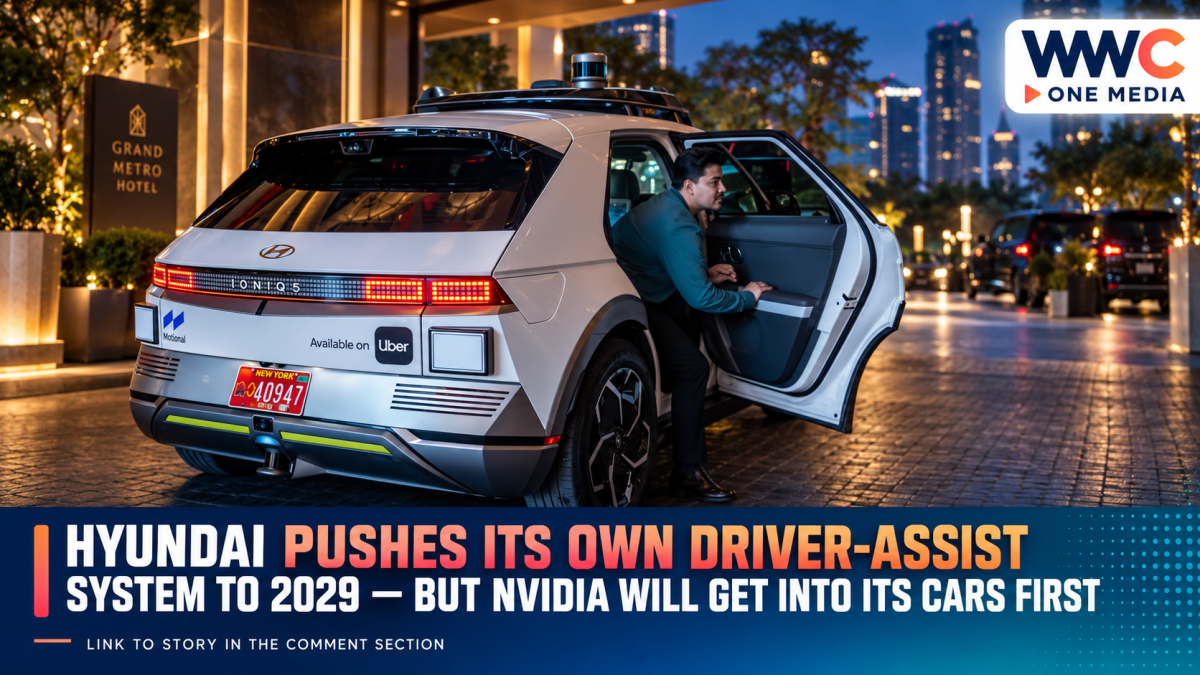
SEOUL — Hyundai Motor Group is pushing the production rollout of its proprietary driver-assistance technology to late 2029, roughly two years later than its previously reported target, as the South Korean auto giant turns to Nvidia to help accelerate its next generation of software-defined vehicles.
The revised timetable adds a new twist to Hyundai’s increasingly high-stakes race against Tesla, Chinese automakers and other global manufacturers investing heavily in artificial intelligence and automated driving.
Rather than wait until its own technology is ready for mass production, Hyundai plans to introduce more advanced driver-assistance capabilities developed with Nvidia in 2028, before deploying its internally developed Atria AI more broadly in production vehicles the following year.
Nvidia becomes the bridge to 2029
Hyundai Motor Group executive Park Min-woo said the partnership should not be interpreted as the automaker surrendering control of its autonomous-driving future to Nvidia.
Instead, Hyundai intends to use Nvidia’s technology as part of a development cycle that gives the automaker access to more real-world driving data while it continues training and improving Atria AI.
The companies expanded their partnership in March, announcing that Hyundai Motor and Kia would build next-generation driving systems around the Nvidia DRIVE Hyperion platform. Nvidia said the cooperation would combine Hyundai’s large global vehicle fleet with Nvidia’s accelerated computing and AI infrastructure.
Hyundai’s own 2026 roadmap puts the strategy into two broad stages.
In 2028, its first mass-produced software-defined vehicle is expected to receive Level 2+ driving technology developed through the Nvidia collaboration.
Then, as Hyundai collects and analyzes data from those vehicles, the company plans to improve Atria AI and progressively expand its own technology across future models.
That makes Nvidia more than a conventional supplier. Its technology effectively becomes part of the bridge Hyundai hopes will take it from today’s advanced driver assistance to a broader internally controlled software ecosystem.
What Level 2+ and Level 2++ actually mean
There is an important distinction for drivers.
The systems Hyundai and Nvidia are discussing for the near term should not be confused with fully autonomous cars.
Reuters reported that Hyundai expects Level 2+ systems to provide more capable assistance on highways, while the more advanced Level 2++ designation can extend assistance into more complicated driving environments.
But the driver must still supervise the vehicle.
Under the widely used SAE/NHTSA framework, Level 2 technology can control steering and acceleration or braking simultaneously, but the human driver remains responsible for watching the road and intervening when necessary.
True conditional automation begins at Level 3, while Level 4 systems can perform the entire driving task within defined operating areas without continuous human supervision.
The “2+” and “2++” terminology used by automakers and technology companies therefore describes capabilities beyond conventional Level 2 systems, rather than separate official SAE automation levels.
Hyundai is betting on cameras and radar first
Another significant part of Hyundai’s strategy involves what its vehicles will see.
According to Reuters, vehicles using Nvidia’s Hyperion 10 architecture are initially expected to rely on cameras, radar and ultrasonic sensors, rather than the more expensive lidar sensors found on some autonomous-driving platforms.
Hyundai has not ruled lidar out entirely.
Park said the company is considering the technology for future Level 3 systems, where redundancy becomes particularly important because the vehicle can assume substantially more of the driving task under specific conditions.
No commercialization date for Hyundai’s Level 3 system was announced.
Atria AI will start learning before 2029
Although mass production using Hyundai’s proprietary system is targeted for 2029, Atria AI will not remain on the sidelines until then.
Hyundai says it plans to deploy Atria AI in Gwangju, South Korea, by the end of 2026 to collect difficult and unpredictable real-world driving scenarios that can be used to improve its models.
That effort connects with a wider autonomous-driving demonstration project involving Hyundai, Kia, the South Korean government and mobility companies.
Yonhap reported that the project calls for roughly 200 autonomous vehicles based on the Hyundai Ioniq 5, with Atria AI analyzing road data as developers work toward technology equivalent to Level 4 automation within designated operating environments.
Hyundai’s software subsidiary 42dot, headed by Park, is central to developing Atria.
Park joined Hyundai after previously working as an Nvidia executive and now leads the group’s Advanced Vehicle Platform division as well as 42dot, underscoring how closely Hyundai is linking vehicle engineering, AI and software development.
Seven million vehicles could become Hyundai’s biggest weapon
Hyundai believes scale could ultimately give it an advantage that software startups cannot easily replicate.
Hyundai Motor and Kia collectively sell more than seven million vehicles annually, giving the group the potential to collect enormous amounts of real-world driving information as compatible software and sensors spread across its fleet.
The company says that data can feed a continuous development loop: vehicles collect information, AI models learn from it, engineers improve the software, and updates can then be returned to vehicles.
Hyundai expects its accumulated autonomous-driving data to surpass competitors by 2033, according to Reuters.
Supporting that ambition will be another enormous investment.
Beginning in 2029, Hyundai plans to operate its Saemangeum AI Data Center, a 100-megawatt facility designed to accommodate more than 50,000 GPUs for large-scale AI computing and vehicle-data processing.
Hyundai and Nvidia are working on far more than cars
The relationship also extends beyond passenger vehicles.
Hyundai and Nvidia are cooperating across AI infrastructure, autonomous driving and physical AI, while Hyundai-owned Boston Dynamics is developing humanoid robots as the automaker expands into robotics.
Separately, Hyundai’s autonomous-driving venture Motional is part of the Nvidia partnership aimed at developing Level 4 robotaxi technology.
That broader strategy shows why the delayed Atria rollout matters.
Hyundai is no longer competing only over engines, batteries or vehicle design. Increasingly, the battle is over AI models, computing platforms, sensor architectures, software updates and — perhaps most critically — driving data.
The delay may matter more than the technology
Hyundai’s revised 2029 timetable gives competitors additional time to advance.
Tesla continues to develop increasingly capable supervised driving software, while Chinese automakers and technology companies are investing aggressively in intelligent vehicles and autonomous systems. Reuters noted that Hyundai’s delay has intensified concerns that it could lose ground in that competition.
But Hyundai is making a different bet.
Instead of insisting every piece of technology be developed internally before deployment, it is using Nvidia to accelerate commercialization while simultaneously collecting the data needed to strengthen its own Atria platform.
That approach could shorten the gap — or make Hyundai increasingly dependent on one of the world’s most powerful AI technology suppliers.
The real test will therefore come after the Nvidia-powered vehicles reach customers in 2028.
If millions of Hyundai and Kia vehicles begin feeding a rapidly expanding AI data network, the two-year delay may ultimately matter less. But if rivals improve faster during the same period, Hyundai could reach 2029 only to discover that the autonomous-driving race has already moved on.



Leave a Reply