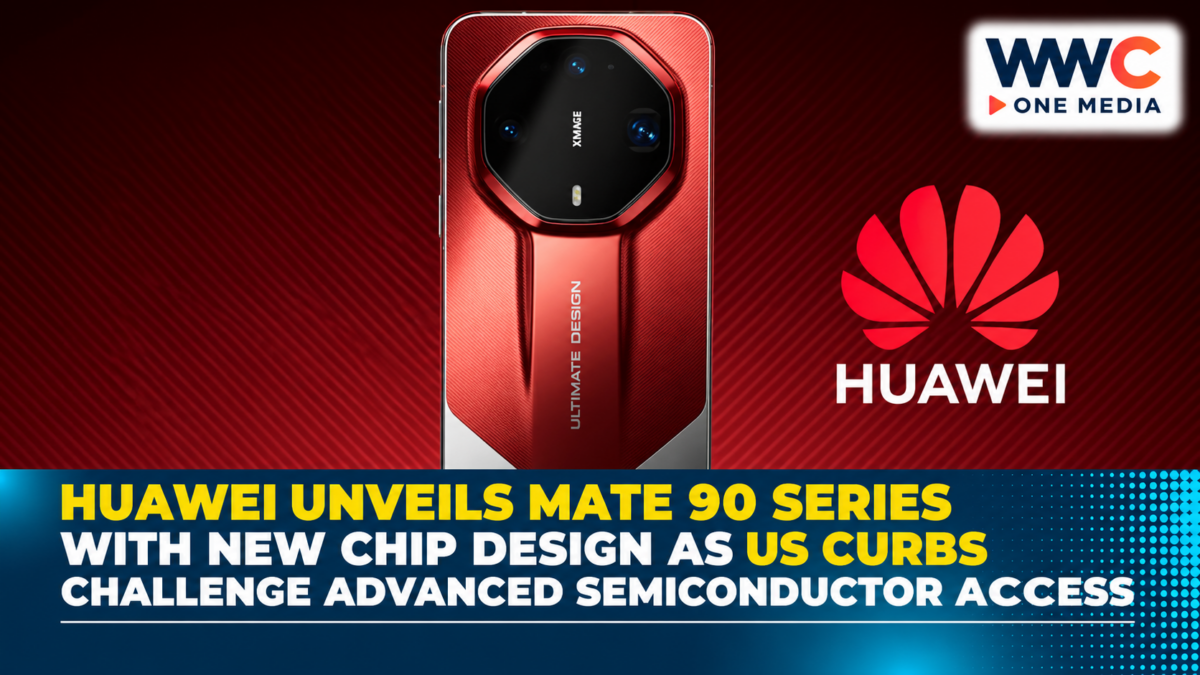
Huawei has launched its Mate 90 smartphone series, placing greater emphasis on its homegrown operating system and a redesigned chip architecture as the Chinese technology giant continues to navigate US restrictions on access to advanced semiconductor technology.
The new flagship lineup was unveiled on October 1, with Huawei positioning the Mate 90 as another step in its effort to improve smartphone performance while relying more heavily on technologies developed within China. The company has faced restrictions that have limited its access to some of the most advanced chipmaking equipment and components.
At the center of the new lineup is Huawei’s Kirin 9050 Pro processor, which powers premium models including the Mate 90 Pro Max. The chip uses a design technique Huawei calls “LogicFolding,” which rearranges internal chip wiring in three dimensions instead of relying solely on a conventional two-dimensional layout.
Huawei says the approach allows more processing elements to be packed into a smaller space, potentially improving performance despite constraints in advanced semiconductor manufacturing. The method, however, also requires more wafers during production, adding another challenge as China continues to face limits on advanced chipmaking capacity.
Huawei consumer business chief Richard Yu acknowledged that advanced semiconductor capacity remains limited in China. He said the company’s smartphone chip supply remains tight, while Huawei’s Ascend artificial intelligence processors are also competing for access to the same constrained manufacturing capacity.
China’s chip industry continues to rely heavily on deep ultraviolet, or DUV, lithography equipment. More advanced extreme ultraviolet, or EUV, technology remains difficult for Chinese manufacturers to access because of international export restrictions. Huawei has said it plans to make greater use of its LogicFolding approach in future smartphones as it works around those limitations.
Huawei has not publicly identified the manufacturer of the Kirin 9050 Pro. Semiconductor Manufacturing International Corp., China’s largest logic chip foundry, is widely believed to be involved in producing Kirin processors used in Huawei devices, although the company has not confirmed that it manufactures the new chip.
The Mate 90 series also runs on HarmonyOS 7, Huawei’s proprietary operating system that does not rely on Android. Huawei says the latest version supports more than 450,000 applications and services, reflecting the company’s broader effort to build an ecosystem independent of US technology.
The top-end Mate 90 Pro Max with 16GB of memory and 512GB of storage is priced at 9,999 yuan, or about US$1,491. That is 2,000 yuan more than the equivalent Mate 80 model when it was launched. The standard Mate 90 starts at 5,999 yuan, while the Pro model starts at 6,999 yuan.
Huawei says the highest-end Mate 90 models deliver a 31% improvement in overall performance compared with the previous flagship generation. The company is seeking to maintain its position in China’s premium smartphone market at a time when manufacturers are dealing with higher memory and component costs.
Yu said rising memory prices had increased the cost of each smartphone by an average of about US$200, putting pressure on manufacturers’ margins. Huawei has therefore also raised prices, although the company said it was doing so more gradually.
The launch comes as China’s broader smartphone market faces weaker shipments. IDC data cited in the reports showed domestic smartphone shipments declined 7% year on year between January and August, while Huawei’s shipments increased 13% over the same period.
Average smartphone selling prices in China also increased as manufacturers shifted toward more expensive devices. The average selling price reached US$543 in the second quarter, an 11.3% year-on-year increase, while Huawei’s average smartphone price stood at US$628 after declining 14.7% from a year earlier.
Huawei is also entering a more competitive foldable-phone market following Apple’s launch of its first foldable smartphone. Huawei currently holds about 75% of China’s foldable market, according to Yu, giving the company a significant presence in a segment that is becoming increasingly important to premium smartphone makers.
Huawei said sales of its Pura X Max foldable phone jumped 76% week on week between September 10 and 13 following Apple’s foldable-phone announcement. The company said shipments of the Pura X Max had surpassed 1.2 million units in China since its April release.
The Mate 90 launch therefore represents more than another flagship-phone refresh. It highlights Huawei’s continued effort to redesign its hardware and software around technologies that can be developed and manufactured within China’s increasingly constrained semiconductor ecosystem.
As US restrictions continue to limit access to advanced chipmaking technology, Huawei’s ability to improve performance through alternative architectures such as LogicFolding could become increasingly important to its smartphone strategy. At the same time, the company’s executives acknowledge that manufacturing capacity remains a significant constraint as demand for both smartphone and artificial intelligence chips grows.