
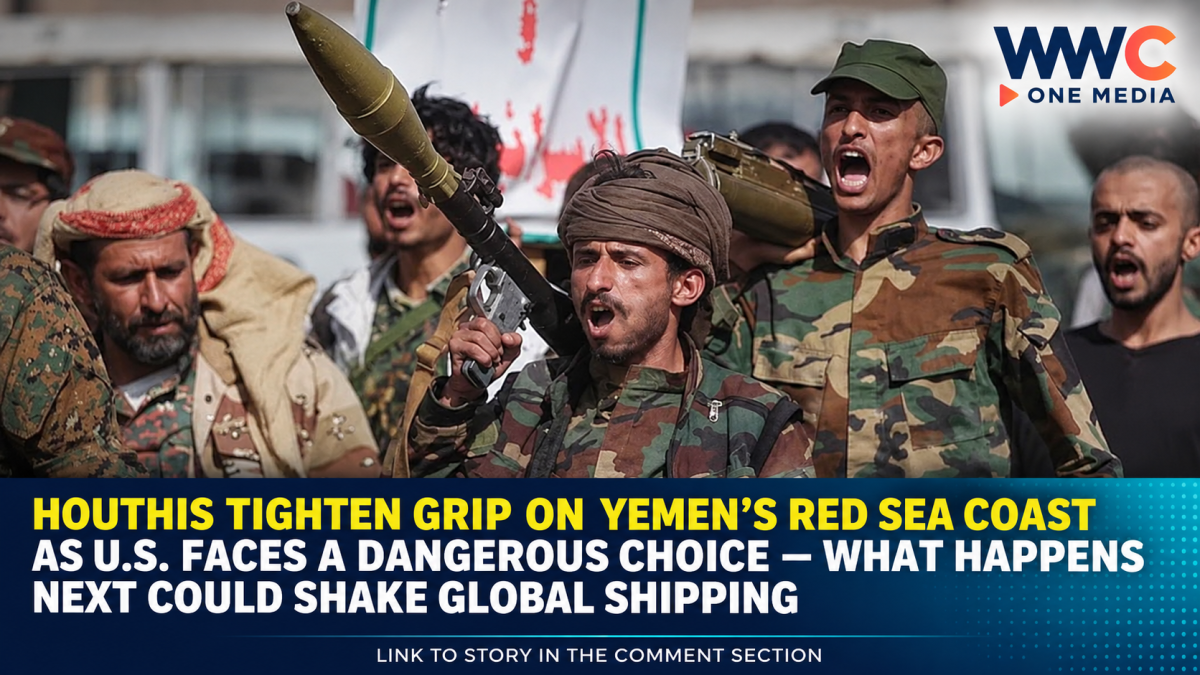
The Houthi advance in Yemen is rapidly reshaping the security picture around one of the world’s most important maritime chokepoints, putting Saudi Arabia under mounting pressure and forcing Washington to confront a difficult question: how far is the United States willing to go to stop the Iran-aligned group?
The Iran-backed Houthis have made a series of major gains along Yemen’s Red Sea coast, including the capture of the strategic port city of Mokha and the island of Mayun, also known as Perim, near the Bab el-Mandeb Strait. The developments have raised fresh concerns over international shipping, energy supplies and the possibility of a wider regional escalation. Reuters and The Associated Press have both reported on the rapid Houthi advance.
The Bab el-Mandeb is a critical maritime gateway connecting the Red Sea with the Gulf of Aden and, through the Suez Canal, the Mediterranean. Greater Houthi control around the waterway could give the group additional leverage over commercial shipping and potentially create another major disruption to global trade at a time when the wider Middle East is already experiencing severe maritime instability.
Washington faces a difficult decision
The Houthi gains are creating an increasingly complicated situation for the administration of U.S. President Donald Trump.
Reuters reported that Saudi Crown Prince Mohammed bin Salman sought U.S. military assistance to counter the Houthi advance. According to people familiar with the discussions, Trump did not agree to direct U.S. strikes against the Houthis, although Washington indicated that it would provide intelligence and targeting assistance to Saudi Arabia.
That decision reflects the difficult strategic position facing Washington.
The United States is already heavily involved in the broader confrontation with Iran, while U.S. forces are also dealing with threats around the Strait of Hormuz. Opening another major military front against the Houthis could stretch American military resources even further and increase the risk of a wider regional war.
Reuters reported that the Houthi advance has therefore created a new bind for Washington: the group is moving closer to a vital shipping corridor, but direct U.S. intervention could carry significant military and political costs.
Saudi Arabia’s options are narrowing
Saudi Arabia, which backs Yemen’s internationally recognized government, has faced a growing threat from the Houthi advance.
The situation became even more serious after Saudi Arabia temporarily shut down its East-West oil pipeline following drone attacks that Riyadh and Baghdad said originated from Iraqi territory. The pipeline provides an important alternative route for Saudi crude when shipping through the Strait of Hormuz is disrupted.
The combination of the Houthi advance toward Bab el-Mandeb and the disruption around Hormuz has intensified concerns about the security of energy supplies.
The Associated Press reported that Saudi oil exports to Asia have already been sharply affected by the conflict, although shipments have recovered somewhat. Analysts warn that further attacks on Saudi energy infrastructure could create additional pressure on global oil markets.
A second major shipping chokepoint under pressure
The significance of the Houthi advance goes far beyond Yemen.
The Strait of Hormuz and Bab el-Mandeb are two separate but strategically crucial gateways for global energy and commercial shipping. With maritime traffic around Hormuz already severely disrupted by the wider Iran conflict, increased Houthi control near Bab el-Mandeb could leave international shipping facing pressure on another major route.
Reuters reported that global oil prices have already moved back above $100 a barrel amid the combination of disruptions around the two waterways.
The development is particularly concerning for countries in Asia and Europe that depend heavily on maritime energy shipments.
Thousands of civilians are fleeing
The military developments are also producing a rapidly worsening humanitarian situation.
The Associated Press reported that at least 76,000 people have fled their homes since July as fighting intensified, with many displaced civilians seeking refuge in Aden. The United Nations has warned that the renewed fighting could push Yemen toward another humanitarian catastrophe.
Yemen’s previous conflict killed an estimated 150,000 people and brought the country close to famine before a 2022 ceasefire. The latest offensive has revived fears that the fragile period of relative calm could collapse completely.
Houthis expand pressure near Saudi border
The escalation is no longer confined to Yemen’s western coastline.
Al Jazeera reported Sunday that a Houthi projectile landed in Saudi Arabia’s Jazan region, injuring two people and damaging a mosque and other buildings. The Houthis said the attack was aimed at a Saudi military base.
The incident underscores the growing possibility that the fighting could spill further into Saudi territory.
At the same time, Saudi Arabia has to weigh the consequences of expanding its military campaign. A major escalation could potentially push the Houthis to intensify attacks on Saudi cities, energy facilities and shipping.
What happens next?
For Washington, Riyadh and the wider international community, the biggest question is whether the Houthi advance can be contained without triggering another major regional war.
The Houthis’ capture of strategic territory around Bab el-Mandeb gives them greater leverage over a shipping route linking Asia and Europe. But maintaining control of such territory could also expose the group to intensified military pressure from Saudi Arabia, Yemen’s government and potentially other regional actors.
For the United States, the calculation is even more complicated: intervene directly and risk opening another front, or limit its involvement while Saudi Arabia attempts to contain the threat itself.
For now, Washington appears to be favoring support rather than direct military intervention. Reuters reported that U.S. officials have emphasized protecting freedom of navigation while allowing regional partners to take the lead in addressing the threat.
But as the Houthis move closer to one of the world’s most important maritime chokepoints, the consequences of waiting could become increasingly difficult to contain.
And that is what makes the next move so important: a local battle in Yemen could determine how much the world pays for oil, how ships move between Asia and Europe, and whether the wider Middle East conflict opens yet another dangerous front.




Leave a Reply