
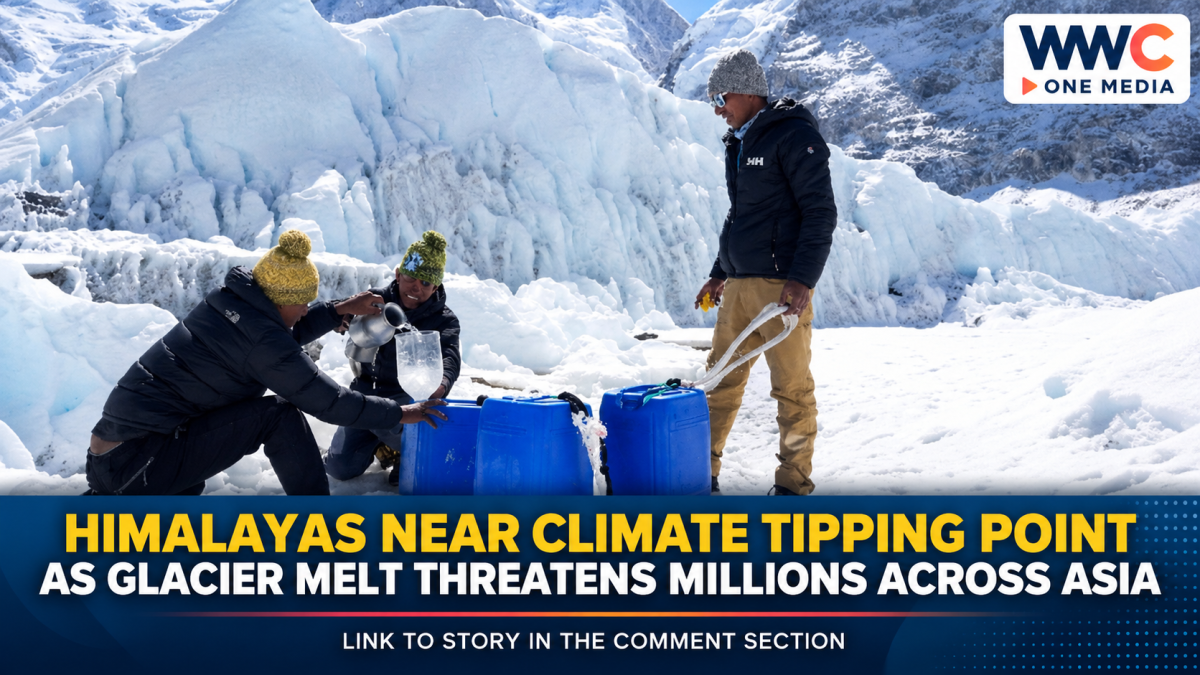
The Himalayas are approaching a critical climate tipping point as glaciers melt at an increasingly rapid rate, threatening water supplies, food production, energy generation and the livelihoods of millions of people across Asia.
A new report warns that Himalayan glacier mass loss is now accelerating far faster than it was a decade ago, raising the prospect that parts of the region could reach “peak water” by the middle of this century.
Peak water refers to the point at which accelerating glacier melt initially increases river flows before the shrinking ice reserves eventually cause those flows to decline.
The consequences could extend far beyond the mountains themselves.
Glacier melt is accelerating
The Hindu Kush-Himalaya region contains thousands of glaciers that act as enormous natural reservoirs, storing water during colder periods and releasing it gradually into rivers.
But warming temperatures are rapidly changing that system.
The latest assessment found that Himalayan glacier mass loss is now about 65 per cent faster than a decade ago.
Researchers warn that continued warming could push the region toward a point where glaciers can no longer provide the same volume of meltwater that downstream communities have depended on for generations.
The danger is not simply that glaciers will disappear overnight.
Instead, the region could experience increasingly unstable water supplies, with heavier runoff and flooding in the short term followed by declining water availability as glaciers become smaller.
Billions depend on Himalayan rivers
The Himalayan mountains feed some of Asia’s most important river systems, including the Ganges, Brahmaputra and Indus.
Their waters support agriculture, drinking supplies, hydropower, industry and ecosystems across several countries.
The impact therefore extends well beyond communities living near glaciers.
India, Nepal, Bhutan, Pakistan, Bangladesh and China all have populations and economic activity that depend heavily on water originating in the Hindu Kush-Himalaya region.
The report warns that changes to the region’s water cycle could affect millions of livelihoods and create growing pressure on governments to secure alternative water supplies.
India faces particularly significant economic exposure. The report estimates that activities dependent on Himalayan water account for more than 20 per cent of India’s gross domestic product.
A dangerous period of rising water can come first
One of the most complicated aspects of the crisis is that faster glacier melting does not immediately mean less water.
As glaciers lose mass, more meltwater can initially flow into rivers.
That can increase the risk of floods and landslides, particularly when combined with intense rainfall and unstable mountain slopes.
But once glaciers shrink beyond a critical point, their ability to provide meltwater diminishes.
That creates a dangerous transition from too much water to too little.
Scientists refer to the turning point as peak water.
The report warns that some Himalayan river systems could approach this stage around the middle of the century.
Glacial lakes are becoming a major danger
Rapid glacier retreat is also creating and enlarging glacial lakes.
These bodies of water can be held back by unstable piles of rock and ice rather than conventional dams.
If a natural barrier collapses, huge volumes of water can rush downstream in a glacial lake outburst flood.
India alone has nearly 200 glacial lakes classified as high risk, including 56 considered very high risk.
Millions of people living downstream could potentially be exposed if one of these lakes suddenly fails.
The danger has become particularly visible following the catastrophic glacier-related disaster that struck Nepal and Tibet in late August.
Nepal disaster shows what is already happening
On Aug. 26, a glacier collapse near the Nepal-China border triggered a devastating flood and debris flow.
The disaster destroyed communities, roads and hydropower facilities and left a huge number of people dead or missing.
At least 1,300 people have been confirmed dead across Nepal and China’s Tibet region, while more than 5,300 remain missing.
More than a dozen hydropower projects were damaged or swept away, with rescue teams still searching for workers who may be trapped inside tunnels.
The scale of the disaster has provided a stark illustration of how vulnerable Himalayan infrastructure can be to increasingly extreme events.
Hydropower faces a double threat
The Himalayan region is also crucial to Asia’s growing demand for renewable electricity.
Nepal has invested heavily in hydropower, using its mountainous rivers to generate electricity and earn revenue from exports to neighbouring countries.
But the recent disaster demonstrated the vulnerability of that strategy.
The August floods damaged numerous hydropower facilities and disrupted Nepal’s electricity system.
India has since approved emergency electricity exports of up to 654 megawatts to Nepal for up to 18 hours a day through the end of 2026 to help compensate for the disruption.
The crisis highlights a difficult paradox: the same rivers that provide enormous potential for clean energy can also become sources of catastrophic destruction when extreme events occur.
Monitoring remains dangerously limited
Scientists face another major problem: there are simply not enough observations from the world’s highest mountain region.
The Hindu Kush-Himalaya contains an estimated tens of thousands of glaciers, but only a small fraction are being monitored directly.
The latest report found that just 21 glaciers are being monitored on the ground.
That leaves major gaps in scientists’ understanding of how quickly individual glaciers are changing and which communities are most exposed to sudden floods or longer-term water shortages.
Better satellite monitoring, field measurements and early-warning systems are therefore becoming increasingly important.
Climate change is making the risks harder to predict
The changing Himalayan environment is also challenging traditional assumptions about infrastructure.
Many dams, roads, bridges and hydropower projects were designed using historical records of rainfall and flooding.
But climate change is altering the frequency and intensity of extreme events.
A flood that would previously have been considered extraordinarily unlikely can become more plausible as glaciers destabilise and temperatures rise.
That means governments may need to rethink how they design infrastructure in mountain valleys and downstream areas.
Millions face a changing water future
The Himalayan crisis is ultimately about much more than melting ice.
It is about whether countries across Asia will be able to maintain reliable supplies of water, food and electricity as the region’s natural systems change.
Farmers could face more unpredictable irrigation supplies.
Cities may have to compete for increasingly uncertain water resources.
Hydropower projects could face both greater flood risks and declining dry-season flows.
Communities living beneath unstable glacial lakes could face sudden disasters with little warning.
The economic consequences could therefore spread across national borders.
The window for preparation is narrowing
Experts say the region still has opportunities to reduce the risks.
Governments can expand glacier and glacial-lake monitoring, install early-warning systems, strengthen downstream evacuation plans and redesign vulnerable infrastructure.
They can also improve cross-border cooperation because Himalayan rivers do not stop at national boundaries.
But adaptation cannot eliminate the underlying problem.
The fundamental driver is rising global temperatures, meaning long-term protection of Himalayan water supplies ultimately depends on limiting further warming while preparing communities for changes that are already underway.
A warning for all of Asia
The Himalayas are often described as the “Third Pole” because of the enormous quantity of frozen water stored there.
What happens to that ice will affect far more people than those who live among the mountains.
The region is approaching a point where faster melting could eventually give way to declining water availability, while increasingly unstable glaciers and lakes raise the immediate risk of catastrophic floods.
The recent disaster in Nepal and Tibet has shown that these threats are no longer distant possibilities.
For millions of people whose food, electricity, drinking water and livelihoods depend on Himalayan rivers, the race is now to prepare before the mountains’ changing water cycle reaches a point that is far more difficult to reverse.




Leave a Reply