
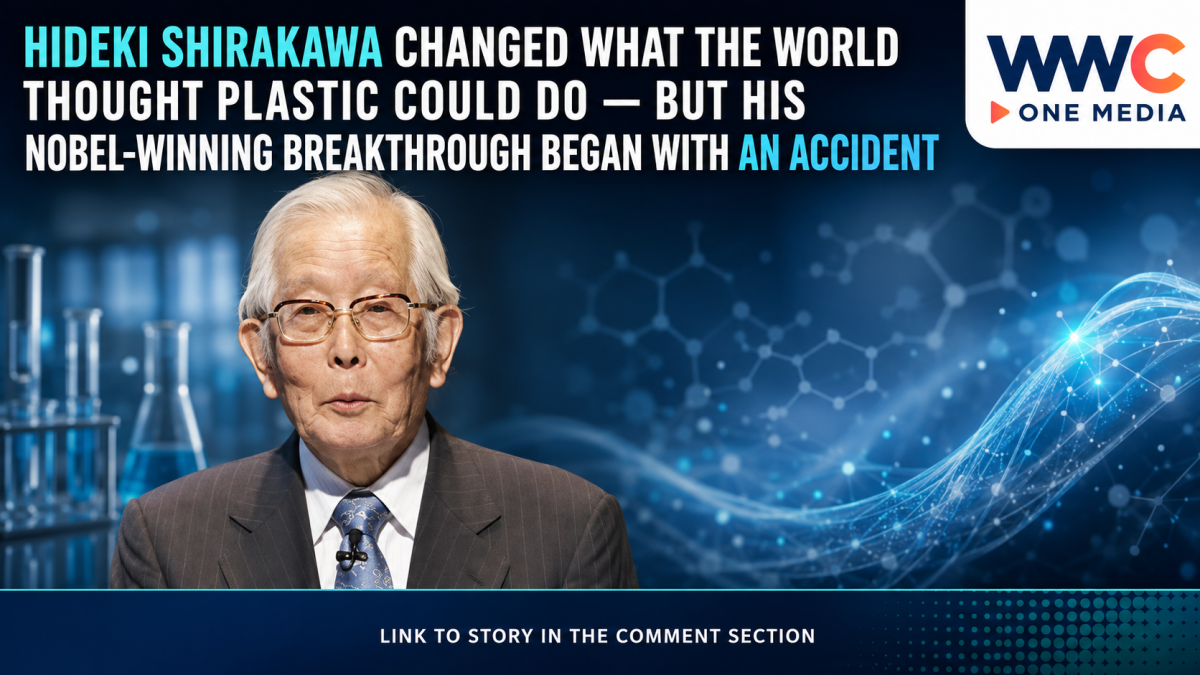
TOKYO — Hideki Shirakawa, the Japanese chemist whose Nobel Prize-winning research shattered the long-held belief that plastics could not conduct electricity, has died at the age of 90, leaving behind a scientific breakthrough that helped open an entirely new field of materials research.
Shirakawa died on August 24 at a hospital in Yokohama, according to reports released Thursday, September 3. The University of Tsukuba, where he spent more than two decades teaching and conducting research, formally announced his death and paid tribute to his contributions both as a scientist and as a mentor to younger researchers.
Initial reports, including the university’s announcement and Associated Press coverage, did not specify his cause of death. Later Japanese reporting provided additional details: Jiji Press reported that Shirakawa died from a metastatic liver tumor and cancer of unknown primary origin, while the Asahi Shimbun reported that his family said he had been hospitalized with cancer. His funeral was held privately with close family members, according to Jiji Press.
The experiment that overturned scientific conventional wisdom
Shirakawa’s legacy rests on a deceptively simple question: What if plastic could behave more like a metal?
For generations, plastics were valued partly because they did not conduct electricity. They were insulators — the very materials used to protect people from the electrical current running through wires.
Shirakawa helped turn that assumption upside down.
While working at the Tokyo Institute of Technology, he became interested in an unusual form of polyacetylene, a polymer that could be produced as a thin, silvery-looking film. Japanese accounts of his career describe an important early breakthrough emerging unexpectedly after an experiment produced a film rather than the material researchers had originally anticipated. Instead of dismissing the result, Shirakawa investigated it.
That curiosity would eventually lead him across the Pacific.
In 1976, Shirakawa went to the University of Pennsylvania, where he collaborated with American scientists Alan J. Heeger and Alan G. MacDiarmid. Their work showed that treating polyacetylene with substances such as iodine could dramatically increase its electrical conductivity.
The effect was extraordinary. Nobel Prize scientific background material says iodine treatment increased the conductivity of polyacetylene by roughly seven orders of magnitude — about ten million times in the celebrated experiments that helped establish the field. Their seminal paper was submitted in 1977.
Suddenly, the idea of an electrically conducting plastic was no longer a scientific curiosity.
It was a new branch of materials science.
The Nobel Prize came more than two decades later
In 2000, the Royal Swedish Academy of Sciences awarded the Nobel Prize in Chemistry jointly to Shirakawa, Heeger and MacDiarmid “for the discovery and development of conductive polymers.”
The Nobel committee said their work transformed the traditional distinction between plastics and metals and opened important links between chemistry and physics.
Shirakawa himself appeared stunned by the honor.
When the prize was announced in October 2000, he told reporters that he had not expected to win and said the recognition brought with it a sense of responsibility. At the time, he viewed much of his original work as belonging to an earlier chapter of science, even as the field it helped create continued expanding.
The award made him one of Japan’s most prominent scientists. That same year, he received Japan’s Order of Culture and was designated a Person of Cultural Merit.
From laboratory discovery to modern technology
The importance of Shirakawa’s research extends well beyond the original polyacetylene experiments.
Conductive and semiconductive polymers became an important family of materials because they can combine useful electrical properties with characteristics associated with plastics — including light weight, flexibility and processability.
Research stemming from the field has contributed to technologies involving light-emitting devices, displays, solar cells, batteries, electromagnetic shielding and other forms of organic and flexible electronics. The Nobel Foundation highlighted applications including LEDs, solar cells and electronic displays when explaining the importance of the scientists’ achievement.
Associated Press noted that the discoveries helped pave the way for lightweight and flexible conductive materials used in products including solar cells and mobile-device displays.
That distinction matters: Shirakawa did not single-handedly invent today’s smartphone or touchscreen. Rather, his work helped establish the conductive-polymer science and organic-electronics research landscape from which numerous later materials and applications developed.
More than 20 years shaping Japanese science
Born in Tokyo on August 20, 1936, Shirakawa graduated from the Tokyo Institute of Technology in 1961 and completed his doctorate in engineering there in 1966. He joined the University of Tsukuba in 1979, became a professor in 1982 and retired in 2000, when he was named professor emeritus.
University of Tsukuba President Kyosuke Nagata remembered Shirakawa not only for his research but also for educating generations of young scientists during more than two decades at the university.
The university noted that even decades after his most famous discovery, Shirakawa continued showing particular concern for young scholars and scientific education.
There is a fitting lesson in that legacy.
One of the most important materials discoveries of the modern era did not begin with a perfectly predictable result. It grew from an unexpected experiment, a scientist willing to investigate what others might have discarded, and an international collaboration that challenged something almost everyone assumed was already settled.
Plastic was supposed to insulate electricity. Shirakawa helped prove that, under the right conditions, it could conduct it instead.
Nearly half a century after the pivotal experiments and more than 25 years after his Nobel Prize, the scientific field that grew from that discovery continues to evolve.
Hideki Shirakawa was 90.
WWC ONE MEDIA MJE

Leave a Reply