
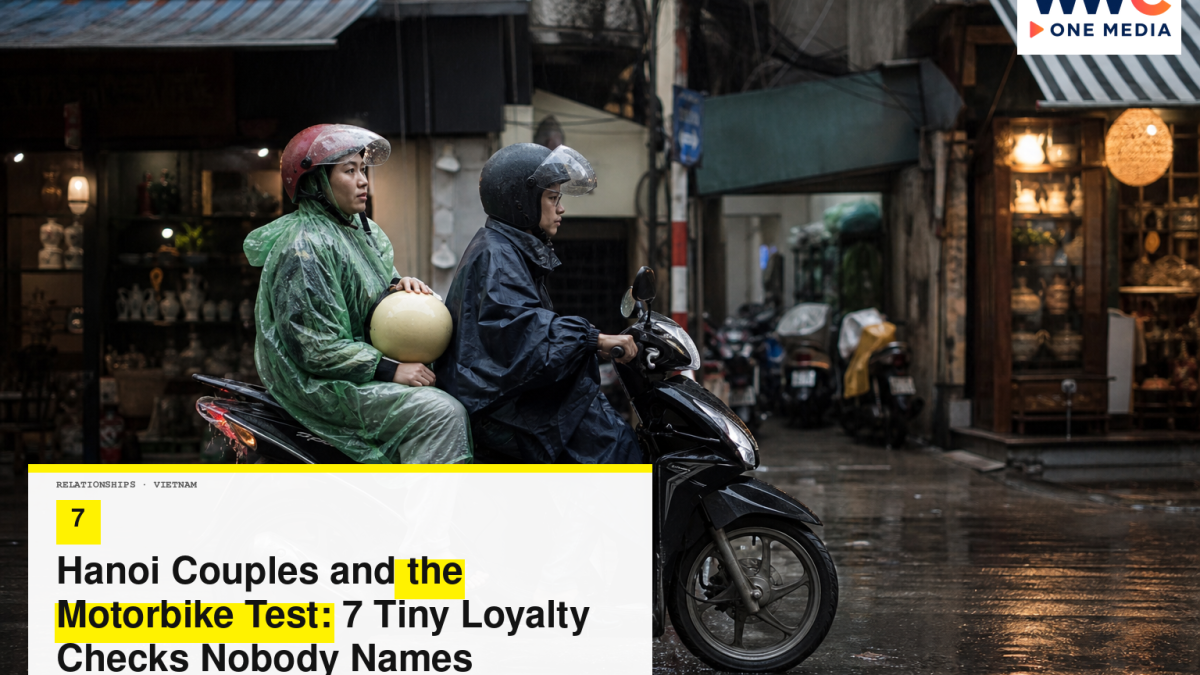
HANOI, Vietnam — Nobody in this city calls it the motorbike test. They will talk about feeling, about family, about whether the parents in the provinces would like you. They will not say: I learned who you were when it rained on the way back from Tay Ho and there was only one dry helmet. Hanoi couples and the motorbike test are the same story. Two people, one Honda or Yamaha or whatever is actually between your knees, a city of lakes and bad surfaces and sudden water, and a set of tiny loyalty checks that never make it into a speech.
This is not a metaphor dump. Pho is a date you can eat. A helmet is a plastic shell. Pillion is a seat. Parents on a video call from Nam Dinh or Thai Binh are parents. The bike is how most of the private life moves. If you want to know whether you are being cared for, stop waiting for an anniversary caption. Watch the ride.
Seven checks. Small on purpose. If you fail a small one in rain at 7pm, the large ones about marriage will not save you.
1. The spare helmet is the first loyalty check Hanoi couples pretend is logistics
Hanoi couples and the motorbike test begin before the engine. Is there a second helmet, in the house, under the seat, in a bag, or do you ride with one good helmet on the driver and a leftover on you, or worse, a performance of “it’s close, we’ll go slow.” Going slow in this traffic is not a gift. It is a story people tell themselves when they did not buy a second shell.
Loyalty here looks like: they thought you might exist on the bike. They kept a helmet that fits a head that is not theirs. They do not lend you the cracked one and keep the decent visor. They do not make you hold the spare in your lap at a cafe in the Old Quarter like a prop.
A script you can say without a fight:
“I want to ride with you. I need a real helmet that fits. If we are going to do this city together, that’s part of how I feel looked after. Not a lecture. A shell.”
If they laugh, you have a laugh. If they say tomorrow and tomorrow is three weeks, you have a queue. If they take you to a shop and wait while you pick, you have a person who can do a boring errand for two.
What not to do. Do not get on anyway to seem easy, then write a long message at midnight about respect. The check already happened at the curb. Do not steal the conversation into a gender seminar in front of a parking attendant. Do not refuse all bikes forever as a personality if you live here and then also complain they never pick you up. You can hate bikes. Then Grab is the plan, named, not a punishment.
City logistics. Old Quarter streets are stop-start and full of people stepping off the curb. Tay Ho has longer stretches and different wind. A helmet that is fine for a two-minute hop near Hoan Kiem can be misery on the way out to the lake. If they only ever pick you up for the short hop and send you home alone on the long one, that is a map of effort.
Objection: “Everyone rides like that.” Plenty of people do. You are still allowed to want the version where your head is not the compromise. Loyalty is often just refusing to make your person the compromise in public weather.
2. Rain: they wait, they cover, or they leave you a Grab — all three are answers
Hanoi rain is not a cinematic drizzle. It arrives like a bucket. Streets glaze. The bike becomes a worse idea in five minutes. This is the check nobody names because it feels unromantic to score a downpour.
Watch what they do. Do they pull under a genuine shelter and wait with you, even if they will be late. Do they have a cheap poncho in the box because they have lived a year here. Do they put the poncho on you first without a speech. Do they say this is stupid, I’ll book a Grab, I’ll ride behind or I’ll see you there. All of those can be care.
The other set. They say it’s fine, hold tighter, as if your knees were a policy. They get impatient because rain threatens their evening. They drop you at a corner that is still open to the water and go, because they “know a faster way.” They joke that you are delicate. Delicate is a word that shows up in small weather and later in large families.
A script in the moment, short, because rain is loud:
“I’m not doing this in the rain. Grab me. You can take the bike. I still want to see you. I don’t want to arrive angry and wet.”
If that sentence ends the date, the date was the bike, not you.
What not to do. Do not perform toughness you will resent. Do not start a relationship argument in the middle of a flooded intersection. Pull over. Phone. Plan. Do not post a cute wet photo while you are privately furious. The photo will outlive the honesty.
Tay Ho in rain is a particular mess because people still want the lake. The Old Quarter in rain is a different mess because there is nowhere to put a bike that is not already a crowd. A loyal person changes the destination. Pho indoors. A cafe they already know has a place to park. Home. Rain is a redirect test. Redirecting without sulking is the skill.
Objection: “You’re making weather into a personality test.” Weather in Hanoi is a weekly fact. Weekly facts are how households are built. If they only shine on dry Saturday afternoons, you have a fair-weather pairing. Call it that.
3. Who sits pillion, who holds the bag, who gets the less stupid side of the road
Pillion is trust. You cannot see the pothole. You feel it. You match their balance or you fight it. A person who rides like you are cargo will treat you like cargo in a kitchen later. A person who checks, before they move, that your foot is in, that the bag is not in the wheel, that you heard the plan for the next left, is doing a tiny loyalty check in motion.
Who sits where is sometimes skill, sometimes ego. If they are the better rider, it is rational they drive. If they insist on driving badly because the man drives, that is not skill. If you are the better rider and they will not sit behind you in the Old Quarter because of an audience, the audience is already in the relationship.
The bag. Someone’s backpack always becomes a third body. A loyal arrangement: the driver keeps the bag in a way that does not punish the pillion, or you split what you carry, or you leave the extra bag at home. A disloyal arrangement: you hold a hot bag of food, a laptop, and the spare helmet while they take a call at a red light.
Side of the road, mirrors, the way they pass a bus. You do not need to become a driving instructor on date three. You do need to say if you are scared. Fear on a bike is information. A partner who mocks fear will mock other limits.
A script after you arrive, not while they are in traffic:
“When you take a call at the light, I feel like I’m not on the bike with you. If we’re riding, can the call wait. I’ll do the same if I’m driving.”
What not to do. Do not grab their waist in a punishment squeeze. Do not teach them through humiliation at a cafe table with friends. Do not refuse to ride with no alternative. Name Grab. Name walking. Name a bus. Hanoi still has other ways to move two people.
Parents in the picture, already. If they will not let you drive because a mother might hear that the girlfriend was in control of the bike, you are dating a story. Stories can be loved. They should be named.
4. Old Quarter versus Tay Ho: whose city is the date
The Old Quarter is noise, tourists, a lake that photographs, streets that require a rider to be patient or become a problem. Tay Ho is a different clock: expats, long lakeside, weekend stretch, a certain kind of date that can feel like an escape from the house. Hanoi couples reveal loyalty in which map they choose and who the map is for.
If every date is the Quarter because it is close to their work and you always cross the city, you are the one spending the petrol in time. If every date is Tay Ho because they like the version of themselves there, and you are lost on the lake loop, that is also a map. Loyalty is rotating. Loyalty is picking a spot that is kind to the person who had the worse day. Loyalty is not making one district a personality.
Pho as a date belongs here, not as a symbol. You go to a pho place that is actually open at the hour you claim. You sit. You order. The bike is parked without a 15-minute drama. If they only take you to a pho that is a performance for visitors, and they eat their real breakfast alone elsewhere, ask to go to the elsewhere. The real stall is a door. Being kept to the pretty stall is a tourist relationship inside a local city.
A script:
“I like Tay Ho. I also want a weeknight near my place, or a pho you actually eat when I’m not here. I don’t need a scenic version of you every time.”
What not to do. Do not sneer at their neighbourhood. Do not sneer at yours. Do not use “too many tourists” as a way to avoid being seen by someone they know. If they will do the Quarter with you at night and never a daylight market where an auntie might call their name, you may be a night district.
Parking in both places is a loyalty cousin. Do they dump the bike illegally and leave you to smile at a whistle. Do they take the extra three minutes. Three minutes is a character.
5. The phone call from the provinces while you are on the back
Parents in Nam Dinh, Thai Binh, Hai Duong, a town you have not been to yet. The phone rings on the bike. They answer. You are pillion, visor down, a ghost in their day. What happens next is a check.
Do they say they will call back. Do they pull over. Do they talk for ten minutes at a light while you cook inside the helmet. Do they mention you — not as a speech, as a fact. “I’m dropping someone, I’ll call when I’m home.” Do they lower their voice in a way that makes you feel like contraband.
You cannot demand a full introduction to a parent during a ride. You can notice whether you are allowed to exist as a sentence.
After, ask, once:
“When your family calls on the bike, I’d rather you pull over or call back. I also want to know, when it’s time, how they will hear about me. I’m not asking for a meeting this month. I’m asking whether I’m a secret in the provinces.”
If they say parents would not understand, get the content. Would not understand a dating life. Would not understand this person. Would not understand anyone until there is a house. Those are different. The motorbike cannot hold all three. A cafe can.
What not to do. Do not grab the phone. Do not shout hello as a joke. Do not go quiet for two days because you heard their mother’s voice and invented a verdict. Do not post about “his family” to force a pace.
Logistics of going home. Tet, a funeral, a sick grandparent: the bike will not take you to another province in a way that is always safe or always kind. Trains exist. Buses exist. If they want you to come, they plan the trip like an adult, helmets and all, not a last-minute pillion marathon that leaves you wrecked in front of a family you have not met.
If they never want you to come, the bike in Hanoi is the whole country you are allowed. Believe the border.
6. Pho as a date: who orders, who waits, who notices if you actually eat
Keep this literal. You sit down for pho. Steam. Table. The bike parked. Loyalty checks that nobody names: do they wait until you have a spoon. Do they order you a default without asking, every time, as if your mouth were a habit. Do they check chilli, herbs, whether you wanted the fatter cut. Do they eat at a speed that leaves you performing catch-up. Do they take a call. Do they talk only about their office.
A date is not a feed. If they bring you to pho and spend the bowl on their phone, you were a passenger again, just sitting.
Who pays. You can alternate. You can split. You can let the person who invited cover it. What you watch is shame. Shame at a cheap bowl is a class problem that will not stay at the table. Shame at being paid for, shame at paying — both show up later when rent is the bowl.
A script:
“I like this place. Next time I want to pick the stall near me. I’ll get the bowls, you get the drinks. Also, can we not take work calls over pho unless someone’s actually on fire.”
What not to do. Do not turn pho into a personality. Do not lecture about authenticity. Do not drag a vegetarian or a sick stomach through a broth as a test of being “easy.” Easy is a word that gets people hurt. Order something they can eat. If the stall cannot, pick another stall. The city has more than one.
Old Quarter pho at tourist hour is a wait. Tay Ho pho can be a different crowd. Waiting is a check. Do they stay in the wait with you. Do they suggest a second place when the wait is stupid. Do they sigh as if you invented the queue.
After the bowl, the bike again. Are you still a person. Or does the helmet go back on and the intimacy go back in the drawer until the next meal.
7. The late-night drop-off versus “I have to get back”
How the ride ends is the last tiny check. Do they take you to the door, wait until you are inside, message when they are home. Or do they leave you on a big road because turning in is annoying. Or do they wait, engine on, until you feel you should invite them up when you did not plan to. Loyalty is not extracting an invitation. Loyalty is a completed drop-off.
“I have to get back” can be true. A parent tracking a curfew even when you are grown. A roommate. An early shift. A genuine exhaustion. The pattern is the check. If they can stay out for their friends until 1 and must get back at 10 when they are with you, you have a ranking. If they always have to get back and never have you over, you have a one-way city.
A script at the curb, not in a passing shout:
“If you’re dropping me, I want to walk to the door. If you need to go, go after that. I don’t need you to come up. I do need to not be left in the road.”
What not to do. Do not use the drop-off as a trap for a conversation about the whole relationship. Everyone is tired. Helmet hair. Exhaust. Book a daylight hour. Do not refuse to get off the bike until they say a word you want. The bike is a bad courtroom. So is a stairwell.
If you are the rider, you do the same checks in reverse. You do not dump them. You do not assume the pillion owes you the night because petrol has a price. You message when you are home so they are not waiting for a crash they will not be told about. That last one is grim and ordinary. Hanoi traffic is not a joke. A loyal pair checks in. It takes ten seconds.
A rain-night script you can keep in your phone
When it starts, you will not be eloquent. Pre-write the practical version.
“Rain is bad. I’m booking a Grab for me. You take the bike if you want. Let’s meet at the pho place on X, the one with the indoor seats. If you’d rather reschedule to tomorrow near Tay Ho after work, say so. I’m not mad at weather. I don’t want to ride this.”
If they argue with the Grab, you still book it. Your body is not a committee. If they take it well, remember that. People reveal more in a 12-minute storm than in a lake photo.
What not to do in the script. Do not add “this is why I don’t trust you.” Do not add your father. Do not add their ex. Rain plus a history lecture is how you both arrive unsafe.
What not to do with the motorbike as a personality
Do not treat the bike as proof of localness. Plenty of unkind locals ride well. Plenty of kind people take Grab because they had a crash, or a parent, or a fear that is allowed.
Do not film the ride for a feed while the pillion is scared. Content is not courage.
Do not drink and then insist you are “fine to go.” If the ride is off the table, the table is a taxi. Loyalty is the taxi.
Do not use the spare helmet as a romantic object and then never clean it. Hygiene is undramatic care.
Do not punish them by refusing a ride after a fight, then also refusing a Grab pin, so they are stuck. Stuck is a control move. Give a pin.
Do not meet parents on the back of a bike after a four-hour road without a plan for toilets, water, a helmet that is not torture, and a way home that is not the same four hours in the dark. That is not introduction. That is an ordeal.
Parents in the provinces: the visit that is not a pillion stunt
If it gets that far, the motorbike test changes shape. You are no longer proving you can hold on around Hoan Kiem. You are proving you can enter a house. Ask about shoes, gifts, how they will name you, whether you sleep in the house, whether you can step out if it goes badly. Ask who drives, and whether you are expected to sit in a family meal and then ride back the same night because there is no bed for you. No bed is a sentence. Hear it in Hanoi, not at 11pm in a yard.
You can take the train. You can go for one night. You can decline a trip that is only endurance. A partner who wants you in the provinces will want you intact when you arrive. Intact includes a helmet, sleep, and a story they have already told their mother, even a small one.
If they will not tell the mother even a small one, the bike in the city is still the border.
Tay Ho evening versus Old Quarter night, without the brochure
A Tay Ho evening can be kind: slower traffic, a walk with the bike parked, a bowl, a ride home that is a bit longer and therefore a bit more of a promise. An Old Quarter night can be kind: close, loud, over fast, a drop-off that is nearby. Neither is morally better. The loyalty is whether both of you get a say, and whether the ride home is still careful when the date was only average.
Average dates matter. Anyone can be charming on a perfect lake. The test is the ordinary Tuesday from a street near the Old Quarter to a room in a different district, at 9.40pm, when they are a bit bored and still put the good helmet on you.
Pho after, or instead, if the lake is a bad idea that night. Keep it a meal. Sit. Pay. Ride. Message. That sequence is a relationship. The caption is optional.
Bottom line
Hanoi couples and the motorbike test are seven tiny loyalty checks nobody names: a spare helmet that actually fits, rain that produces a wait or a Grab instead of a dare, pillion treated as a person, a map that is not only one district, a parent’s call that does not turn you into contraband, pho as a meal you both inhabit, and a drop-off that finishes at the door. The lake will still be pretty. The Quarter will still be loud. Care shows up in plastic, weather, and whether they still ride like you are on the back when nobody is watching.




Leave a Reply