
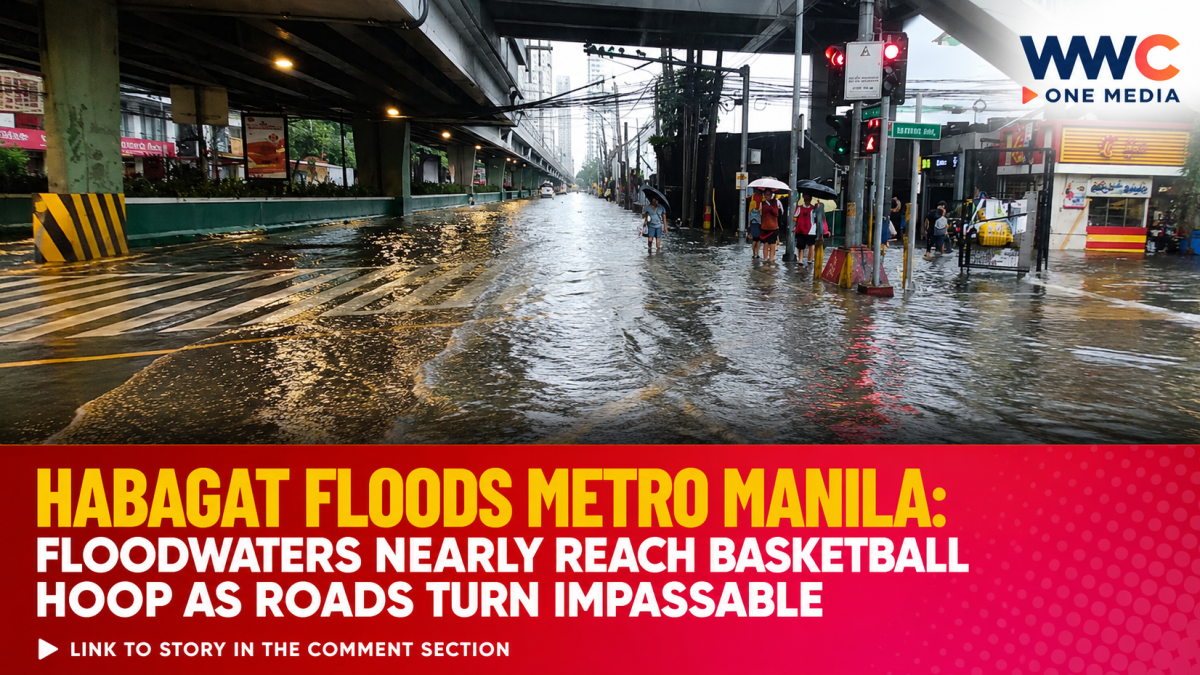
MANILA, Philippines — Metro Manila was hit by another round of intense rain on Saturday, August 29, as the Southwest Monsoon or Habagat unleashed heavy downpours that flooded roads, disrupted travel and left some communities facing dangerously deep floodwaters.
The situation became particularly alarming in Quezon City, where floodwaters in Kaingin Bukid, Barangay Apolonia Samson, were reported to have risen to nearly the height of a basketball hoop at around 1:32 p.m., according to GMA News. The Quezon City government had earlier ordered forced evacuations in several areas, including the affected barangay.
In Parañaque City, flooding was also severe. Streets in San Pedro and San Felipe in San Isidro were submerged, with residents using boats and rescuers to move through flooded areas. GMA News also reported that some children were seen playing in the floodwaters despite health concerns associated with prolonged exposure to contaminated floodwater.
Near-zero visibility adds to the danger
The flooding was accompanied by extremely poor visibility.
In Makati City, visibility was described as nearly zero at around 1 p.m. as the rain intensified and high-rise buildings became barely visible through the downpour. Similar conditions were reported along Commonwealth Avenue in Quezon City, where visibility was also nearly zero around noon.
The combination of deep floodwater, heavy rain and poor visibility created dangerous conditions for motorists and pedestrians, with several major roads becoming difficult or impossible to pass.
Several Metro Manila roads became impassable
Reports from the Metropolitan Manila Development Authority (MMDA) showed widespread flooding across the capital region.
Philstar.com reported that some portions of Quezon City, including Araneta-Talayan, G. Araneta Avenue and portions of Araneta-Maria Clara, became impassable to all types of vehicles. Flooding was also reported in Valenzuela, Las Piñas and Manila.
Among the areas listed as impassable or severely affected were:
- Araneta-Talayan, Quezon City — waist-deep flooding
- G. Araneta Sr. Avenue, Quezon City — waist-deep
- MacArthur Highway, Valenzuela — knee-deep in some portions
- Barangay Zapote, Las Piñas — knee-deep
- Rizal Avenue-R. Papa, Manila — half-knee-deep
- E. Rodriguez-Araneta, Quezon City — knee-deep
ABS-CBN News likewise documented numerous flooded roads throughout Metro Manila on August 29, highlighting the widespread impact of the monsoon rains.
Red rainfall warning raised flood risk
PAGASA placed Metro Manila and several surrounding provinces under a red rainfall warning during the height of the Saturday rains. Under this warning level, serious flooding is expected in flood-prone communities, particularly where intense rainfall persists.
The Philippine Star reported that the enhanced Habagat inundated numerous parts of Metro Manila, with some roads rendered impassable, rivers rising to critical or dangerous levels and the La Mesa Dam spilling.
The MMDA also deployed personnel to help unclog drainage inlets and address flooding in several areas, while traffic jams were reported along major arteries including EDSA, C-5, Commonwealth Avenue, Quezon Avenue, Ortigas Avenue and Roxas Boulevard.
The flooding comes after an already unusually wet August
The latest Metro Manila flooding is part of a broader period of persistent rain affecting Luzon.
PAGASA said intense Habagat rains on August 17 had already drenched Metro Manila and nearby provinces, with some locations receiving 200 to 400 millimeters of rain over one week. At its Science Garden station in Quezon City, PAGASA recorded roughly a week’s worth of normal August rainfall in just six hours on August 17.
The continued rainfall has left many areas saturated, increasing the likelihood that additional heavy rain will quickly translate into surface flooding.
The broader flooding crisis has also caused significant damage elsewhere in Luzon. The Inquirer reported that, as of Saturday, thousands of families were staying in evacuation centers, while nationwide infrastructure and agricultural losses had reached billions of pesos.
More rain remains a concern
GMA News reported that Habagat rains were expected to continue over Luzon, with a low-pressure area inside the Philippine Area of Responsibility at the time of its report having a high chance of developing into a tropical cyclone within 24 hours.
The Philippine Star subsequently reported that another low-pressure area was being monitored east of extreme Northern Luzon and could develop into a tropical cyclone if it entered the Philippine Area of Responsibility.
For Metro Manila residents, the warning is clear: the flooding problem may not end when the rain temporarily stops. Saturated ground, swollen waterways, overflowing drainage systems and additional rainfall could quickly worsen conditions in already flooded communities.
Authorities continue to urge residents in flood-prone areas to monitor official weather and local government advisories, avoid unnecessary travel through flooded roads, and move to safer locations when evacuation orders are issued.
For now, the images from Metro Manila tell the story: in some communities, floodwater has risen from a road hazard into a life-threatening emergency—with more rain still a possibility.




Leave a Reply