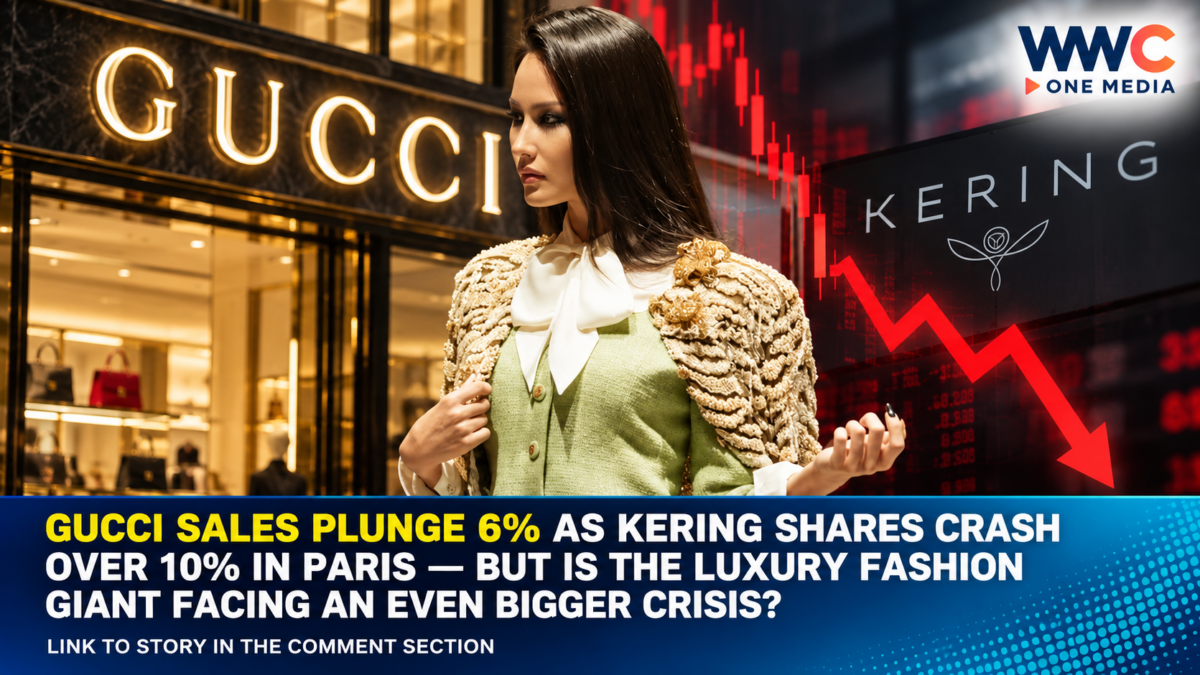
Paris, France — October 24, 2026 — Gucci, one of the world’s most recognizable luxury fashion brands, is facing renewed pressure after another disappointing sales report sent shares of its French parent company, Kering, tumbling more than 10% on the Paris stock market.
The sharp sell-off on Friday, October 23, followed Kering’s disclosure that Gucci’s third-quarter 2026 revenue dropped 6% on a comparable basis, as weakening luxury demand in China and Japan undermined hopes of a sustainable recovery.
The results have raised fresh questions about whether Kering’s ambitious transformation strategy can restore Gucci’s appeal before prolonged weakness further damages the group’s financial performance.
Gucci’s €1.29 Billion Quarter Exposes Continuing Sales Problems
According to Kering’s official financial results released on October 22, Gucci generated approximately €1.29 billion in revenue during the three months ending September 30, 2026.
The luxury brand recorded a 6% comparable sales decline from the previous year, while reported revenue declined 4%.
The performance was particularly disappointing because Gucci remains one of Kering’s most important businesses and accounts for approximately half of the group’s profits.
Kering’s overall quarterly revenue reached €3.345 billion, representing a 1% comparable decline from the same period last year.
Investors reacted swiftly, pushing Kering shares down approximately 10.7% in early Paris trading on October 23.
The market reaction illustrates how heavily Kering’s prospects remain tied to Gucci, despite owning other major luxury labels.
China and Japan Become Major Obstacles to Gucci’s Recovery
One of the biggest challenges facing Gucci is weakening demand across important Asian luxury markets.
Mainland China, historically a major source of growth for international luxury fashion houses, has become a significant obstacle to Kering’s recovery efforts.
Reduced boutique traffic has made it increasingly difficult for Gucci to convert its global brand recognition into stronger sales.
Japan has also contributed to the difficult trading environment, while signs of softer consumer demand in North America have added uncertainty.
The slowdown comes as luxury shoppers navigate inflation, geopolitical instability and changing spending priorities.
For luxury businesses that previously relied on strong spending from Chinese consumers, the shifting environment presents a serious challenge.
Kering CEO Luca de Meo Faces Mounting Pressure
Kering chief executive Luca de Meo is leading a major transformation designed to make the luxury group more efficient, competitive and profitable.
His strategy includes streamlining operations, sharpening individual brand identities, improving product offerings and reducing the number of underperforming stores.
Kering reported that it completed 105 net store closures during the first nine months of 2026.
The company now expects at least 125 net closures for the full year, exceeding its earlier target.
However, shrinking the retail footprint alone will not solve Gucci’s underlying challenge: attracting more consumers into stores and persuading them to purchase its products.
Gucci is also working on improving its handbag selection, product quality, pricing structure and speed of bringing new collections to market.
Under creative director Demna, the brand is attempting to rebuild its fashion relevance while appealing to consumers seeking both distinctive design and lasting luxury value.
These changes will require time to translate into meaningful financial results.
Not All of Kering’s Brands Are Struggling
Despite Gucci’s disappointing performance, several businesses within Kering’s portfolio are showing greater resilience.
Retail sales across Kering’s fashion houses excluding Gucci increased 2% on a comparable basis during the third quarter.
Saint Laurent and Bottega Veneta continued to demonstrate underlying strength, helping cushion the impact of weaker Gucci sales.
Kering’s jewelry division recorded 11% quarterly revenue growth, while its eyewear business reported a 4% increase.
These results suggest the company’s problems are not evenly distributed across its luxury portfolio.
Instead, much of the pressure remains concentrated in Gucci, making a successful revival of the Italian fashion house central to Kering’s overall recovery.
A Broader Luxury Industry Slowdown Adds to the Pressure
Gucci is not alone in facing a more challenging global luxury market.
Other major luxury companies, including LVMH and Hermès, have also reported uneven quarterly performances, reflecting the pressure affecting high-end consumer spending.
The Middle East conflict, persistent inflation and weaker purchasing confidence among aspirational luxury shoppers have complicated the industry’s outlook.
For companies such as Gucci, the challenge extends beyond short-term economic conditions.
Fashion houses must also respond to changing consumer preferences, increasing competition and demands for stronger product differentiation.
Luxury customers who once rushed to purchase high-profile designer items are becoming more selective about where they spend.
Could Gucci’s Comeback Take Longer Than Investors Expect?
The latest financial results have intensified scrutiny of Kering’s turnaround timeline.
Although the company maintains its commitment to improving its recurring operating margin in 2026, its October earnings announcement did not repeat its previous ambition of restoring overall revenue growth this year.
That omission has raised questions about the speed of the recovery.
Analysts have also warned that improvements in Gucci’s brand desirability remain at an early stage.
Still, Kering’s management says the transformation is progressing, supported by more disciplined operations, product improvements and stronger performances across other brands.
A key opportunity could emerge from Gucci’s long-term beauty partnership with L’Oréal, which is expected to take effect in mid-2027, subject to the required approvals and contractual conditions.
The agreement is intended to strengthen Gucci’s position in fragrances and beauty, creating another potential avenue for future growth.
What Happens Next for Gucci and Kering?
The coming quarters will be crucial for determining whether Gucci can reverse its extended sales decline.
Investors will be watching whether new collections attract customers, Chinese luxury demand stabilizes and Kering’s cost-reduction measures begin delivering stronger profitability.
The company must also demonstrate that its biggest brand can regain momentum without sacrificing the exclusivity and pricing power that define luxury fashion.
For Kering, the stakes are enormous.
Gucci remains one of the most influential names in global fashion, but its latest sales figures show that reputation alone cannot guarantee sustained commercial success.
The question now is whether Gucci’s sweeping transformation will spark a genuine comeback — or whether the legendary Italian fashion house faces an even longer battle to reclaim its position in the global luxury industry.